
A defiant rhythm of freedom and desire, where simplicity becomes power and the road never truly ends.
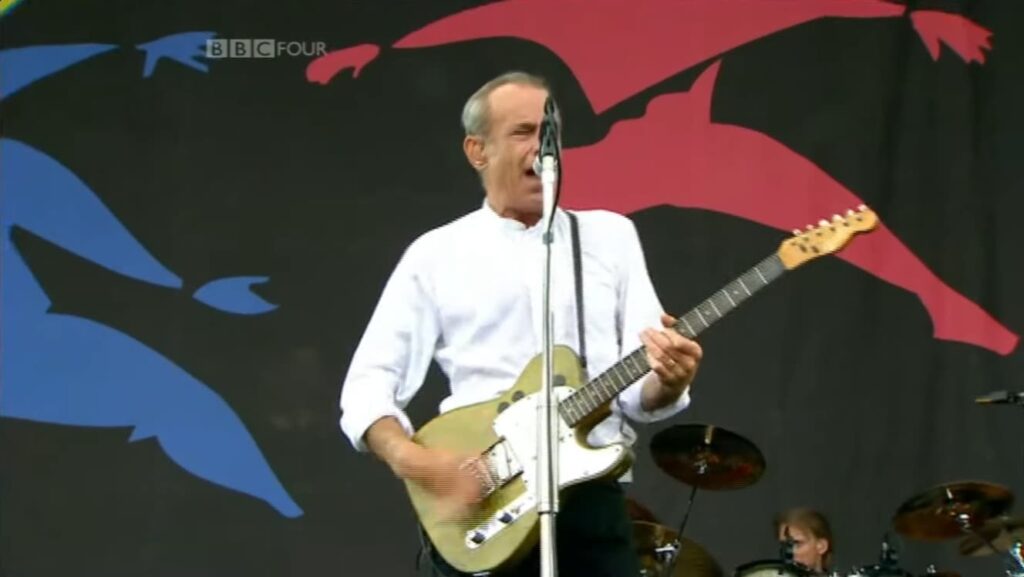
When Status Quo thundered through “Whatever You Want” on the stage of the Glastonbury Festival, it was not just another live performance—it was a reaffirmation of everything the band had stood for since the late 1960s. First released in 1979 as the title track of their album Whatever You Want, the song climbed to No. 4 on the UK Singles Chart, becoming one of the most recognizable and enduring anthems in their catalog. Decades later, under the open sky of Glastonbury, it sounded less like a relic of the past and more like a living, breathing declaration of identity.
By the time of that festival appearance, Status Quo had already built a reputation that few bands could match—not through reinvention, but through unwavering consistency. While the music world shifted through punk, new wave, and countless other movements, they held firmly to their signature boogie rock sound. That refusal to chase trends is precisely what gave “Whatever You Want” its lasting resonance. It was never meant to be complicated. It was meant to be honest.
The song itself is built on a deceptively simple foundation: a driving rhythm, a straightforward riff, and lyrics that speak with blunt clarity. Yet within that simplicity lies its strength. There is no ambiguity in its message—freedom, choice, and the quiet assertion that one can take or leave what life offers. In the hands of Status Quo, this becomes more than just a lyrical theme; it becomes a philosophy, one that defined their career as much as their sound.
At Glastonbury, that philosophy found its perfect setting. The festival, with its sprawling crowds and unpredictable atmosphere, has always been a place where authenticity is tested. Audiences there do not respond to pretense—they respond to presence. And Status Quo delivered exactly that. As the opening chords of “Whatever You Want” rang out, there was an immediate sense of recognition, a shared understanding between band and audience that this was not about spectacle, but about connection.
What made the performance particularly striking was the passage of time embedded within it. The band members, no longer the young men who first recorded the track in 1979, carried with them decades of experience. Yet the energy remained intact. If anything, it had deepened. The rhythm felt steadier, the delivery more assured—not driven by the urgency of youth, but by the confidence of having endured.
There is a certain honesty in that kind of performance. No elaborate staging, no attempt to modernize the sound beyond recognition. Just guitars, drums, and a groove that refuses to fade. It is a reminder that some music does not need to evolve to remain relevant. It simply needs to remain true to itself.
For those listening, the song often becomes intertwined with personal memory. It recalls long drives, crowded rooms, moments when decisions were made without certainty but with conviction. “Whatever You Want” does not offer guidance or resolution. Instead, it reflects a state of mind—a willingness to accept life as it comes, to take what matters and leave what does not.
That is perhaps why it continues to resonate, especially in a live setting like Glastonbury. In a world that often feels increasingly complex, the song’s directness feels almost radical. It strips away excess, leaving only the essentials: rhythm, voice, and a message that does not need to be explained.
Looking back, the success of “Whatever You Want” on the charts in 1979 was only the beginning. Its true legacy has been built over years of performances, each one adding another layer of meaning. The Glastonbury rendition stands as one of those moments—a convergence of past and present, where a song written decades earlier finds new life without losing its original spirit.
In the end, Status Quo did not just perform “Whatever You Want” that day. They reminded everyone why it mattered in the first place. Because beyond the charts, beyond the years, beyond the changing landscape of music, there remains something enduring in a song that speaks plainly, plays honestly, and never pretends to be anything it is not.
And as the final chords echoed across the field, it felt less like an ending and more like a continuation—one more verse in a story that, much like the rhythm itself, refuses to stop.