
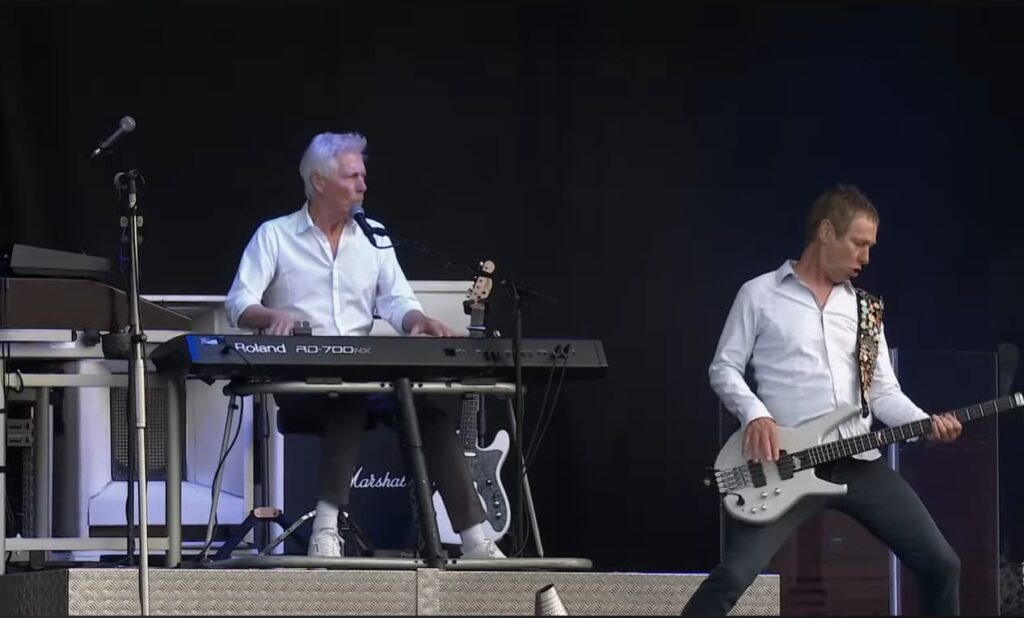
A relentless celebration of rock’s purest drive, where every chord and beat pushes forward with unapologetic energy.
When Status Quo took the stage at Wacken Open Air in 2017, the air vibrated with anticipation, carrying decades of boogie rock heritage across a sea of thousands. Their performance of “Down Down”, originally released in 1974 and climbing to No. 1 on the UK Singles Chart, was more than a nostalgic nod; it was a declaration that the spirit of pure, unpretentious rock could still ignite the hearts of a modern crowd. This was a song whose simplicity belied its infectious power—a rhythm that hooks immediately, a riff that lingers in memory, and lyrics that celebrate the drive to move forward without hesitation.
From the very first notes, the performance communicated an enduring truth about Status Quo: longevity in music is not about trend-following but about authenticity and commitment. The band, veterans with decades of touring etched into their shoulders, played with a precision and stamina that belied their years. Every power chord, every galloping beat of Rick Parfitt and Francis Rossi’s guitars, was a reminder that “Down Down” was crafted not just for the charts in 1974 but for the stage, for the communal pulse of music lovers feeling every vibration in their bones.
The story behind “Down Down” captures the essence of a band in full stride. Written during a period when Status Quo were redefining themselves from a psychedelic past toward hard-hitting boogie rock, the track embodied their philosophy: rock should be simple, relentless, and inclusive. It was a celebration of life’s motion—ups and downs, but always moving forward—and the success on the UK Singles Chart was a validation of a sound that felt natural, honest, and unforced. Unlike many contemporaneous hits, it didn’t rely on elaborate studio effects or complex arrangements. Its power was direct, almost primal, echoing through decades of airwaves, car radios, and live performances.
The 2017 Wacken rendition added layers of context and resonance. Performing at one of the world’s largest open-air festivals, predominantly known for heavy metal, Status Quo were not just playing a song—they were bridging generations. Older fans remembered the original release, the first time it blasted from vinyl speakers, perhaps in a small pub or a living room. Younger festival-goers, many of them encountering the song live for the first time, were swept into a rhythmic force they could not ignore. The energy was mutual: the band drawing from the audience’s excitement, and the crowd feeding on decades of a band’s unbroken dedication.
The performance also served as a reflection on endurance, not only musically but personally. At that stage in their careers, few bands could summon the raw, unrelenting drive required to sustain a three-chord boogie rhythm with the same vigor as in their youth. And yet, there it was—“Down Down”, timeless, powerful, still capable of inciting fists in the air, heads banging, and a shared exhilaration that transcended age. The song’s message, though never overtly philosophical, spoke to the human condition: life moves on, you push through challenges, and joy can be found in momentum, no matter how many years have passed.
Watching Status Quo perform “Down Down” live at Wacken 2017, one feels the full scope of rock’s promise: music as a vessel for shared emotion, for history, for personal memory, and for pure, unfiltered energy. The song is no longer merely a hit from 1974; it is a living testament to resilience, to the electrifying pulse of rock, and to the enduring connection between performer and listener. It proves that while decades may pass, some rhythms never lose their power—they just grow deeper, richer, and infinitely more meaningful.
In the echo of the final chord, the crowd roared not just for a song, but for an era, a legacy, and the unbroken heartbeat of a band whose life is defined by the music they never stopped giving. “Down Down” remains a triumph of simplicity and vitality—a reminder that rock, in its most honest form, never fades.