
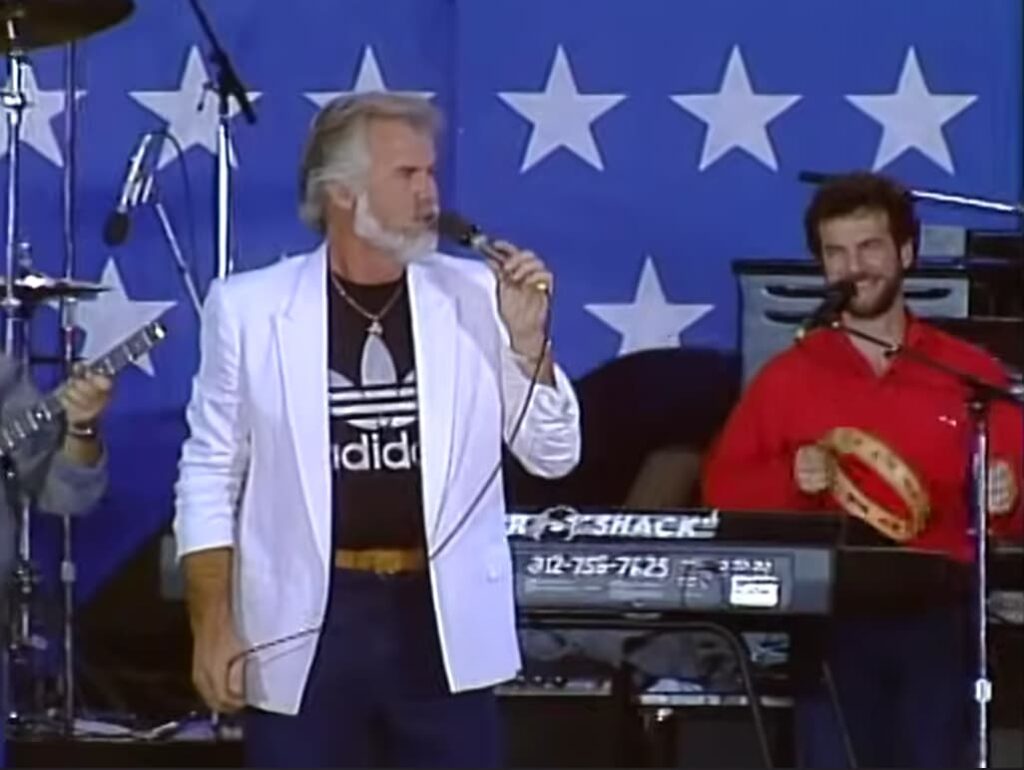
A soulful tribute to enduring love, where heartfelt storytelling meets the raw intimacy of a live performance.
On the sprawling fields of Farm Aid 1985, under the golden haze of an American late summer afternoon, Kenny Rogers took the stage to perform “Ruby”, a song that had already carved its place into the hearts of country music fans. Released originally in 1976 as part of the album 《Daytime Friends》, the song had climbed the Billboard Hot Country Singles chart, peaking at No. 1, yet it was the live interpretation at Farm Aid that transformed it from a recording into a moment of communal reflection. In that instant, the song’s simple yet profound narrative about love lost and cherished became a shared experience, resonating far beyond the confines of a concert stage.
The story of “Ruby” is deceptively simple. Penned with tender lyricism, the song captures the quiet sorrow and wistful longing of a man reflecting on a love that shaped him, even as it has quietly slipped away. Its verses unfold with the deliberate pacing of a conversation, the kind that lingers late into the evening when memories resurface with gentle insistence. When Kenny Rogers performed it live at Farm Aid, there was an added poignancy: here was a voice that had traversed decades, carrying with it the weight of both personal and collective memory, touching a crowd gathered not only for music but for a cause. The lyrics—about the bittersweet permanence of love and the ache of absence—gained a new dimension in the open-air arena, amplified by the sincerity and gravitas of a man who had lived as much as he sang.
The Farm Aid performance of “Ruby” was remarkable not just for its musicality, but for its intimacy amidst an immense gathering. The audience, farmers, and music fans alike, fell into a hushed reverence as Rogers’ warm baritone poured over the crowd, every note carrying the fragile tension of memory. In that moment, it was impossible to distinguish between performer and listener—the song’s narrative became a collective confession, and every heart in the field seemed to beat in tandem with its rhythm. The subtle pauses, the elongated notes, and the gentle swells of instrumentation underscored the song’s timeless quality, making listeners feel both the pain of loss and the comfort of remembrance.
Kenny Rogers had long been a master of translating human experience into song, and “Ruby” epitomized this talent. While some songs rely on spectacle or bombast, “Ruby” depends on vulnerability, the kind that reveals itself in the inflections of a voice and the spaces between chords. In 1985, performing it at Farm Aid—a charity event supporting America’s struggling farmers—Rogers added layers of resonance: the song about personal longing now echoed within a broader narrative of community, perseverance, and shared hardship. It reminded listeners that both love and life are fragile, yet enduring.
The legacy of “Ruby”, especially through performances like Farm Aid, rests in its ability to transport listeners across time. For older audiences, it evokes memories of quiet reflection, of listening to music that was more than entertainment—it was a companion in moments of joy, heartbreak, and contemplation. The song’s enduring relevance lies in its emotional honesty: it speaks to the universal experiences of attachment, loss, and the subtle beauty of fleeting moments.
Even decades later, hearing “Ruby” conjures the image of Kenny Rogers standing alone on that vast stage, guitar in hand, sunlight glinting across the fields, connecting with an audience through nothing more than a song, a voice, and the quiet truth that some stories—like love itself—never fade. Farm Aid 1985 was not just a concert; it was a testament to the power of music to unify, console, and remind us that beauty often resides in the simplest and most heartfelt expressions of the human experience.