
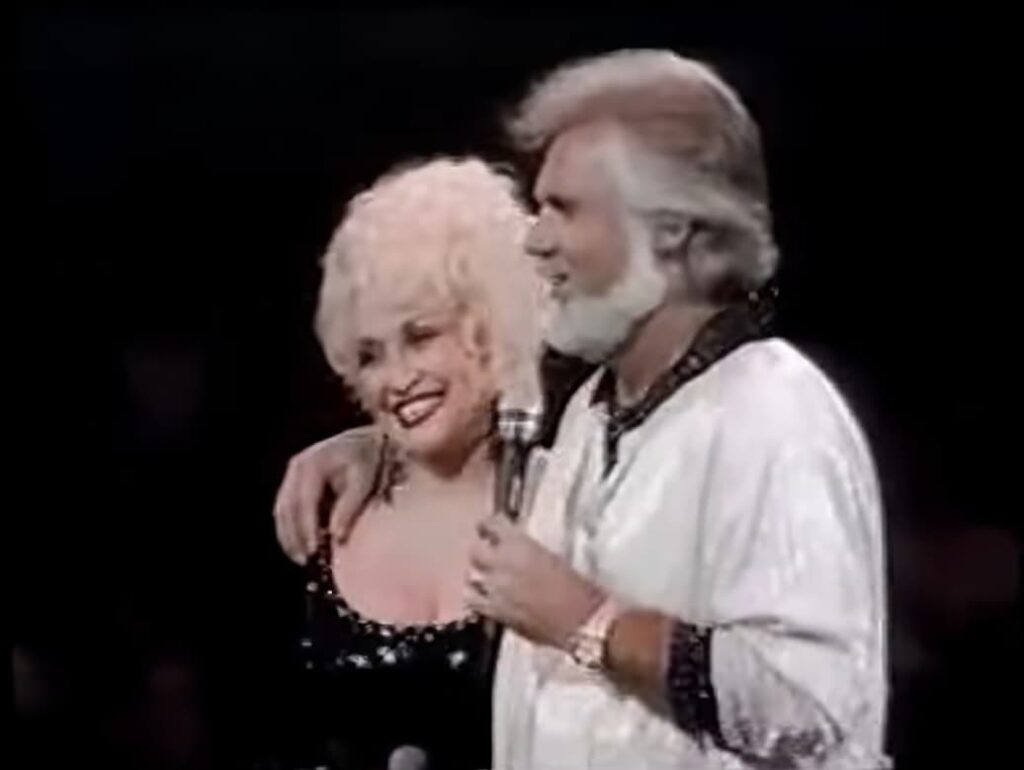
A borrowed night of love and loneliness, where two voices meet not to promise forever, but to ease the silence for a while
When Dolly Parton and Kenny Rogers joined together for “We’ve Got Tonight”, they were stepping into a song that already carried a quiet weight. Originally written and recorded by Bob Seger in 1978, the composition spoke of loneliness, vulnerability, and the fragile comfort of shared moments. But in their 1983 duet version—featured on the album “Eyes That See in the Dark”—the song found a new emotional dimension, rising to No. 1 on the Billboard Hot Country Singles chart and reaching No. 6 on the Billboard Hot 100, marking one of the most successful collaborations of their careers.
By the time they performed it live in 1985, the song had already settled into something deeper than a chart success. It had become a kind of conversation—one that did not rely on grand declarations, but on the quiet understanding between two voices that seem to recognize the same solitude.
There is something immediately striking about how Dolly Parton and Kenny Rogers approach this song together. Unlike many duets that build toward dramatic interplay, “We’ve Got Tonight” unfolds with restraint. Each line feels measured, almost hesitant, as though both singers are aware of the emotional ground they are standing on. There is no rush to resolve the tension, no attempt to turn the moment into something larger than it is.
And perhaps that is what makes it so enduring.
The song does not promise permanence. It does not speak of love that will last beyond the night. Instead, it acknowledges something far more delicate—the need for connection in a moment when both individuals feel alone. “Why don’t you stay?” is not asked with certainty, but with a quiet vulnerability, as though the answer is never guaranteed.
In the 1985 live performance, this vulnerability becomes even more pronounced. There is a stillness in the way they stand, a sense that the song exists in the space between them rather than being projected outward. Kenny Rogers’ voice carries a weathered warmth, steady and grounded, while Dolly Parton brings a softness that never loses its clarity. Together, they create a balance that feels natural, almost inevitable.
The arrangement remains faithful to the original structure, yet there is a subtle shift in tone. Where Bob Seger’s version leans toward introspection, this duet introduces a dialogue—two perspectives meeting in the same emotional place. It is not about one person reaching out, but about two people arriving at the same realization from different directions.
There is also a quiet honesty in the way the song addresses its subject. Loneliness, in “We’ve Got Tonight”, is not dramatized or exaggerated. It is presented as something ordinary, something that exists without explanation. And in that ordinariness, it becomes deeply relatable.
The success of this duet also reflects the unique chemistry between Dolly Parton and Kenny Rogers, whose collaborations throughout the early 1980s—including “Islands in the Stream”—defined a particular era of country-pop crossover. Yet “We’ve Got Tonight” stands apart from those brighter, more celebratory recordings. It is quieter, more introspective, and perhaps more revealing.
Over time, the song has taken on a different kind of resonance. What once may have been heard as a simple duet now feels like a reflection on moments that are often left unspoken—the spaces between relationships, the nights when certainty is absent, and the quiet decisions that shape what comes next.
Watching the 1985 performance, one is reminded that not all meaningful songs are built on resolution. Some exist precisely because they do not resolve, because they remain suspended in a moment that cannot be extended beyond its natural limits.
And when the final note fades, there is no sense of closure.
Only a lingering awareness of what was shared, however briefly.
In the end, Dolly Parton and Kenny Rogers do not try to redefine “We’ve Got Tonight.” They simply allow it to exist as it is—a fragile, honest expression of connection in the face of uncertainty.
And in doing so, they leave behind something that feels both temporary and lasting at the same time.
A reminder that sometimes, a single night—unpromised and unspoken—can hold more truth than anything meant to endure.