
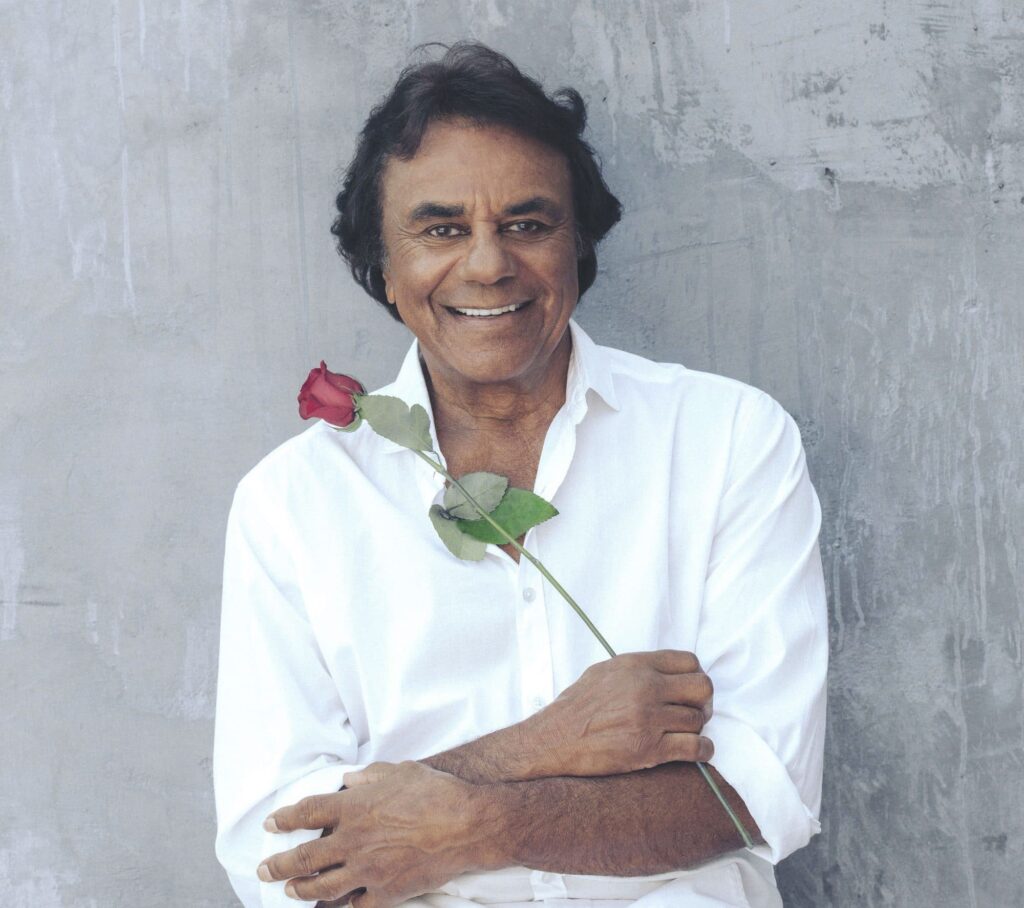
A quiet whisper of longing and tenderness, where love lingers softly in memory like a fading evening light.
When Johnny Mathis recorded “Misty Roses,” he was stepping into a composition already rich with introspection, written by the deeply expressive singer songwriter Tim Hardin. Mathis included the song on his 1969 album Raindrops Keep Fallin’ on My Head, a record that reached No. 38 on the Billboard 200, reflecting a period when his voice was evolving beyond the lush pop ballads of his earlier career into something more reflective, more intimate. Though “Misty Roses” was not released as a major charting single, its quiet presence within the album has allowed it to endure as one of the more delicate and emotionally nuanced recordings in his catalog.
There is something unmistakably fragile about “Misty Roses.” From the very first line, it feels less like a performance and more like a confession—one that is offered gently, without urgency, as though the singer is uncertain whether the words should be spoken aloud at all. This is where Johnny Mathis finds his strength. His voice, long celebrated for its smoothness and control, takes on a different quality here. It softens, becoming almost translucent, allowing the emotion beneath the surface to show through without embellishment.
The song itself is built on a simple yet evocative idea: love that cannot fully exist in the present, love that drifts somewhere between memory and longing. The imagery of “misty roses” suggests something beautiful but intangible, something that cannot quite be held. It is a metaphor that lingers, much like the feeling the song leaves behind. In Mathis’s hands, this imagery becomes even more poignant. He does not push the emotion forward; instead, he lets it unfold at its own pace, trusting the listener to meet him in that quiet space.
Musically, the arrangement mirrors this restraint. Soft strings and subtle instrumentation create an atmosphere that feels almost suspended in time. There is no dramatic swell, no attempt to overwhelm. Every note seems carefully placed, allowing the silence between phrases to carry as much weight as the melody itself. This balance between sound and silence is what gives “Misty Roses” its lasting impact. It invites reflection rather than demanding attention.
In the broader context of Johnny Mathis’s career, the song represents a moment of subtle transition. Known for grand romantic standards, he here embraces something more understated, more introspective. It is a reminder that his artistry was never confined to one style or era. He had the ability to adapt, to interpret songs in a way that felt deeply personal, even when the material came from another writer’s pen.
For listeners, “Misty Roses” often becomes intertwined with quiet moments—late evenings, distant memories, conversations that were never fully finished. It does not evoke a specific story as much as a feeling, a sense of something that once was, or perhaps something that might have been. There is a certain comfort in that ambiguity. The song does not resolve its emotions; it simply holds them, gently, allowing them to exist without explanation.
Over time, recordings like this reveal their true value. They may not dominate the charts or define an era in the way more prominent hits do, but they endure in a different way. They become companions to reflection, to memory, to the quieter corners of life where music is not just heard but felt deeply.
And as Johnny Mathis lets the final notes of “Misty Roses” fade into silence, what remains is not a sense of closure, but of continuation. The feeling lingers, unresolved yet complete in its own way, like a thought that returns again and again, each time carrying a little more meaning than before.