
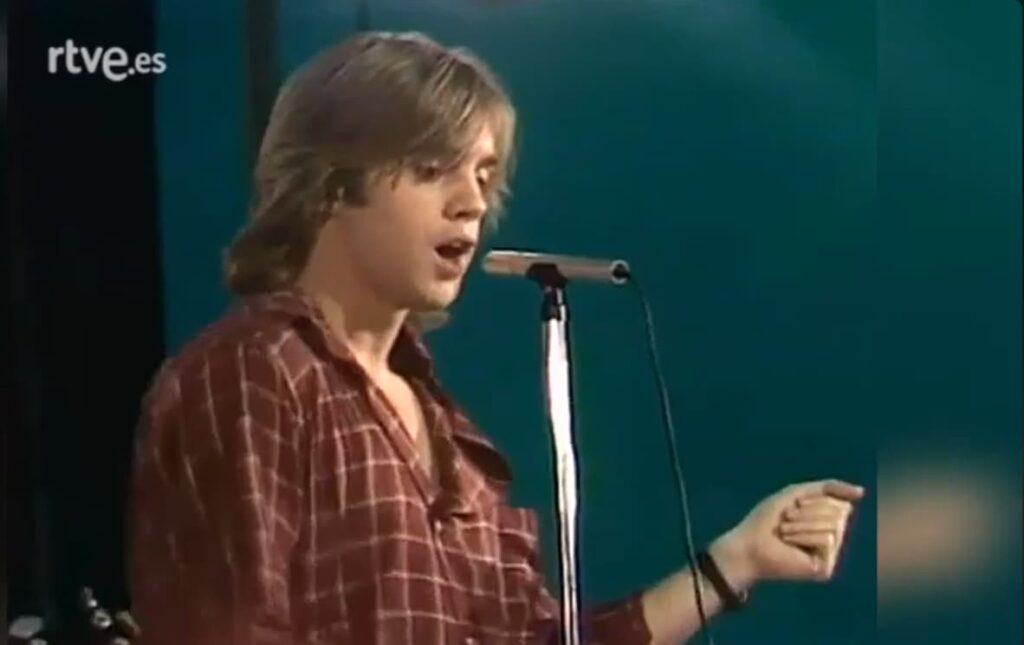
A burst of youthful energy caught between eras, where rock and roll is not reborn, but relived with a restless heart that refuses to stand still.
When Shaun Cassidy performed “Rip It Up” on the Spanish television program Aplauso on December 22, 1979, the moment carried more weight than its surface might suggest. Originally a classic written by Robert Blackwell and John Marascalco, and first made famous by Little Richard in 1956, “Rip It Up” had long been a cornerstone of early rock and roll. Yet in Cassidy’s hands, more than two decades later, it became something else entirely—a bridge between the raw beginnings of the genre and the polished, media-driven world of late 1970s pop.
By the time of this performance, Shaun Cassidy had already experienced the height of teen idol fame. His 1977 breakthrough single “Da Doo Ron Ron” had reached No. 1 on the US Billboard Hot 100, and his albums consistently found places in the upper reaches of the charts. However, “Rip It Up” was never released as a major charting single during this phase of his career. Instead, it lived within his performances, particularly as part of his 1979 album Under Wraps, a record that marked a subtle shift toward a more mature and rhythm-oriented sound.
What makes this rendition on Aplauso so compelling is not its chart position, but its intention. Cassidy was no longer simply presenting himself as a pop figure carefully shaped for radio success. There is a noticeable urgency in the way he approaches “Rip It Up”—a desire to connect with the roots of rock and roll, to tap into something less controlled, less predictable. The performance feels slightly rougher around the edges, and that roughness becomes its strength.
The song itself has always been about release. In its original form, Little Richard delivered it with explosive force, turning it into a declaration of freedom and celebration. Cassidy’s version, by contrast, carries a different kind of tension. It is energetic, certainly, but there is also a sense of searching within it—as though he is reaching back toward a time he never fully lived, trying to understand its spirit through performance.
That tension reflects the broader musical landscape of 1979. Rock music had fragmented into countless directions—disco dominating dance floors, punk challenging conventions, new wave redefining style. In such a context, a song like “Rip It Up” could easily have felt like a relic. Yet Cassidy’s performance suggests otherwise. By bringing it onto a contemporary television stage, he repositions it, not as something outdated, but as something foundational. It reminds the audience that before all the layers and evolutions, there was a simpler, more immediate form of expression.
Visually, the Aplauso performance reinforces this idea. The staging is unmistakably late 1970s, yet the song itself pulls in the opposite direction. Cassidy stands at the center of that contrast—modern in appearance, yet channeling a sound that predates him. It creates a moment where time seems to fold in on itself, where past and present coexist without fully merging.
There is also a quiet narrative in this performance about identity. For an artist like Shaun Cassidy, who rose to fame so quickly and so visibly, the challenge was never just to succeed, but to sustain meaning within that success. Choosing to perform “Rip It Up” was, in its own way, a statement—a recognition that music is not only about the present moment, but about the lineage it carries forward.
Looking back now, the performance holds a certain poignancy. It captures an artist in transition, standing at the edge of one phase of his career and not yet fully settled into the next. The energy is real, the intention clear, but there is also an undercurrent of uncertainty that makes it human.
And perhaps that is what gives this version of “Rip It Up” its lasting resonance. It is not the most definitive rendition, nor the most famous, but it is one that reveals something deeper—a moment when a song, an artist, and an era briefly intersect, leaving behind an echo that lingers long after the final note fades.