
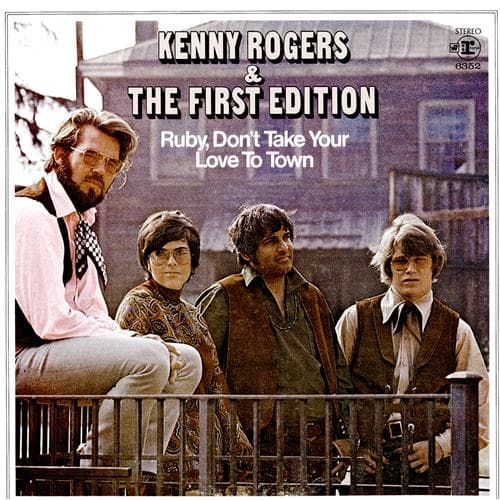
A wounded voice in a quiet room, where love, pride, and helplessness collide in a story too heavy to resolve, only to endure.
When Kenny Rogers and The First Edition released “Ruby, Don’t Take Your Love to Town” in 1969, it arrived not merely as a song, but as a stark and unsettling narrative that refused to look away. Written by Mel Tillis, the track became one of the most defining moments in Rogers’ early career, reaching No. 2 on the UK Singles Chart and No. 6 on the US Billboard Hot 100, while also climbing to No. 39 on the US Country chart—a rare crossover that underscored its emotional reach across audiences.
From its very first lines, “Ruby, Don’t Take Your Love to Town” places the listener in a confined, almost suffocating space. The story is told from the perspective of a disabled veteran, believed by many listeners at the time to be a casualty of the Vietnam War, though Mel Tillis himself later clarified it was inspired more broadly by the struggles faced by returning soldiers. What matters is not the specific war, but the condition of the man left behind by it—physically broken, emotionally stranded, and painfully aware of what he can no longer give.
There is a stillness in the performance by Kenny Rogers that gives the song its lasting power. He does not raise his voice, does not dramatize the pain. Instead, he delivers each line with a restrained clarity, as though the words themselves carry enough weight without embellishment. That restraint becomes the song’s defining characteristic. It forces the listener to sit with the discomfort, to feel the slow passing of time in that room, to understand the quiet desperation that builds with every verse.
The arrangement mirrors that emotional landscape. Sparse instrumentation, gentle but persistent, creates a backdrop that never intrudes upon the story. It allows the narrative to unfold in its own time, without distraction. This was a deliberate choice, one that set “Ruby” apart from many of its contemporaries. In an era when music was often expanding outward—experimenting with sound, with structure—this song turns inward, focusing entirely on the human condition it portrays.
The controversy surrounding the song at the time of its release only added to its impact. Some radio stations hesitated to play it, uncomfortable with its portrayal of a wounded veteran and the implied moral tension between him and Ruby. The line “If I could move, I’d get my gun and put her in the ground” was particularly striking, not because it called for action, but because it revealed the depth of the narrator’s frustration and loss of control. It was not violence that defined the song, but the impossibility of it—the fact that the man could no longer act, only imagine.
What makes “Ruby, Don’t Take Your Love to Town” endure is its refusal to offer resolution. There is no reconciliation, no clear ending. Ruby leaves, or perhaps she has already left in ways that matter more than physical absence. The narrator remains, suspended in a moment that does not move forward. It is a portrait of love strained beyond its limits, not by betrayal alone, but by circumstance, by the quiet cruelty of time and fate.
In the broader arc of Kenny Rogers’ career, this song stands as a turning point. It revealed his ability to inhabit a character fully, to bring narrative songs to life with a sincerity that would later define classics like “The Gambler” and “Lucille.” But “Ruby” is different. It is not a story told with distance or reflection; it is immediate, almost uncomfortably so.
Listening to it now, decades later, the song carries an even deeper resonance. It speaks not only of war or injury, but of any moment when life changes in ways that cannot be undone. It reminds us that some stories do not resolve neatly, that some emotions remain suspended, waiting for an answer that never comes.
And perhaps that is why “Ruby, Don’t Take Your Love to Town” continues to linger. Not because it comforts, but because it tells the truth—quietly, steadily, without turning away.