
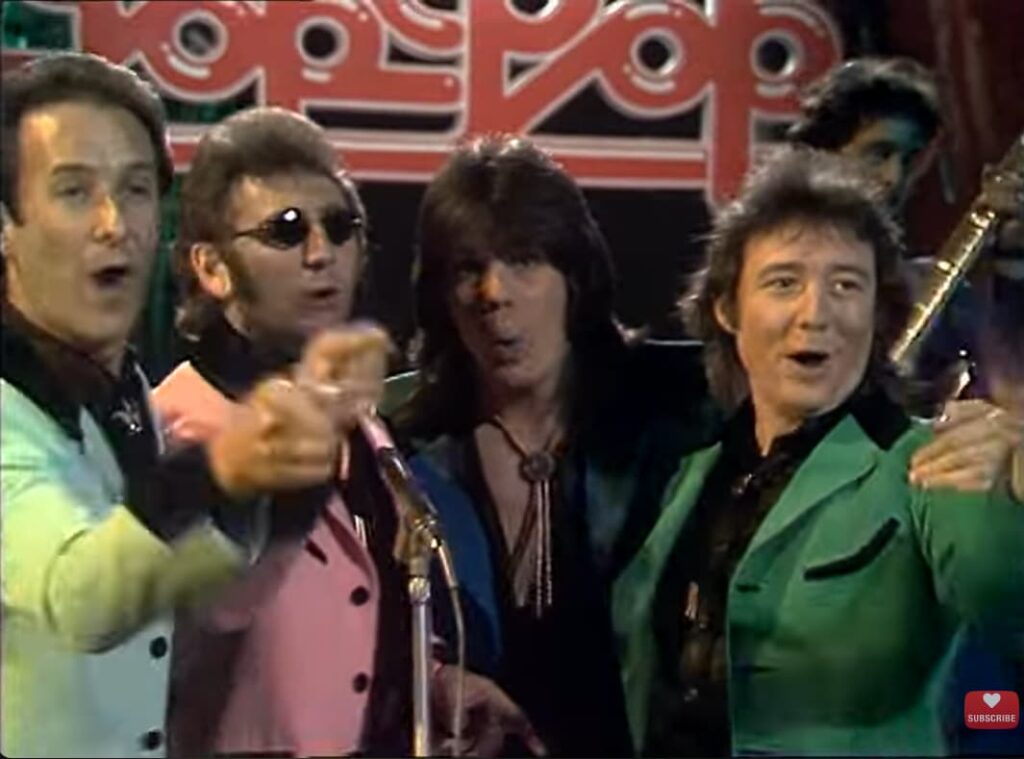
A question that lingers beyond the melody, where innocence meets longing and the past returns not as memory, but as feeling.
When Showaddywaddy brought “I Wonder Why” to television audiences through TopPop, they were carrying forward a song that had already traveled a long road through popular music history. Originally recorded in 1958 by Dion and the Belmonts, the song had reached No. 22 on the US Billboard Hot 100, becoming an early expression of doo wop’s tender confusion and youthful yearning. Nearly two decades later, in 1978, Showaddywaddy reintroduced “I Wonder Why” to a new generation, and their version climbed to No. 2 on the UK Singles Chart, marking one of the band’s most successful releases.
From the outset, there is something disarmingly simple about “I Wonder Why.” The lyrics do not attempt to resolve anything; they circle around a feeling, a question that never quite finds its answer. That uncertainty is the song’s essence. In its original form, it captured the fragile emotional landscape of youth, where affection and confusion often arrive together, indistinguishable from one another. By the time Showaddywaddy revisited it, the context had changed, but the emotion had not.
What Showaddywaddy achieved with their version was not merely a cover, but a careful restoration. They preserved the harmonic richness of the original while introducing a fuller, more polished sound that reflected the recording standards of the late 1970s. The layered vocals, so central to their identity, gave “I Wonder Why” a warmth that felt both familiar and renewed. It was as though the song had been waiting patiently to be heard again, unchanged at its core, yet subtly reshaped by time.
The TopPop performance adds another dimension to this story. Television, by its nature, captures not just sound but presence. Watching Showaddywaddy perform “I Wonder Why,” one notices the balance they maintain between authenticity and presentation. Their style—visually rooted in the aesthetics of an earlier era—might have seemed out of step with the shifting trends of the late 1970s, yet it never felt outdated. Instead, it created a sense of continuity, a reminder that certain musical expressions do not belong to a single moment, but to a longer, more enduring tradition.
There is also a quiet confidence in the way the band approaches the song. They do not overinterpret it, do not attempt to impose new meaning where it is not needed. The restraint is deliberate. It allows the listener to engage with the song on personal terms, to bring their own experiences into that unanswered question. And perhaps that is why “I Wonder Why” continues to resonate. It does not dictate emotion; it invites it.
In the broader landscape of late 1970s music, this success is particularly noteworthy. It was a time when genres were fragmenting, when new sounds were emerging with increasing urgency. Yet here was a song, rooted in the late 1950s, rising once again to near the top of the charts. It suggests that beneath the surface of constant change, there remains a steady undercurrent—a desire for melody, for harmony, for songs that speak in a quieter voice.
Listening now, the passage of time seems to deepen the song’s meaning. The question at its center—“I wonder why”—no longer feels confined to a single moment of youthful uncertainty. It expands, becoming something broader, more reflective. It speaks to the many moments in life that resist explanation, the feelings that cannot be easily named or resolved.
And in that sense, Showaddywaddy’s “I Wonder Why” is more than a revival. It is a continuation, a thread connecting different eras through a shared emotional language. The TopPop performance captures that connection in a fleeting but lasting way, preserving a moment when a simple song, carried across decades, found its voice once more—clear, gentle, and quietly enduring.