
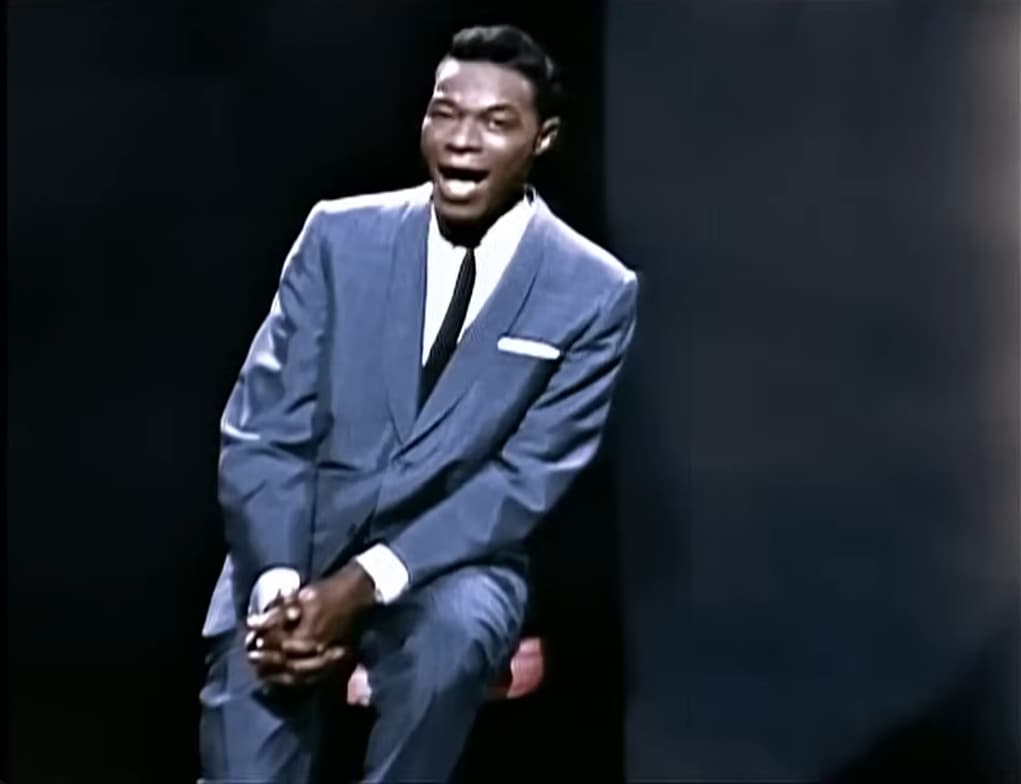
A voice of velvet and quiet authority fills a modest television stage, turning an evening broadcast into something enduring, intimate, and almost timeless.
In 1963, Nat King Cole appeared on BBC television for what would be known as “An Evening With Nat King Cole”, a performance that now feels less like a program and more like a preserved atmosphere. By that point, Cole was no longer simply a successful artist—he was an institution, a figure whose voice had already shaped more than a decade of popular music. His recordings had consistently reached the highest levels of the charts, with songs like “Too Young” spending 5 weeks at No. 1 on the Billboard chart in 1951, and “Mona Lisa” becoming one of the defining hits of its time, also reaching No. 1 in 1950. These achievements formed the quiet backdrop to his BBC appearance, though nothing in the performance suggests a man concerned with legacy.
What unfolds on that evening is something far more subtle. The setting is restrained, almost understated by modern standards. There are no elaborate stage designs, no overwhelming orchestration intended to impress. Instead, there is space—space for the voice, space for the phrasing, space for the kind of musical control that does not need to declare itself. Nat King Cole steps into that space with a calm assurance, carrying with him a style that had already bridged the worlds of jazz, pop, and traditional standards.
There is a particular quality to Cole’s voice in live settings, one that recordings only partially capture. It is not just the smoothness that audiences often remember, but the discipline behind it—the way each note seems measured, each line delivered with a sense of balance that never tips into excess. In the BBC performance, this restraint becomes the defining feature. He does not reach for dramatic effect. Instead, he allows the songs to unfold naturally, trusting that their emotional weight will find its way to the listener without force.
The repertoire he draws from during this period reflects the breadth of his career. Having begun as a jazz pianist leading the King Cole Trio, he had gradually moved into a more vocal-centered style, becoming one of the most recognizable voices in popular music. By 1963, he had already recorded a vast catalog of standards, ballads, and orchestrated pieces that appealed across generations and continents. His presence on British television speaks to that international reach—a quiet acknowledgment that his music had traveled far beyond its origins.
Yet what makes “An Evening With Nat King Cole” so compelling is not its scale, but its intimacy. There is a sense that the performance exists in a space just slightly removed from time. The audience is there, but not overwhelming. The arrangement supports, but never dominates. And at the center, Cole remains composed, almost reflective, as though aware that the strength of his performance lies not in variation, but in consistency.
Looking back, there is an added layer of poignancy to this appearance. It would come just two years before his passing in 1965, a reminder of how much of his artistry was still present, still evolving, even in the later stages of his life. There is no hint of decline in his voice here. If anything, there is a deepened sense of control, a maturity that allows him to inhabit each song fully without needing to reshape it.
For those who return to this performance now, it offers something that feels increasingly rare. Not spectacle, not reinvention, but presence. The kind of presence that holds attention without demanding it, that lingers not because it is loud, but because it is certain of its place.
In the end, Nat King Cole’s BBC performance in 1963 stands as more than a televised concert. It is a moment of quiet mastery, where a voice already woven into the fabric of popular music continues to speak with clarity and grace. And long after the broadcast has faded, that voice remains—steady, unhurried, and unmistakably its own.
 Great Songs