
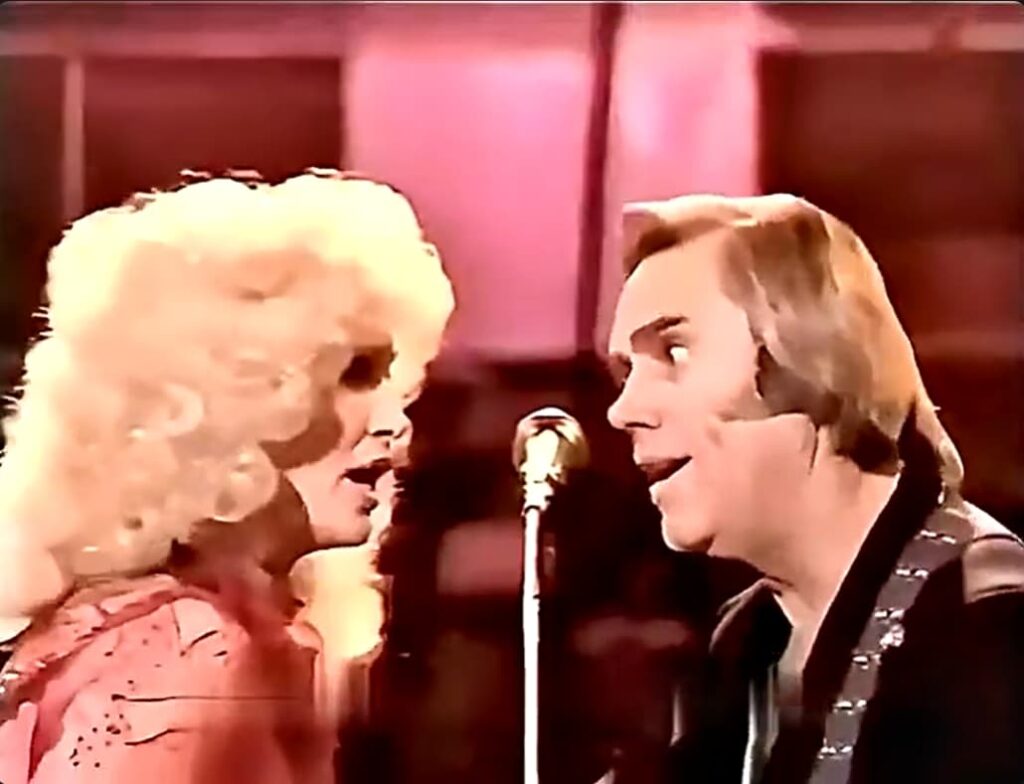
Two voices shaped by love and fracture meet again on stage, proving that some harmonies survive even when everything else changes
When George Jones and Tammy Wynette stepped onto the stage at Wembley Arena in 1981, the moment carried a weight that went far beyond performance. This was not simply another international tour stop. It was a reunion of voices that had already lived through love, separation, and the complicated space that remains when both refuse to disappear entirely.
By 1981, their personal story was well known. Married in 1969 and divorced by 1975, Jones and Wynette had continued to record and perform together, their music evolving into something that reflected not just romance, but endurance. Their earlier duets had already made a deep impact on the Billboard Hot Country Singles chart, with “We’re Gonna Hold On” reaching No. 1 in 1973 and “Golden Ring” doing the same in 1976. These songs had defined them as one of country music’s most compelling duos. But by the time they arrived at Wembley, those songs carried new meanings—no longer just hopeful declarations, but echoes of something that had been tested by time.
The Wembley performance itself stands as a rare document of that evolution. Far from Nashville, in front of a British audience that had embraced American country music with growing enthusiasm, George Jones and Tammy Wynette brought with them not just their catalog, but their history. There is something quietly striking about that setting—two artists rooted in the American South, standing on a London stage, singing songs shaped by deeply personal experiences. It speaks to the universality of what they represented.
Musically, the performance remains grounded in the traditions that had defined their careers. The arrangements are straightforward, allowing the focus to remain on the voices. And it is in those voices that the true story unfolds. Jones, often referred to as one of the greatest vocalists in country music history, delivers each line with a depth that feels almost conversational, as though he is not performing, but remembering. Wynette, with her clear and emotionally precise tone, provides a counterbalance—steady, unwavering, yet never detached.
What makes this live appearance particularly compelling is the space between them. It is not tension in the obvious sense, but something more subtle—a shared understanding that does not need to be spoken. When they sing together, there are moments where the past seems to surface briefly, only to settle again into the present. It is this interplay that gives their performance its lasting resonance.
The early 1980s were a period of transition for country music, with the genre increasingly intersecting with pop influences and broader international audiences. Yet in this Wembley concert, there is a sense of continuity. Jones and Wynette do not adjust their style to fit the moment. Instead, they bring their music as it is—rooted, direct, and emotionally honest.
Listening to recordings from this performance now, there is an added layer of reflection. Time has a way of reshaping how such moments are understood. What might have once been seen as simply another concert now feels like something more enduring—a meeting point between past and present, between what was and what remains.
For George Jones and Tammy Wynette, this night at Wembley was not about reclaiming something lost. It was about acknowledging what still existed. Their voices, shaped by years of both harmony and conflict, came together once more—not perfectly, but truthfully.
And perhaps that is why the performance continues to resonate. It does not offer resolution. It does not attempt to rewrite history. Instead, it allows the music to carry everything that has come before, letting each note settle where it may.
As the final chords fade and the applause lingers in the background, what remains is not just the memory of a concert, but the sense that some connections, once formed, do not fully disappear. They change, they adapt, but in moments like this, they return—quietly, unmistakably, and with a depth that only time can create.