
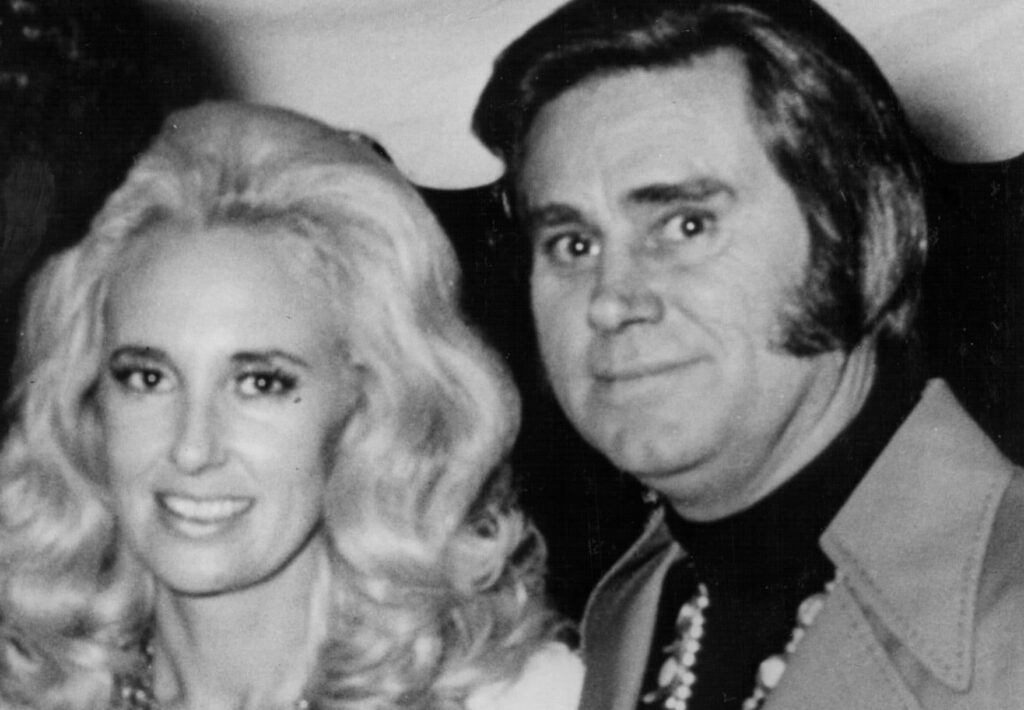
A fragile promise between two voices, where love tries to heal what life has already tested
When George Jones and Tammy Wynette recorded “Everything’s Gonna Be Alright,” they were not simply performing another duet—they were, in many ways, continuing a conversation that had already been unfolding through years of shared music and a deeply complicated personal history. Released in 1981 as part of the album Together Again, the song reached No. 9 on the Billboard Hot Country Singles chart, a modest but meaningful success that reaffirmed the enduring connection between their voices.
By the time this recording emerged, Jones and Wynette had long since moved beyond the early days of their partnership, both musically and personally. Their marriage had ended in 1975, yet their collaborations continued, shaped now by distance, memory, and a kind of emotional understanding that few duos could replicate. In this context, “Everything’s Gonna Be Alright” takes on a deeper significance. It is not simply a song about reassurance—it is a reflection of two lives that had already endured more than most of the lyrics could fully contain.
The structure of the song is deceptively simple. Built around a gentle exchange between two voices, it offers a message of comfort, a quiet insistence that whatever has gone wrong can still find its way back to something stable. But when sung by George Jones and Tammy Wynette, those words carry an added weight. There is a subtle tension beneath the surface, as though both singers understand that such reassurance is not always guaranteed.
What makes this recording particularly compelling is the contrast in their vocal delivery. Jones brings a depth that feels almost weathered, his phrasing shaped by years of personal struggle and artistic refinement. Wynette, on the other hand, offers a clarity that balances that weight, her voice steady yet never detached. Together, they create a dynamic that feels less like harmony in the traditional sense and more like conversation—two perspectives meeting somewhere in the middle.
The early 1980s marked a transitional period for country music. The genre was gradually embracing a more polished, crossover-friendly sound, moving away from some of its rawer roots. Yet in “Everything’s Gonna Be Alright,” there remains a strong connection to the traditional storytelling that had defined earlier decades. The arrangement is restrained, allowing the vocals to remain at the forefront. Steel guitar lines weave gently through the background, while the rhythm section maintains a steady, unobtrusive presence.
There is also a sense that this song reflects a broader theme that runs through much of Jones and Wynette’s work together: the idea that love is not a fixed state, but something that evolves, often through difficulty. Their earlier hit “We’re Gonna Hold On” (No. 1, 1973) carried a similar message, though it was delivered with a different kind of optimism. By contrast, “Everything’s Gonna Be Alright” feels more measured, more aware of the uncertainties that come with time.
Listening now, the song carries a quiet poignancy that may not have been as immediately apparent upon its release. It is not dramatic or overtly emotional, yet it lingers in a way that more elaborate productions often do not. Perhaps this is because it does not attempt to resolve everything it presents. Instead, it leaves space—for doubt, for memory, for the possibility that reassurance is sometimes as much an act of faith as it is a statement of truth.
For George Jones and Tammy Wynette, this recording stands as another chapter in a shared musical legacy that continues to resonate. It is a reminder that their greatest strength was not just in their individual voices, but in the way those voices interacted—reflecting, challenging, and ultimately complementing one another.
And as the final lines fade, what remains is not certainty, but something quieter—a sense that even in the face of uncertainty, there is value in the attempt to believe that things might, somehow, find their way back to balance.