
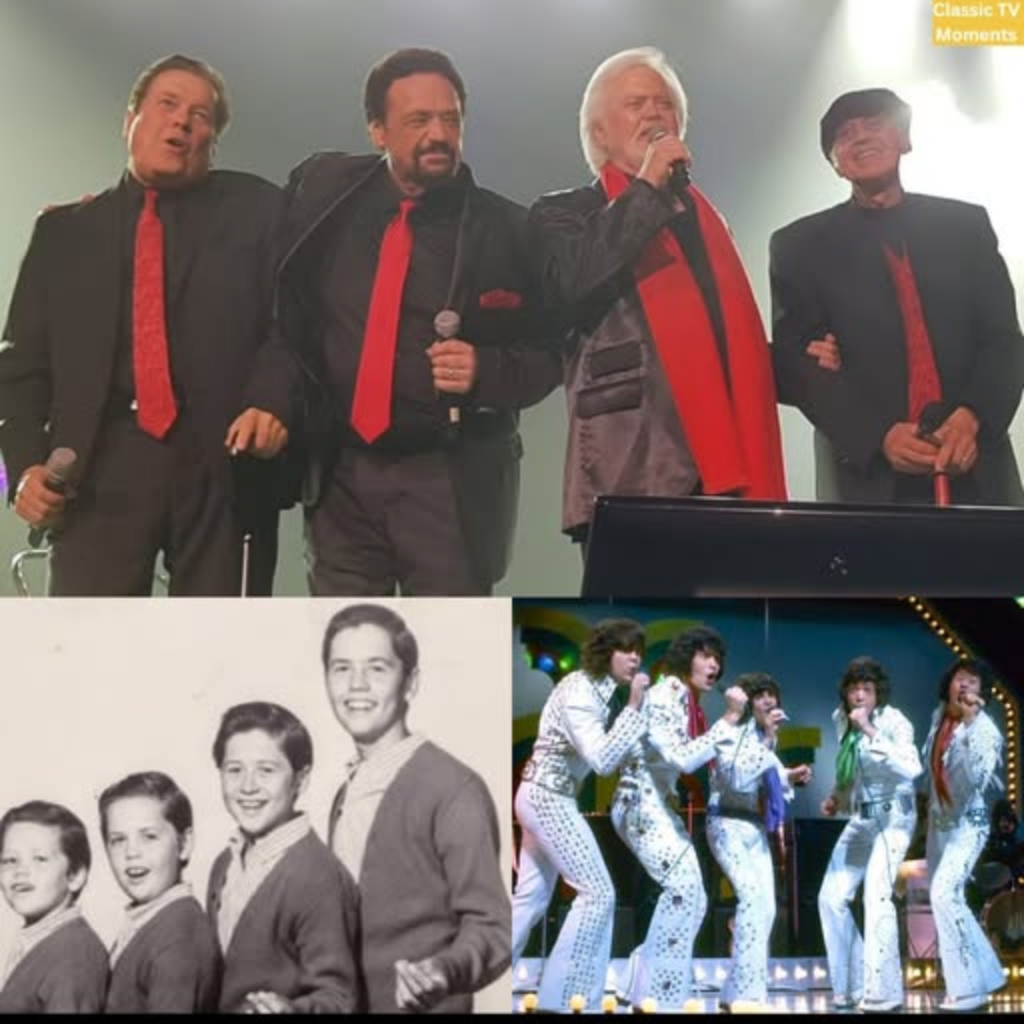
A final song offered not as an ending, but as gratitude—where time gathers quietly and a lifetime of harmony says goodbye
When The Osmonds appeared together on The Talk on October 14, 2019, the moment carried a quiet intention that only became fully clear with time. Performing “The Last Chapter,” a song written specifically for that occasion, Alan Osmond, Wayne Osmond, Merrill Osmond, and Jay Osmond stood together not simply as performers, but as brothers closing a circle that had begun decades earlier.
There were no chart positions attached to this performance, no commercial ambition behind it. And yet, in a way that few chart-topping hits can achieve, it carried a significance that has only deepened with passing years. Following the recent loss of Alan Osmond, and earlier the passing of Wayne Osmond in January 2025, that appearance now feels less like a reunion and more like a final document—a moment preserved without fully knowing how much it would come to mean.
To understand the weight of that evening, one must look back to where it all began. The Osmonds rose to prominence in the late 1960s and early 1970s, a time when family groups held a special place in popular music. Their harmonies were precise, their image carefully presented, and their success undeniable. Songs like “One Bad Apple” reached No. 1 on the Billboard Hot 100 in 1971, establishing them as a major force in mainstream pop. Later hits such as “Yo-Yo” (No. 3, 1971) and “Down by the Lazy River” (No. 4, 1972) reinforced their appeal, blending youthful energy with a sense of unity that became their signature.
But what distinguished The Osmonds was never just their success. It was the sense of continuity they represented—a group bound not only by music, but by family. Over time, as trends shifted and the industry evolved, their presence became less about chart dominance and more about legacy. They endured, not because they adapted to every change, but because they remained consistent in what they were.
By 2019, the years had naturally altered both voice and perspective. The harmonies were still there, though softened by time. The energy, once exuberant, had settled into something more measured. Yet in “The Last Chapter,” there was no attempt to recreate the past. Instead, there was acknowledgment—of everything that had come before, and of those who had been there to witness it.
The performance itself was understated. There were no elaborate arrangements or dramatic gestures. The focus remained on the voices, on the presence of the four brothers standing side by side. It felt less like a show and more like a conversation—one directed not just at the audience in the studio, but at the countless listeners who had followed their journey over the years.
What gives this moment its lasting resonance is not just the music, but the intention behind it. It was never meant to be a comeback or a revival. It was a farewell, though not in the conventional sense. There was no emphasis on endings, no sense of finality imposed upon it. Instead, it carried the tone of gratitude—a quiet recognition that their story had been shared with others, and that those connections had endured.
Now, with the passing of Alan Osmond and Wayne Osmond, the performance takes on an added layer of meaning. It stands as the last time the original brothers appeared together in this way, a moment that cannot be recreated. What was once simply a thoughtful gesture now feels like something more deliberate, almost as though it had been guided by an understanding that was never spoken aloud.
Listening again, or watching that performance unfold, there is a sense that time has settled gently around it. The voices are no longer reaching forward. They are reflecting, acknowledging, and, in their own way, letting go.
And perhaps that is what remains most clearly. Not the idea of an ending, but the image of four brothers standing together one last time, offering a song not to define their legacy, but to thank those who had carried it with them all along.