
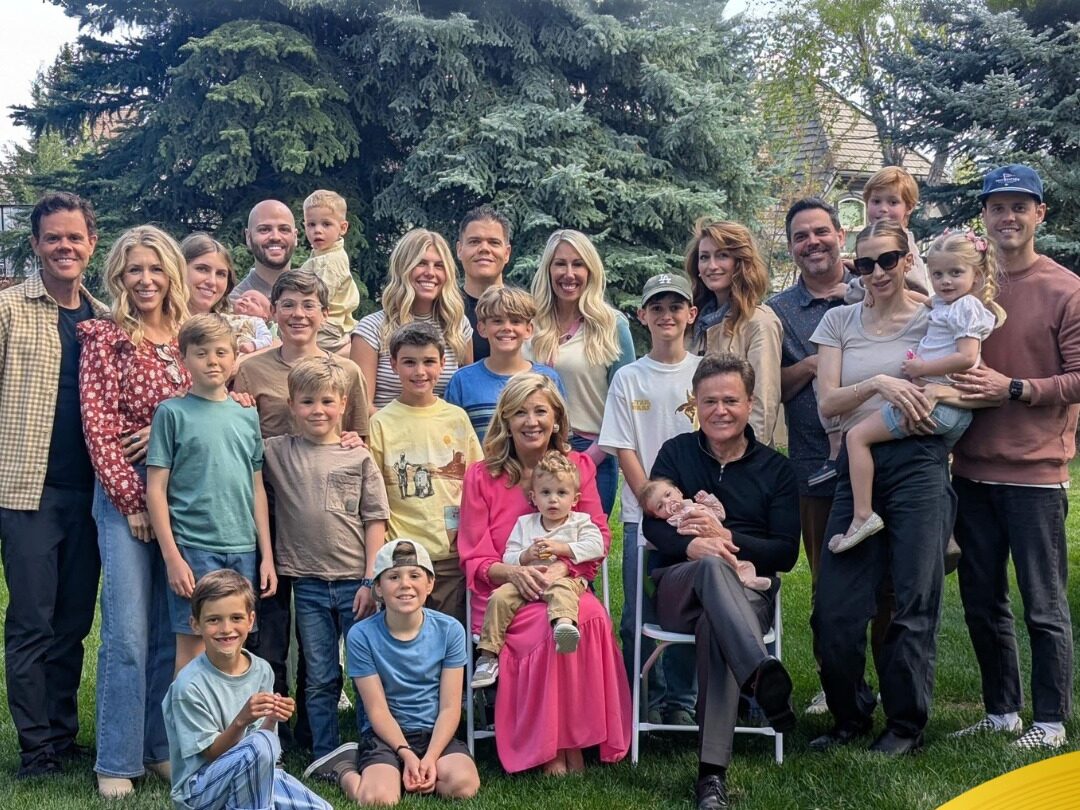
A legacy carried in quiet ways—beyond the stage, Donny Osmond found his truest harmony not in fame, but in fatherhood
For much of the 1970s, the name Donny Osmond was inseparable from the sound of polished pop, family harmony, and a kind of clean-cut stardom that defined an era. As part of The Osmonds, and later through his own solo career, he stood at the center of a phenomenon that few artists ever experience. Songs like “Go Away Little Girl”, which reached No. 1 on the Billboard Hot 100 in 1971, and “Puppy Love”, which climbed to No. 3 in 1972, were not just hits—they became part of a cultural moment that seemed to move in perfect rhythm with the optimism of the time.
But the story suggested by “Five Sons, One Famous Name: The Private Osmond Story” does not begin on stage, nor does it remain there. It moves inward, toward something far less visible yet far more enduring. It asks a quieter question: what remains when the spotlight dims, and the applause becomes memory?
Behind the public image of Donny Osmond—the television appearances, the tours, the carefully maintained persona—there existed a parallel life shaped not by audiences, but by family. Five sons, raised not only in the shadow of a famous name, but within the structure of a life that had already seen both extraordinary success and the pressures that come with it.
What becomes immediately clear in this narrative is that fame, while influential, was never allowed to become the defining force within that household. The expectations were different. There was no insistence that the next generation follow the same path, no quiet pressure to extend the legacy through imitation. Instead, there was space—space to choose, to step away, to become something separate.
That choice, in itself, is revealing. For someone whose own life was shaped so early by performance, the decision to allow his children to exist outside of it suggests a certain understanding—an awareness of what the spotlight gives, and what it takes away.
There is a kind of balance in that approach. The name Osmond carries weight, history, recognition. It opens doors, but it also creates expectations. To grow up within that name is to be constantly aware of its presence. And yet, in this story, that presence does not dictate direction. It exists, but it does not control.
Each of the five sons moves forward differently, not as extensions of a legacy, but as individuals shaped by it without being confined to it. There is no single narrative to follow, no unified path that mirrors what came before. And perhaps that is where the real meaning of this story lies—not in continuity, but in divergence.
For Donny Osmond, this outcome reflects something deeper than career success. It suggests a shift in values, a movement away from public validation toward something more private and enduring. The harmony that once existed in music now exists in a different form—less audible, but no less real.
Looking back, it becomes clear that the most significant achievements are not always the most visible ones. Chart positions fade into history, television appearances become archival footage, and even the most recognizable songs eventually settle into memory. But the influence carried within a family, the quiet shaping of lives over time—that remains, often unnoticed, yet deeply significant.
There is also a certain humility in this transition. To step away from the center, to allow others to define themselves without interference, requires a kind of restraint that is rarely discussed in stories of fame. It is not about letting go entirely, but about knowing when presence matters more than prominence.
In that sense, “Five Sons, One Famous Name” is not just a reflection on Donny Osmond’s life beyond the stage. It is a reconsideration of what legacy truly means. Not something preserved in repetition, but something carried forward in new, unexpected ways.
And as time continues to move, the image that remains is not of a performer under bright lights, but of a father standing just outside them—present, steady, and quietly aware that the most meaningful parts of his story were never meant for the stage at all.