
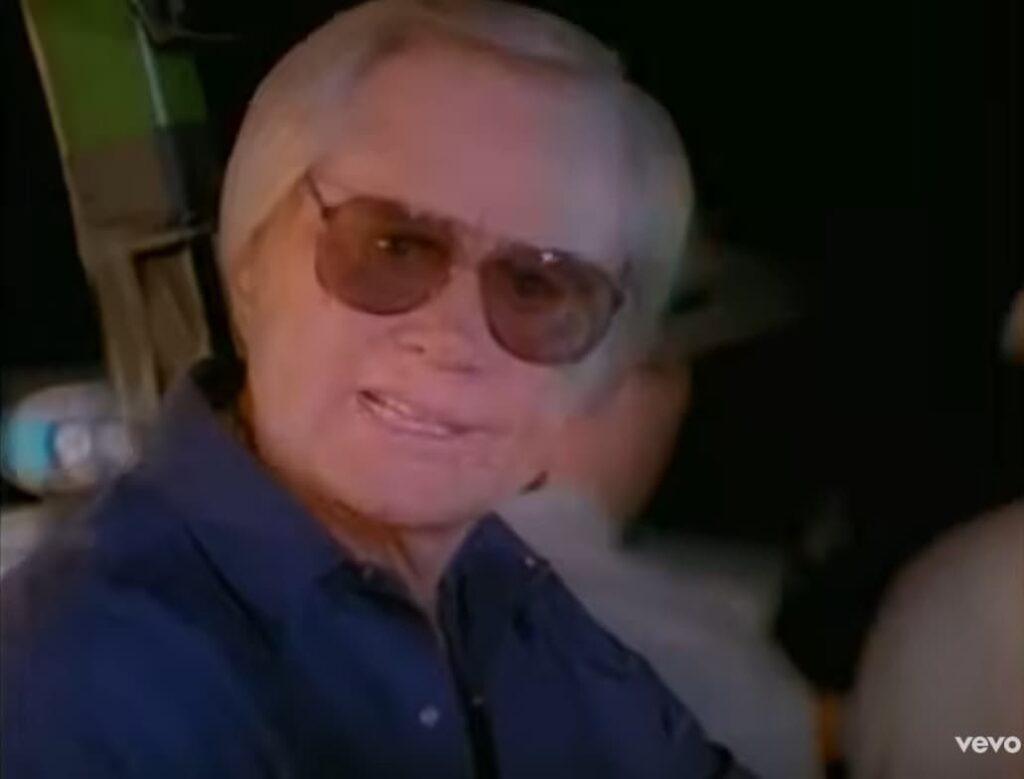
A restless heart dressed in rhythm—“The Honky Tonk Song” captures the pull of places that promise escape, but never quite deliver peace
When George Jones recorded “The Honky Tonk Song” in 1967, he was already well into a career that had begun to define the emotional core of country music. Released as a single on Musicor Records, the song climbed to No. 5 on the Billboard Hot Country Singles chart, reinforcing Jones’ consistent presence in the upper reaches of the genre during the 1960s. It may not have reached the very top of the charts, but its significance lies elsewhere—in the way it quietly reflects the life he was living at the time.
Written by George Jones himself, “The Honky Tonk Song” feels less like a crafted narrative and more like a familiar routine set to music. There is no dramatic storyline, no attempt to elevate the setting beyond what it is. Instead, the song presents a simple cycle—working, drinking, returning to the same places night after night. Yet within that repetition, something deeper begins to emerge.
The late 1960s were a complicated period for Jones. Professionally, he was successful—regularly charting hits, maintaining a strong presence on radio, and building a reputation as one of country music’s most expressive vocalists. Personally, however, his life was becoming increasingly unstable, shaped by struggles that would later become widely known. It is within this tension that “The Honky Tonk Song” finds its meaning.
Musically, the track remains rooted in the traditional honky tonk style—steady rhythm, clear instrumentation, and a vocal delivery that carries both control and vulnerability. Jones does not overstate the emotion. He allows it to sit just beneath the surface, present but restrained. This approach gives the song a sense of authenticity that cannot be manufactured. It does not ask for sympathy; it simply exists as it is.
The lyrics themselves are deceptively straightforward. They describe a pattern that feels almost ordinary—spending time in bars, finding temporary relief in familiar surroundings, and returning to the same cycle again. But the repetition is the point. It suggests a kind of quiet entrapment, where the routine becomes both comfort and limitation.
There is no resolution offered. No indication that things will change. And that absence of resolution is what gives the song its lasting impact. It reflects a reality that is often left unspoken—the idea that not every story moves toward clarity or closure. Some simply continue.
Listening now, with the benefit of hindsight, the song takes on an additional layer of meaning. It becomes difficult to separate the voice from the life behind it. George Jones was not just interpreting these words; he was living within them. The honky tonk was not a setting he imagined—it was a place he knew intimately.
This connection between life and music is what elevates “The Honky Tonk Song” beyond its chart position. It transforms it from a genre piece into something more personal, more reflective. It is not a song about escape—it is a song about the illusion of escape, and the realization that some things follow you wherever you go.
There is also a subtle dignity in the way Jones delivers the song. He does not portray himself as defeated. Instead, there is a quiet acceptance, as though he understands the cycle but does not yet see a way out of it. This nuance is what defines his artistry. He does not simplify complex emotions—he allows them to remain complex.
Over time, George Jones would record many songs that dealt with loss, regret, and reflection, often with greater recognition and acclaim. But “The Honky Tonk Song” remains an important part of that journey. It represents an earlier stage—one where the patterns were still forming, where the awareness was present but not yet fully articulated.
And perhaps that is why it continues to resonate. Not because it offers answers, but because it does not. It captures a moment in time with honesty, leaving it unchanged.
The lights of the honky tonk remain the same. The music plays, the doors open and close, and the night moves forward.
And within it, a voice carries on—not trying to escape, but simply telling the truth as it is lived.