
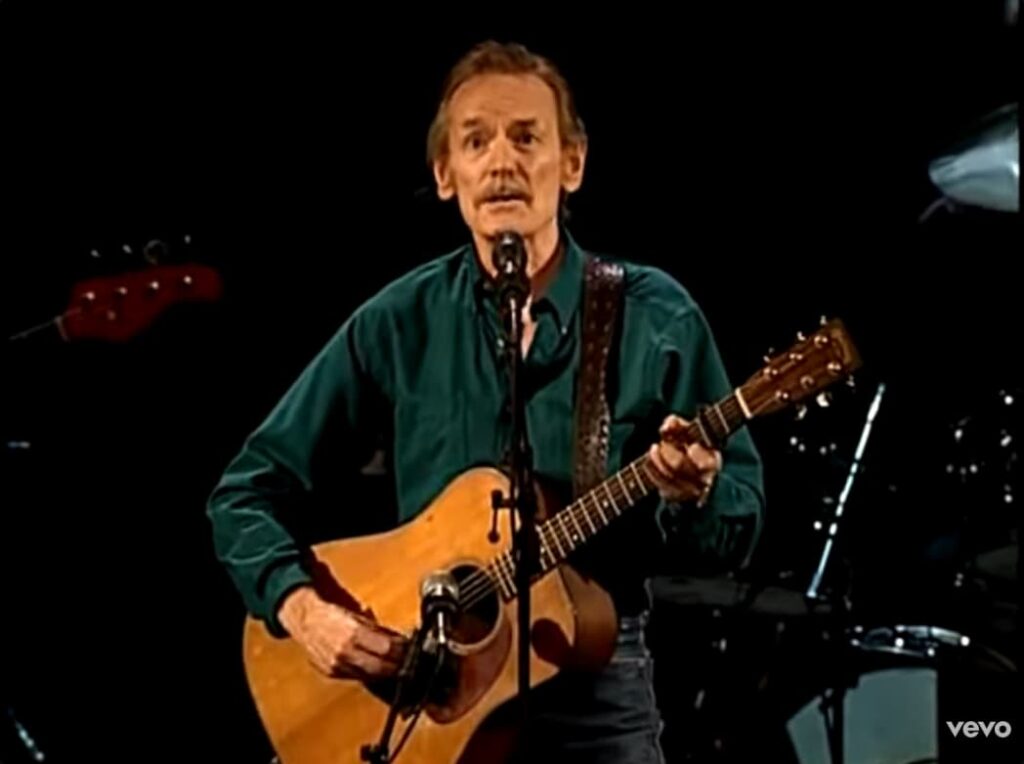
A quiet declaration tested by time—“I’ll Prove My Love” becomes less a promise and more a reckoning in Gordon Lightfoot’s live voice
When Gordon Lightfoot performs “I’ll Prove My Love” live in Reno, the song no longer exists as a simple statement of devotion. It becomes something more measured, more reflective—a promise revisited after years of living with its consequences. Originally released in 1974 on the album “Sundown,” the track sits within one of the most commercially successful periods of Lightfoot’s career. The album itself reached No. 1 on the Billboard 200, while the title track “Sundown” also climbed to No. 1 on the Billboard Hot 100, marking a rare crossover achievement for a folk-rooted artist.
Though “I’ll Prove My Love” was not issued as a major single and did not chart independently, its placement within “Sundown” gives it a particular significance. This was an album shaped by tension—personal, emotional, and relational. Much of its material reflects the strain of a turbulent relationship, widely understood to be connected to Lightfoot’s involvement with Cathy Smith. In that context, the idea of “proving love” becomes complicated. It is no longer a simple vow, but something that must be tested against doubt, distance, and the passage of time.
In the original studio recording, there is a controlled clarity. Lightfoot’s voice, steady and precise, delivers the lyrics with a sense of quiet determination. The arrangement remains understated, allowing the narrative to take precedence. It feels like a man stating his intention, perhaps even convincing himself as much as anyone else.
But in the live performance from Reno, the song shifts. The years between the recording and the performance introduce something that cannot be replicated in the studio—perspective. The voice is slightly weathered, the phrasing more deliberate. There is less urgency, but more weight behind each line.
What stands out immediately is the restraint. Lightfoot does not attempt to heighten the emotion for the audience. Instead, he allows the song to unfold naturally, almost as if he is revisiting it for his own understanding. The promise within the lyrics is no longer delivered with certainty. It carries a hint of reflection, as though shaped by experiences that have complicated its meaning.
This transformation is subtle, but significant. The idea of proving love, once forward-looking, now feels retrospective. It invites questions rather than offering answers. Was the promise kept? Was it enough? The performance does not resolve these questions, and in that refusal lies its strength.
Musically, the live setting enhances this introspection. The arrangement remains minimal, often centered around guitar, allowing space for silence to play its role. Those pauses between phrases become part of the performance, giving the listener time to absorb not just the words, but the distance between them.
There is also a sense of honesty that defines Lightfoot’s stage presence. He does not embellish unnecessarily, nor does he attempt to reinterpret the song beyond recognition. He respects its original form, while allowing his current perspective to shape its delivery. This balance between preservation and evolution is what gives the performance its depth.
Within the broader arc of Gordon Lightfoot’s career, “I’ll Prove My Love” occupies a quieter space. It is not among his most commercially recognized songs, yet it contributes to the emotional continuity of his work. It reflects a recurring theme in his songwriting—the complexity of relationships, the difficulty of maintaining connection, and the realization that intention alone is not always enough.
Listening to the Reno performance, one begins to understand that the song is no longer about proving anything to someone else. It becomes a form of self-examination. A way of looking back at what was said, what was felt, and what ultimately remained.
There is no dramatic conclusion. The song ends as it began—calm, measured, unresolved.
And perhaps that is what gives it its lasting resonance. Not the certainty of love, but the effort to understand it. Not the promise itself, but the distance between making it and living with it.
In that space, Gordon Lightfoot does not offer clarity. He offers something more enduring—an honest reflection, carried quietly through time.