
A Reunion That Echoes Like a Familiar Melody: Memory, Youth, and the Quiet Power of Time
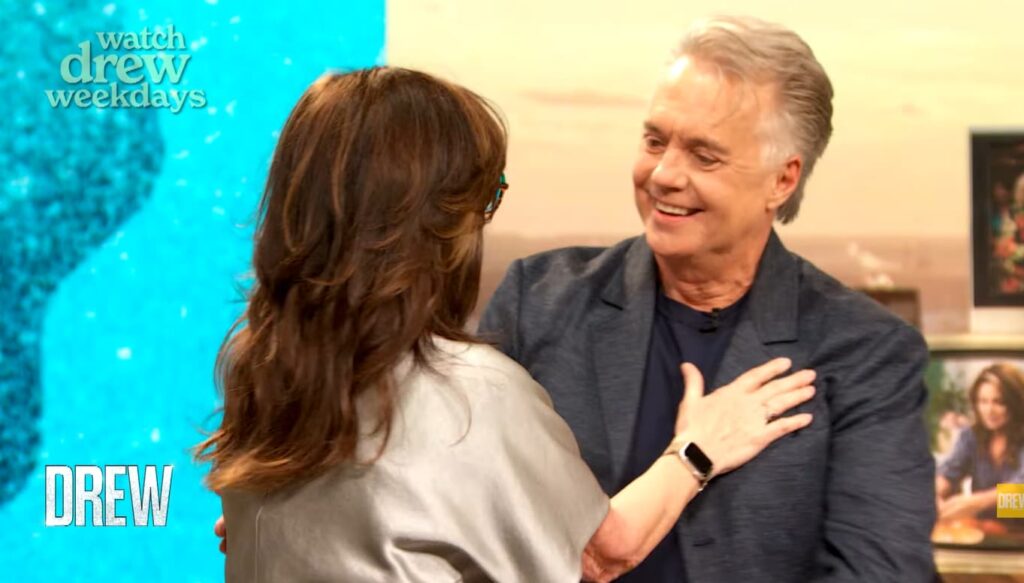
There are moments in popular culture that do not arrive with fanfare or chart-topping triumphs, yet resonate with a depth that no hit single could ever quite achieve. The recent emotional reaction of Valerie Bertinelli to her surprise reunion with her The Hardy Boys Mysteries co-star Shaun Cassidy is one such moment—less a headline, more a soft, lingering chord struck deep within the collective memory of a generation shaped by television, music, and the fragile glow of youth.
To understand the weight of this reunion, one must return to the late 1970s, when Shaun Cassidy was not merely a television actor but a bona fide pop sensation. His 1977 debut album, “Shaun Cassidy”, soared to No. 1 on the Billboard 200, propelled by the infectious single “Da Doo Ron Ron”, which itself climbed to No. 1 on the Billboard Hot 100. Cassidy’s boyish charm, combined with a voice that carried both innocence and urgency, made him a defining figure of the teen idol era. Meanwhile, Valerie Bertinelli, through her work in television, embodied a different but equally powerful presence—grounded, relatable, and quietly luminous.
Their shared connection to The Hardy Boys Mysteries was brief in duration but lasting in emotional imprint. The show itself, though not a chart-topping musical entity, existed within a broader cultural ecosystem where music and television were inseparable. Teen idols crossed mediums effortlessly; their songs played on radios while their faces flickered across living room screens. In that sense, Cassidy’s music and his on-screen persona were two sides of the same coin—each reinforcing the other.
What makes this reunion particularly moving is not simply the passage of time, but the way it reframes memory. When Valerie Bertinelli reacted—visibly touched, almost caught off guard—it was not just recognition of an old colleague. It was the sudden return of an era. The late 1970s, with its analog warmth, its slower rhythms, and its unfiltered sincerity, seemed to step briefly into the present.
There is a certain poetry in how figures like Shaun Cassidy continue to live in the cultural imagination. His music, though rooted in the polished pop-rock production of its time, carried emotional directness. Songs like “Da Doo Ron Ron” may appear simple on the surface, yet beneath that simplicity lies a youthful exuberance that is difficult to replicate in more self-conscious eras. It is precisely this quality that makes such reunions feel almost sacred—they remind us of a time when emotion in music was immediate, unguarded.
For Valerie Bertinelli, whose life and career have traversed decades of change, the reunion becomes something more introspective. It is a mirror held up to time itself. One can imagine the unspoken thoughts: the early days of fame, the friendships formed under studio lights, the sense that everything was just beginning. And then, suddenly, decades have passed.
Unlike a chart position or a gold record, this moment cannot be quantified. There is no Billboard ranking for memory, no certification for nostalgia. Yet its significance is undeniable. It speaks to the enduring power of cultural touchstones—how a television show, a song, or even a fleeting collaboration can leave an imprint that refuses to fade.
In many ways, this reunion underscores a truth often overlooked in discussions of music history: that the emotional afterlife of a song or an artist can be far more profound than its initial commercial success. Shaun Cassidy’s brief reign at the top of the charts may belong to the past, but the feeling he inspired continues to ripple forward, carried in moments like this.
And perhaps that is the quiet lesson here. That music, at its most meaningful, is not confined to vinyl grooves or chart statistics. It lives in memory, in recognition, in the sudden warmth of seeing a familiar face after so many years. In that fleeting exchange between Valerie Bertinelli and Shaun Cassidy, one can almost hear the echo of a distant melody—soft, enduring, and impossibly young.