
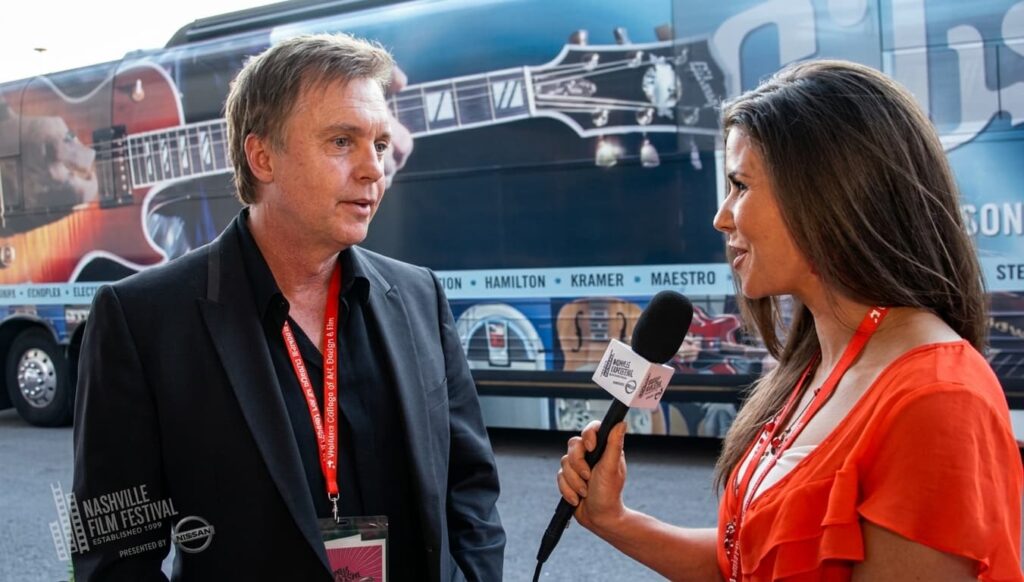
A fleeting moment between youth and reflection—Shaun Cassidy at the Nashville Film Festival reveals an artist quietly stepping beyond the echo of his own beginnings
When Shaun Cassidy appeared at the Nashville Film Festival, it was not simply another public engagement, nor a return to the stage in the way audiences once remembered him. Instead, it felt like a quiet reintroduction—an artist revisiting the space between who he was and who he had become. Unlike the late 1970s, when his music regularly climbed the charts—most notably with “Da Doo Ron Ron” reaching No. 1 on the Billboard Hot 100 in 1977, and the album Shaun Cassidy achieving multi-platinum success—this moment carried a different kind of weight. It was no longer about chart positions or commercial peaks, but about perspective.
In the years of his early fame, Shaun Cassidy embodied a particular kind of youthful energy that defined an era. His recordings were polished, immediate, and widely embraced, placing him firmly within the landscape of late-1970s pop. Songs like “That’s Rock ’n’ Roll” and “Hey Deanie” reflected not only his voice, but the spirit of the time—bright, accessible, and filled with a sense of forward momentum. Yet as the years moved on, Cassidy stepped away from that identity, turning toward writing and production, shaping stories behind the scenes rather than standing at the center of them.
By the time of the Nashville Film Festival appearance, the distance between those two phases had become part of the story itself. The festival, known for its appreciation of narrative and craft, offered a fitting setting. Here, Cassidy was not framed as a former teen idol, but as a storyteller—someone who had lived within different creative forms and allowed them to inform one another.
There is something deeply reflective in moments like this. The audience that once knew him through records and television now encounters a figure shaped by time, by choices made away from the spotlight. The shift is subtle, yet unmistakable. The voice may remain familiar, but the context has changed. And within that change lies a quiet kind of honesty.
Unlike a single or album release, this appearance cannot be measured through charts or sales figures. Its significance is less tangible, but perhaps more enduring. It represents continuity—not in the sense of repetition, but in the ability to carry one’s creative identity forward, even as its outward form evolves.
What emerges most clearly is the sense that Shaun Cassidy never abandoned music or storytelling; he simply allowed them to take on new shapes. The transition from performer to writer is not always visible, yet it often reveals a deeper understanding of the craft. At the Nashville Film Festival, that understanding becomes part of the conversation. It is present not only in what is said, but in how it is said—in the pauses, the reflections, the awareness of distance traveled.
There is also, inevitably, a sense of memory attached to such an appearance. Not nostalgia in its simplest form, but something more layered—a recognition of time’s passage, and of how meaning changes as years accumulate. The songs that once defined a moment now exist alongside the experiences that followed them. They are not diminished by this. If anything, they are given new context.
In this way, the event becomes less about revisiting the past and more about understanding it. The early success, the transition away from the spotlight, the return in a different capacity—all of these elements form a continuous narrative. And within that narrative, there is no need for dramatic reinvention. Only a steady acknowledgment of what has been, and what remains.
In the end, Shaun Cassidy’s presence at the Nashville Film Festival offers something that cannot be captured in rankings or headlines. It offers perspective. A reminder that an artist’s journey does not end when the charts fall silent, but continues in quieter, less visible ways. And sometimes, it is in those quieter moments that the truest sense of artistry reveals itself—not in the height of fame, but in the depth of understanding that follows.