
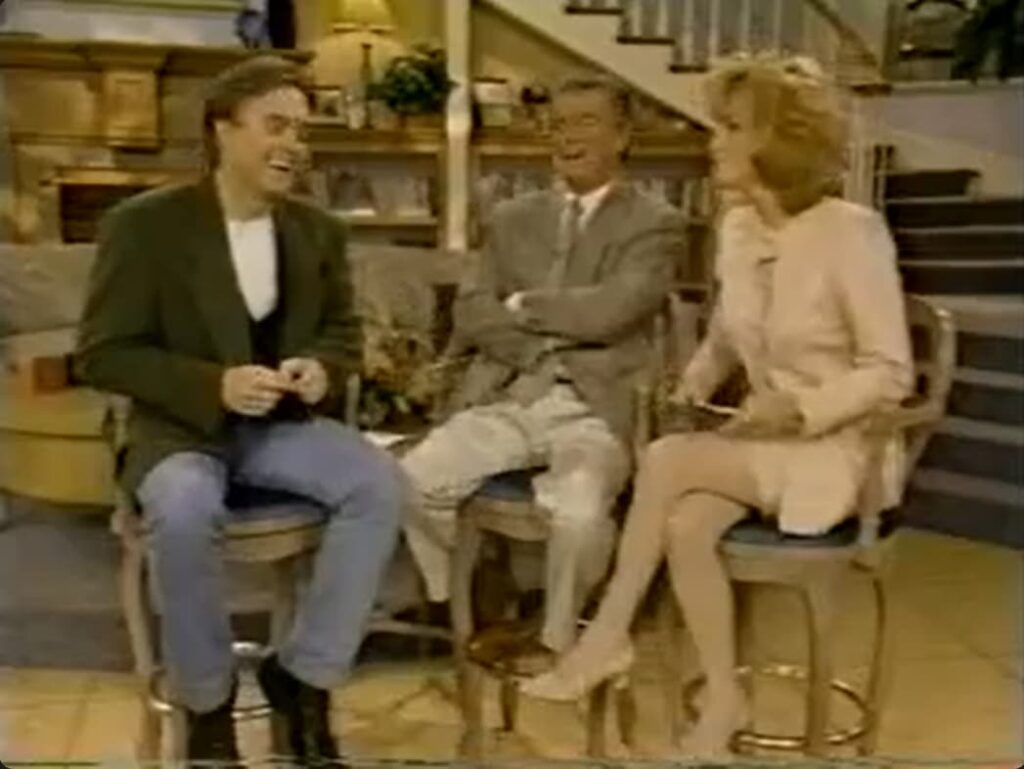
A former teen idol returns not to relive the past, but to quietly redefine it—Shaun Cassidy on television in 1995 reveals what remains after the spotlight fades
On September 21, 1995, when Shaun Cassidy appeared as a guest to promote American Gothic, the moment carried a quiet kind of significance that went far beyond a routine television interview. Nearly two decades had passed since Cassidy’s voice first dominated the airwaves, when “Da Doo Ron Ron” reached No. 1 on the Billboard Hot 100 in 1977, followed by “Hey Deanie,” which climbed to No. 7, confirming his place among the most recognizable pop figures of that era. His albums—particularly Shaun Cassidy (1977), which went multi-platinum—had once defined a certain kind of youthful energy, a sound that felt immediate and unmistakably of its time.
But by 1995, the landscape had changed—and so had he. The appearance tied to American Gothic, a television series that would later gain a cult following for its dark, atmospheric storytelling, marked a different chapter in Cassidy’s career. No longer positioned as a pop sensation, he had transitioned into acting and creative development, exploring narratives that were far removed from the bright, accessible world that had first introduced him to audiences.
What makes this moment compelling is not simply the shift in profession, but the shift in presence. Watching Shaun Cassidy in this context, there is a noticeable calm—a distance from the urgency that once surrounded his image. He does not carry the need to reaffirm his past success, nor does he attempt to escape it. Instead, he exists comfortably alongside it, as though those earlier years have settled into something quieter, something more internal.
The conversation around American Gothic itself reflects this evolution. The series, with its darker tone and psychological depth, stood in contrast to the kind of mainstream entertainment Cassidy had once been associated with. It was a project that required a different kind of engagement—not immediate, not easily categorized. In many ways, it mirrored the transition he had undergone personally, moving from visibility to substance, from recognition to reinvention.
There is also an unspoken narrative present in this appearance—the story of time and its effect on identity. For many artists who experience early success, the challenge is not simply maintaining relevance, but redefining oneself beyond the expectations that success creates. In Cassidy’s case, this redefinition does not come through dramatic statements or deliberate reinvention. It unfolds gradually, almost quietly, through choices that shift the focus away from image and toward craft.
The absence of music in this moment is, in itself, significant. The songs that once defined Shaun Cassidy are not performed here, yet they remain present in a different way. They exist as context, as background—a reminder of where the journey began. But they do not dominate the conversation. Instead, they allow space for something else to emerge: a sense of continuity that does not rely on repetition.
There is a certain restraint in the way Cassidy carries himself during this appearance. He speaks with clarity, without urgency, as though the need to prove anything has long since passed. This restraint becomes the defining quality of the moment. It suggests a kind of understanding—that success, when viewed from a distance, becomes less about its intensity and more about its place within a larger life.
For those who remember the sound of “Da Doo Ron Ron” echoing through radios in the late 1970s, this appearance offers a different perspective. It does not replace those memories, nor does it attempt to reinterpret them. Instead, it adds to them. It shows what comes after—the quieter years, the shifts in direction, the gradual movement toward something less visible but perhaps more enduring.
And in that sense, the 1995 appearance becomes more than a promotional moment. It becomes a reflection—of time, of change, of the way a public identity can evolve without losing its foundation.
As the conversation draws to a close, there is no sense of conclusion, no final statement to define what has been said. Instead, there is a lingering impression, a quiet acknowledgment that the story is ongoing.
Because in the end, Shaun Cassidy is not simply revisiting a career or promoting a project. He is demonstrating something more subtle—the ability to move forward without abandoning what came before, to carry the past without being confined by it. And in that balance, there is a kind of grace that speaks more clearly than any chart position ever could.
Video:
