
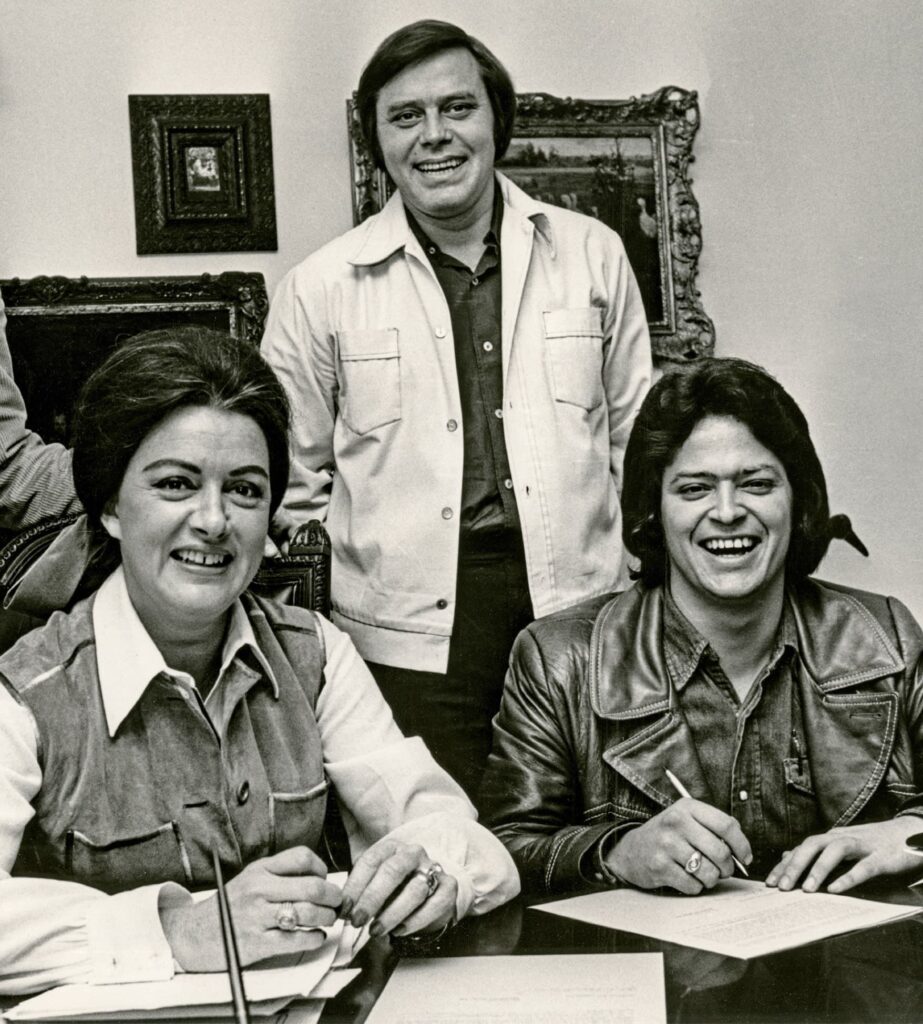
A single song, sung in two languages, opened the door to a new voice that would quietly reshape country music
There are moments in music history that do not arrive with noise or grand announcement—moments that pass almost unnoticed at the time, yet carry within them the quiet certainty of change. The story of Johnny Rodriguez begins with one of those moments. Not on a grand stage, not under bright lights, but in a small room in Nashville where a young man stood, nervous yet determined, holding onto a voice that did not quite fit the mold of the time—and because of that, would soon redefine it.
Before the success, before the chart-topping hits, Johnny Rodriguez was simply a young singer from Texas, shaped by the sounds of country, Latin music, and the lived experience of a life that had not followed an easy path. His voice carried something unmistakable—warm, textured, and filled with a quiet soulfulness that seemed to bridge cultures without effort. At a time when Nashville was still largely defined by tradition, this was something new. Something different. And perhaps, something not immediately understood.
But then came Tom T. Hall.
A respected songwriter and storyteller in his own right, Tom T. Hall had an instinct for authenticity. When he first heard Johnny Rodriguez, he recognized something that could not be taught or manufactured. It was not just the voice—it was the feeling behind it. True to his word, Hall brought him to Nashville, inviting him into his touring band and opening a door that might otherwise have remained closed.
The turning point came during an audition arranged with industry figures, including a BMI executive, where Johnny Rodriguez chose to sing “I Can’t Stop Loving You”—a song already rich with history, most famously recorded by Ray Charles. But Rodriguez did something unexpected. He sang it in both English and Spanish, weaving the two languages together with a natural ease that felt less like a performance and more like a reflection of who he truly was.
There is something quietly powerful about that choice. In a city where tradition often guided expectation, Johnny Rodriguez did not abandon who he was to fit in. Instead, he brought his full identity into the room—his heritage, his influences, his voice. And in doing so, he offered something Nashville had not quite heard before.
Tom T. Hall would later recall that moment with striking simplicity:
“I’m not a talent scout, but listen to this kid sing this song.”
It was not a dramatic declaration. It did not need to be.
Because before the song had even finished, something had already shifted. The room understood. This was not just another hopeful young singer passing through. This was the beginning of something lasting.
In the years that followed, Johnny Rodriguez would go on to become one of the most successful Hispanic artists in country music history. His debut album, Introducing Johnny Rodriguez (1973), produced the No. 1 hit “You Always Come Back (To Hurting Me)”, marking the arrival of a new voice that blended traditional country with subtle Latin influences. He would continue with a string of chart-toppers, including “Ridin’ My Thumb to Mexico” (No. 1, 1973) and “That’s the Way Love Goes” (No. 1, 1973)—songs that carried both commercial success and a distinct emotional identity.
But beyond the charts and accolades, what remains most meaningful is that first moment—the quiet audition where a young man stood between two languages, two worlds, and chose not to separate them. It was a risk, whether he realized it or not. Yet it was also a truth. And music, at its best, has always found a way to recognize truth when it hears it.
Looking back now, it is easy to see that Nashville was not just witnessing a new artist that day. It was witnessing a subtle expansion of its own boundaries. A reminder that country music, for all its traditions, has always had room—perhaps even a need—for voices that carry something different.
And so, what began as a simple audition became something more enduring. Not a loud breakthrough, but a quiet beginning. The kind that lingers long after the final note fades, leaving behind the unmistakable feeling that something important has just begun.