
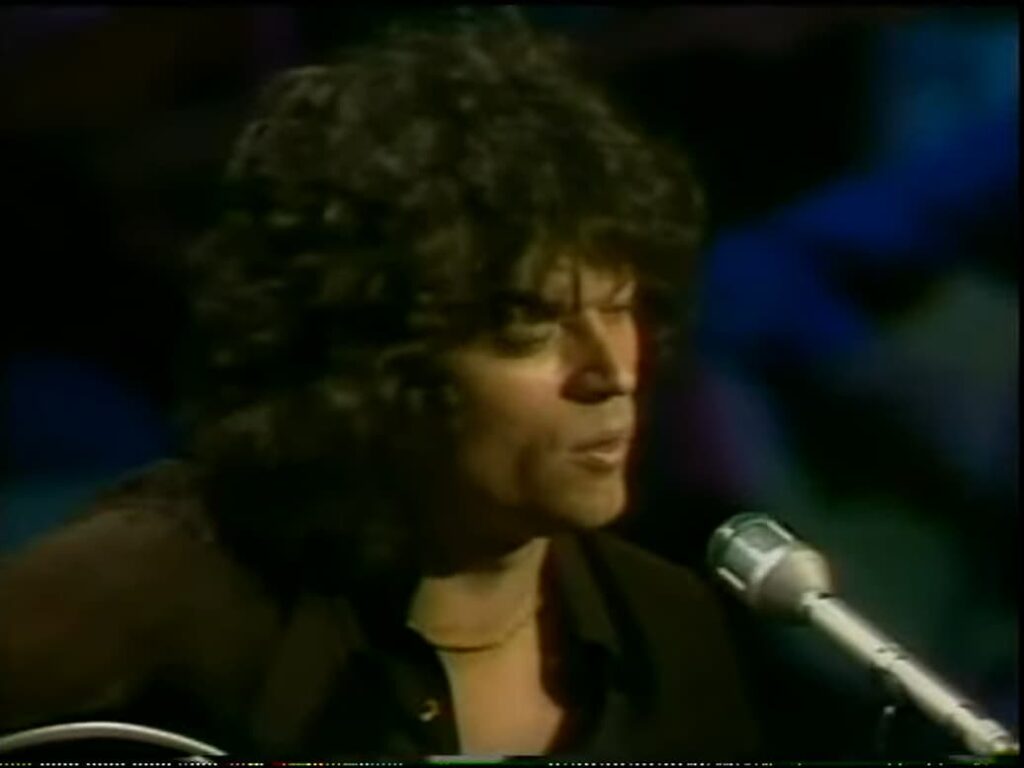
A conversation between two old souls—“You Always Come Back To Hurting Me” lingers as a quiet acceptance of love that never quite learns how to stay
When Johnny Rodriguez joined Tom T. Hall for “You Always Come Back To Hurting Me,” the result was not a song designed to chase charts, but one rooted in the storytelling tradition that defined country music at its most honest. Unlike many of Rodriguez’s earlier hits that climbed to No. 1 on the Billboard Hot Country Singles chart, this particular collaboration did not emerge as a major charting single. Yet its significance lies elsewhere—in the meeting of two voices shaped by experience, each carrying a different weight of memory into the same melody.
By the time this song found its way into the hands of listeners, both artists had already carved out distinct identities. Johnny Rodriguez, with his smooth phrasing and understated emotional delivery, had become one of the most recognizable voices of the early 1970s country scene. Songs like “Ridin’ My Thumb to Mexico” and “That’s the Way Love Goes” had established him as an artist capable of expressing longing without excess.
On the other side stood Tom T. Hall, often referred to as “The Storyteller,” a writer whose strength lay not in vocal flourish, but in observation. His songs rarely raised their voices. Instead, they spoke plainly, almost conversationally, allowing small details to carry larger truths. In “You Always Come Back To Hurting Me,” that sensibility is unmistakable. The song feels less like a performance and more like something overheard—two perspectives meeting somewhere between confession and resignation.
The structure of the song is deceptively simple. There is no dramatic twist, no attempt to resolve the tension it presents. The central idea repeats itself gently: a relationship that cannot quite end, yet cannot avoid causing pain. It is a cycle, familiar and unbroken. And perhaps that is what gives the song its quiet power. It does not pretend that every story moves forward. Some remain exactly where they began, returning again and again to the same unresolved place.
Musically, the arrangement reflects this sense of restraint. The instrumentation is traditional—acoustic guitar, soft steel accents, a steady rhythm that never pushes too hard. It leaves space for the voices, and more importantly, for the pauses between them. Rodriguez brings warmth and fluidity, while Hall’s presence adds a grounded, almost spoken quality. Together, they create a balance that feels natural, unforced.
There is something deeply reflective in the way the song unfolds. It does not accuse, nor does it defend. Instead, it observes. It acknowledges that certain connections carry both comfort and harm, and that the line between the two is often difficult to separate. The title itself—“You Always Come Back To Hurting Me”—does not sound like anger. It sounds like recognition.
Listening now, the song carries a weight that may not have been fully apparent at the time of its release. It feels less like a statement and more like a memory revisited. The kind that returns unexpectedly, not with intensity, but with quiet clarity. There is no urgency here, no demand for resolution. Only the steady understanding that some stories are not meant to be resolved, only remembered.
What makes this collaboration endure is its honesty. Neither Johnny Rodriguez nor Tom T. Hall attempts to elevate the material beyond what it is. They allow it to remain grounded, almost modest in its expression. And in doing so, they reveal something deeper—that truth in music does not always arrive through grand declarations. Sometimes, it is found in repetition, in familiarity, in the simple acknowledgment of what continues, even when it perhaps should not.
In the end, “You Always Come Back To Hurting Me” does not offer comfort in the traditional sense. It does not promise change or closure. Instead, it offers recognition—the quiet understanding that certain patterns in life and love persist, not because they are chosen, but because they are known. And in that recognition, the song finds its place, lingering softly, long after the final note has faded.