
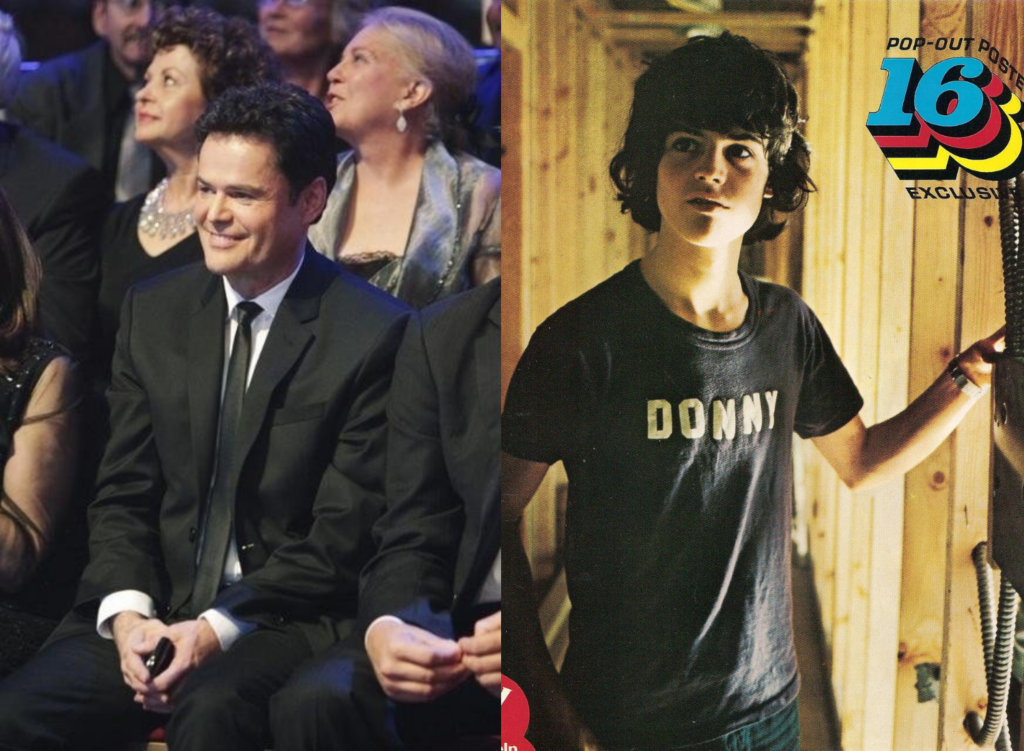
A love quietly enduring behind the spotlight—how Donny Osmond’s greatest strength was never a chart-topping song, but the unwavering devotion that carried him through fame’s hidden shadows
When discussing the musical legacy of Donny Osmond, one cannot ignore the remarkable commercial success that defined his early career. As a solo artist and as part of The Osmonds, he became one of the most recognizable teen idols of the 1970s. His 1971 single “Go Away Little Girl” reached No. 1 on the Billboard Hot 100, marking a rare achievement for a young performer navigating the fragile transition from childhood fame to adult artistry. That song, tender and restrained, spoke of emotional distance and quiet heartbreak—perhaps more prophetic than anyone realized at the time.
Yet behind the polished television appearances, the sold-out tours, and the carefully crafted image of youthful perfection, there existed a far more complex and demanding reality. Fame, especially when it arrives early and intensely, often extracts a cost that is not immediately visible. And in the case of Donny Osmond, that cost was not borne by him alone.
The story that has gradually come into focus over the years is not centered on a single song or album, but rather on the enduring presence of Debbie Osmond, the woman who stood beside him long before the world fully understood what such devotion required. Married in 1978, at a time when Donny’s career was undergoing both transformation and uncertainty, Debbie entered a life that was anything but ordinary.
While audiences continued to associate Donny with the innocence of hits like “Puppy Love”—which climbed to No. 3 on the Billboard Hot 100 in 1972—the reality behind the scenes was far more demanding. The pressures of maintaining relevance in an ever-changing musical landscape, coupled with the emotional toll of constant public scrutiny, created a strain that few could truly comprehend.
It is here that the narrative takes on a deeper, more reflective tone.
Debbie Osmond was never part of the stage lights, never a voice on the records, and yet her influence can be felt in the longevity of Donny’s career. When the teen idol era faded, as it inevitably does, many artists of that generation struggled to redefine themselves. Some disappeared entirely, while others became echoes of their former success. Donny, however, endured.
That endurance was not accidental.
Through the quieter years, when chart positions were no longer guaranteed and the industry’s attention shifted elsewhere, Debbie remained a constant. She provided not only emotional stability but also a sense of grounding that allowed Donny to navigate the uncertainties of reinvention. It is no coincidence that his later successes, including his resurgence in musical theater and his long-running Las Vegas residency with Marie Osmond, were built on a foundation that had been carefully preserved during those more fragile times.
There is a certain irony in revisiting songs like “Go Away Little Girl” today. What once sounded like a simple tale of youthful restraint now carries a more layered meaning when viewed through the lens of a life lived under relentless attention. The themes of distance, sacrifice, and emotional complexity resonate differently, as though the music itself had been quietly hinting at a deeper story all along.
And perhaps that is the most compelling aspect of this narrative.
Music often captures a moment, a feeling, a fragment of truth—but it rarely tells the whole story. In the case of Donny Osmond, the full picture includes not only the chart-topping hits and the television fame, but also the unseen resilience that sustained him through decades of change.
Debbie Osmond’s story, now increasingly recognized, adds a human dimension that transforms how we listen to those familiar songs. It reminds us that behind every polished performance lies a network of support, often unacknowledged, yet absolutely essential.
As time passes, the spotlight inevitably softens. The applause fades, the charts become historical records, and what remains are the relationships that endured when the music paused. For Donny Osmond, that enduring presence has been Debbie—a quiet force whose strength did not seek recognition, but whose impact is impossible to overlook.
In the end, the legacy of an artist is not measured solely by the height of their success, but by their ability to continue, to adapt, and to remain whole in the face of constant change. And sometimes, the most powerful story is not found in the song itself, but in the life that made the music possible.