
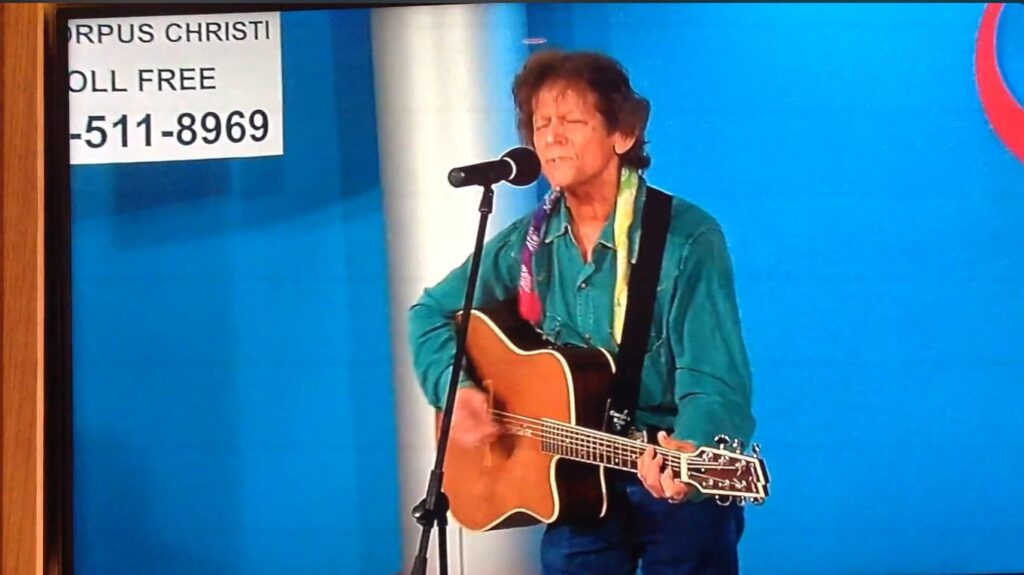
A Voice That Carried Tradition and Heart: Johnny Rodriguez Returns to the Stage with Timeless Country Soul
There is a particular kind of warmth that only classic country music can offer—a sound shaped by lived experience, quiet resilience, and stories told without pretense. When Johnny Rodriguez stepped onto the stage for his Domingo Live Show performance on May 8, 2016, it was not merely another concert. It was a living echo of a golden era, a reminder of a voice that once redefined what country music could be in the early 1970s.
By the time of this performance, Rodriguez was already a legend. Emerging in 1973 with his debut album Introducing Johnny Rodriguez, he quickly made history. His first single, “Pass Me By (If You’re Only Passing Through)”, climbed to No. 9 on the Billboard Hot Country Songs chart, marking the arrival of a fresh, deeply expressive voice. But it was what followed that truly set him apart—six No. 1 hits within a remarkably short span, including “You Always Come Back (To Hurting Me)”, “Ridin’ My Thumb to Mexico”, and “That’s the Way Love Goes.” At a time when the genre was still finding its modern identity, Rodriguez brought something new: a seamless blend of traditional country storytelling with subtle Latin influences, reflective of his Mexican-American heritage.
Watching the 2016 Domingo Live Show, one cannot help but notice how little that essence had changed. The years may have softened the edges of his voice, but they also deepened it. There is a richness there—something earned, not taught. Each lyric feels less like a performance and more like a memory being revisited. Songs that once climbed the charts now carry a different weight, shaped by time and distance.
Rodriguez’s journey to stardom has always been the kind that feels almost mythical. Discovered while singing in a Texas jail cell—an often retold story that has become part of country folklore—he was soon taken under the wing of Tom T. Hall and later signed by Mercury Records. His rise was swift, but never shallow. What distinguished him was not just his voice, but his phrasing—the way he could stretch a line just enough to make it linger in the listener’s mind.
By 1979, Rodriguez had amassed 15 Top 10 country hits, a remarkable achievement that secured his place among the defining voices of his generation. Yet, like many artists of that era, his later years were quieter, his presence less dominant in the charts but no less meaningful to those who remembered.
That is what makes the 2016 performance so poignant.
There is no urgency to prove anything. No attempt to chase trends or reclaim past glory. Instead, there is a quiet confidence—a man standing in front of an audience, sharing songs that have traveled with him through decades. The connection feels intimate, almost conversational. When Rodriguez sings, it is as though he is speaking directly to those who have grown alongside his music.
The Domingo Live Show setting adds another layer of authenticity. It is not a grand arena or a spectacle-driven production. It is something more grounded, more human. The kind of stage where the music is allowed to breathe, where the stories behind the songs can surface naturally. And Rodriguez, with his understated presence, fits perfectly into that space.
What lingers most after watching such a performance is not any single note or lyric, but the feeling it leaves behind. A sense of continuity. Of music that endures not because it is loud or fashionable, but because it is honest.
In an age where so much changes so quickly, seeing Johnny Rodriguez still standing there—still singing, still telling those familiar stories—feels like a quiet reassurance. Some voices, it seems, are not meant to fade. They simply evolve, carrying with them the echoes of everything they have lived through.
And in that gentle, unhurried way, the Domingo Live Show becomes more than just a performance. It becomes a moment of reflection—a reminder of where country music has been, and of the voices that helped shape its soul.