
A Love That Only Ends in Silence: When Devotion Outlives Time Itself
Few songs in the history of country music have carried the emotional weight, quiet devastation, and enduring legacy of “He Stopped Loving Her Today”. First recorded by George Jones and released in 1980 as part of the album I Am What I Am, the song did more than simply climb charts—it restored a career, redefined a genre, and etched itself into the very soul of country music. Upon its release, it reached No. 1 on the Billboard Hot Country Singles chart, becoming Jones’s first chart-topping hit in six years. It would go on to win the CMA Song of the Year (1980 and 1981) and is widely regarded as one of the greatest country songs ever recorded.
Written by Bobby Braddock and Curly Putman, the song tells a story so simple, yet so profoundly human: a man who never stopped loving a woman who left him—until the day he died. There is no dramatic confrontation, no resolution, no reconciliation. Only time, memory, and a love that quietly endured through decades of loneliness. The brilliance of the composition lies in its restraint. It does not beg for emotion—it allows it to unfold, line by line, like an old photograph slowly fading at the edges.
At the time of recording, George Jones himself was battling personal demons. His life was marked by struggles with alcohol and instability, and many in the industry had begun to doubt whether he could ever return to form. In fact, Jones initially disliked the song, calling it too morbid. It took persuasion—and patience—from producer Billy Sherrill to bring the performance to life. What emerged in the studio was not just a recording, but a confession. Jones didn’t merely sing the song—he lived it, pouring into it a lifetime of regret, longing, and hard-earned truth.
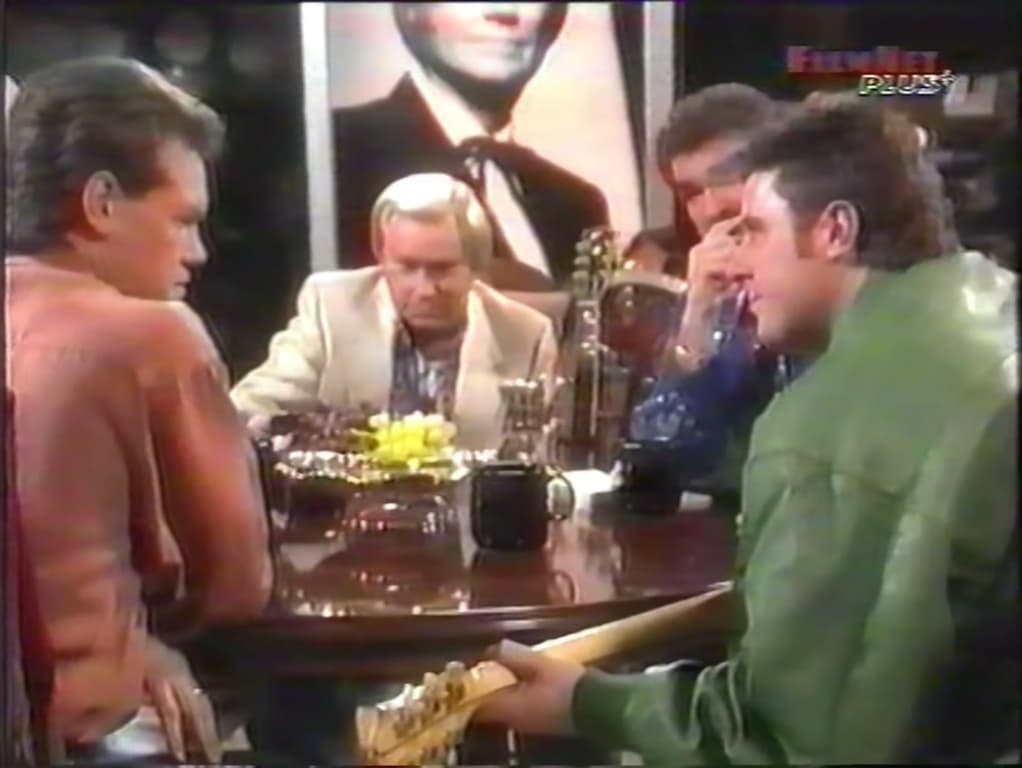
Years later, when voices like Alan Jackson, Randy Travis, and Vince Gill gathered to perform this timeless piece alongside the memory of Jones, something extraordinary happened. It was no longer just a song—it became a conversation across generations. These were artists deeply shaped by the traditions Jones helped define, each bringing their own tone, their own scars, their own reverence.
When they sat together, often around a single table, exchanging verses of “He Stopped Loving Her Today” and blending it with the haunting beauty of “I’m So Lonesome I Could Cry”—originally written and recorded by Hank Williams in 1949—the moment transcended performance. It became a quiet tribute to the very essence of country music: loneliness, endurance, and the fragile dignity of a broken heart.
There is a certain stillness in these renditions. No grand staging, no overwhelming instrumentation. Just voices—seasoned, weathered, unmistakably human. Alan Jackson’s steady warmth, Randy Travis’s deep, resonant gravity, Vince Gill’s aching tenderness—they do not attempt to outshine the original. Instead, they circle around it, honoring it, preserving its spirit like a fragile heirloom passed from one generation to the next.
What makes “He Stopped Loving Her Today” endure is not simply its narrative, but its truth. It speaks to a kind of love that does not demand happiness, does not expect return, and does not fade with time. It is, in many ways, a reflection of life itself—where not all stories are meant to be resolved, and not all wounds are meant to heal.
Listening to these legendary voices revisit the song is like opening a door to another time. A slower time. A quieter time. When music did not rush to impress, but waited patiently to be felt. And in that space, the song breathes again—not as a relic of the past, but as something living, something deeply understood.
In the end, perhaps the most haunting line is not sung, but implied: that love, in its purest form, does not end when it is forgotten—but when the heart itself falls silent.
And in that silence, George Jones still sings.