
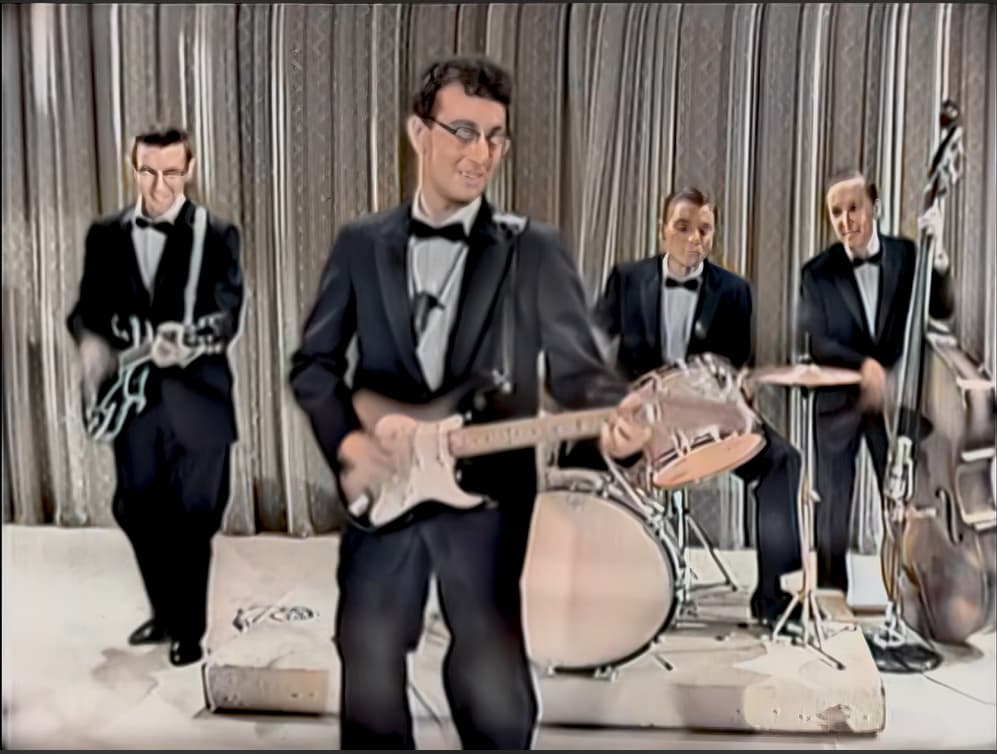
A Bright Pulse of Young Love and Rock ’n’ Roll Innocence, Captured in a Moment That Still Echoes Through Time
There are performances that feel like history unfolding in real time—unpolished, immediate, and alive with a kind of youthful electricity that no studio recording can quite replicate. “Peggy Sue”, performed live by Buddy Holly & The Crickets on The Ed Sullivan Show, is one of those rare moments. It is not merely a song being sung; it is the sound of rock ’n’ roll still discovering itself, still finding its voice, and doing so with a sincerity that feels almost disarming today.
Originally released in 1957, “Peggy Sue” quickly became one of Buddy Holly’s signature songs, reaching No. 3 on the Billboard Top 100 and solidifying his place among the defining figures of early rock music. Issued under the name Buddy Holly & The Crickets on Coral Records, the song stood out not only for its infectious rhythm but for its distinctive vocal phrasing—those hiccup-like inflections that Holly delivered with such natural charm. It was a sound that felt new, unpretentious, and unmistakably his own.
The story behind “Peggy Sue” carries a quiet personal note. The song was named after Peggy Sue Gerron, the girlfriend (and later wife) of Crickets drummer Jerry Allison. Initially titled “Cindy Lou,” it was changed during the recording process—a small decision that would go on to immortalize a real person within the fabric of popular music. There is something touching about that origin, as if the song itself were a snapshot of a moment between friends, preserved forever in melody.
When Buddy Holly brought “Peggy Sue” to the stage of The Ed Sullivan Show, the context shifted in a subtle but meaningful way. Television, at the time, was becoming a powerful medium, capable of carrying music into living rooms across the country. Yet, unlike later decades where performances might lean toward spectacle, this appearance retained a sense of simplicity. There were no elaborate effects, no distractions—just a young man with a guitar, a band behind him, and a song that seemed to pulse with life.
What makes this live performance particularly compelling is its immediacy. Holly’s voice, slightly raw yet controlled, carries an emotional honesty that feels almost conversational. He does not overstate the song’s meaning; instead, he lets its rhythm and repetition do the work. The famous stuttering delivery of the name “Peggy Sue” becomes more than a stylistic choice—it becomes a heartbeat, a nervous excitement, the sound of affection trying to find its words.
Musically, “Peggy Sue” is deceptively simple. Built around a driving rhythm and a steady guitar line, it does not rely on complexity to make its impact. Instead, it captures something more elusive: the feeling of young love in its earliest stages, when everything feels immediate and important, yet wonderfully uncomplicated. There is no grand narrative here, no dramatic arc—only a moment, suspended in time.
And yet, listening now, one cannot ignore the deeper resonance that has gathered around the song over the years. Knowing the brevity of Buddy Holly’s life—his tragic passing in 1959—adds a layer of poignancy to performances like this. What was once simply a lively rock ’n’ roll tune becomes, in retrospect, a reminder of potential, of a voice that would influence generations yet had so little time to evolve.
In the broader landscape of music history, “Peggy Sue” stands as a cornerstone. It helped shape the language of rock ’n’ roll, influencing artists from The Beatles to countless others who followed. But beyond its historical importance, it remains something deeply human—a song that captures a fleeting feeling with clarity and warmth.
The live performance on The Ed Sullivan Show preserves that feeling in its purest form. It is not polished to perfection, nor does it need to be. Its beauty lies in its authenticity, in the sense that what we are hearing is not just a performance, but a moment—brief, bright, and forever echoing.
And perhaps that is why “Peggy Sue” continues to endure. Not because it is grand or complex, but because it is honest. It reminds us that sometimes, the simplest expressions of affection can leave the deepest impressions—lingering long after the music has faded, like a memory that refuses to disappear.
 Oldies Songs
  Music Legend