
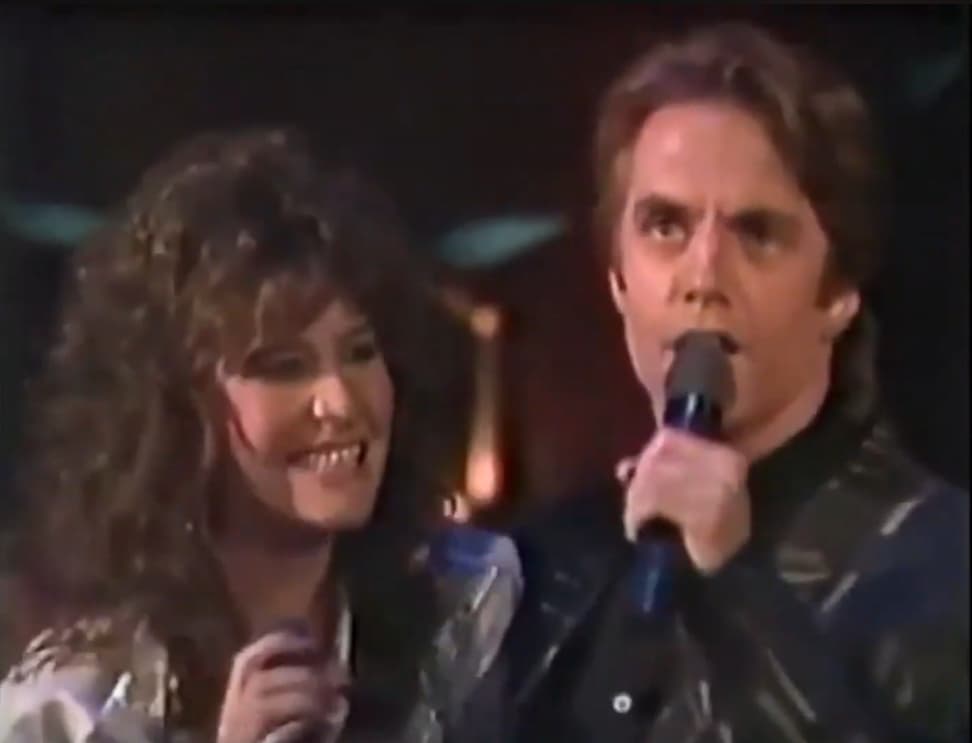
A fleeting moment of tender devotion, where love is spoken simply yet echoes with youthful sincerity and quiet longing.
There is something quietly enchanting about “I Love You So”, especially as performed by Shaun Cassidy & Robyn Bernard during the General Hospital Hallelujah era—a moment that feels less like a polished studio release and more like a captured breath of youthful emotion, suspended in time. While not a traditional chart-topping single with documented Billboard rankings, the performance holds a different kind of cultural currency—one rooted in television history, in the emotional landscape of late-1970s and early-1980s pop culture, and in the intimate connection between music and storytelling.
At the height of his fame, Shaun Cassidy was already a household name, propelled by hits like “Da Doo Ron Ron” and “Hey Deanie”, both of which climbed high on the Billboard Hot 100, with “Da Doo Ron Ron” reaching No. 1 in 1977. Yet this duet with Robyn Bernard, known for her role as Terry Brock on General Hospital, reveals another side of Cassidy—less the teen idol polished for radio, and more the gentle interpreter of feeling, performing within a narrative context that allowed vulnerability to take center stage.
“I Love You So” in this setting becomes more than a song; it is a dramatic device, a quiet confession woven into the fabric of a storyline that captivated millions of viewers. The late 1970s and early 1980s marked a golden era for daytime television, and General Hospital stood at the forefront, blending romance, intrigue, and music in a way that felt immediate and personal. The Hallelujah sequences, in particular, carried a spiritual and emotional undertone, where songs like this one resonated as expressions of hope, longing, and connection.
Musically, the piece is disarmingly simple. Its melody does not demand attention with grand flourishes; instead, it lingers gently, allowing the voices of Shaun Cassidy & Robyn Bernard to carry its emotional weight. There is a certain fragility in their delivery—a sense that the words “I love you so” are not declarations shouted to the world, but rather whispered, almost as if they might vanish if spoken too loudly. This restraint is precisely what gives the performance its enduring charm.
The story behind such performances often goes unrecorded in official discographies, yet they live vividly in memory. For many, this duet is inseparable from the narrative arcs of General Hospital, where characters’ emotions blurred with the actors’ performances, creating moments that felt deeply authentic. It is this blending of fiction and sincerity that elevates the song beyond its modest origins.
In a broader sense, “I Love You So” reflects a time when music did not always need to dominate the charts to matter. There was space for quieter expressions, for songs that lived within scenes, within glances, within pauses between dialogue. These were the moments that stayed with listeners—not because they were the most commercially successful, but because they felt true.
Listening to this performance now, one cannot help but feel a gentle pull backward—toward a time when emotions in popular media were allowed to unfold slowly, without irony or detachment. The duet stands as a reminder of how powerful simplicity can be, and how music, even in its most understated form, can capture something timeless.
In the end, “I Love You So” is less about musical innovation or chart dominance, and more about presence—about two voices meeting in a shared space of feeling, offering something tender and unguarded. It is a small moment, perhaps, but one that continues to echo softly, long after the final note fades.