
A Honky-Tonk Revival Cry—Where Heartbreak Rides Loud Through Steel Strings and Dusty Highways
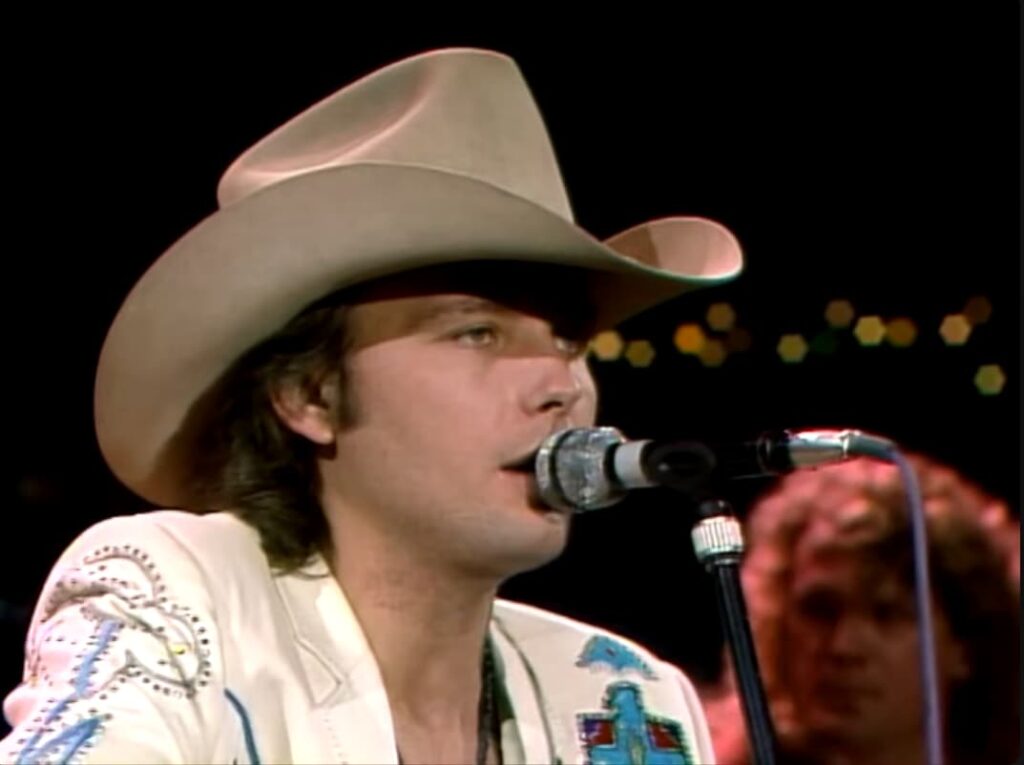
There are songs that feel like they belong to a place as much as to a moment in time—songs that carry the scent of neon-lit bars, the hum of late-night highways, and the quiet ache of solitude. “Guitars, Cadillacs”, performed live by Dwight Yoakam in Austin, Texas, is one such piece—raw, unpolished, and deeply rooted in the traditions of classic country music, yet undeniably alive with a modern edge that helped redefine the genre in the 1980s.
Originally released in 1986 as the title track of his debut album Guitars, Cadillacs, Etc., Etc., the song marked a turning point not only in Dwight Yoakam’s career but also in the broader landscape of country music. At a time when the genre was leaning heavily toward polished, pop-influenced production, Yoakam chose a different path—one that looked back to the Bakersfield sound of Buck Owens and Merle Haggard. The single climbed to No. 4 on the Billboard Hot Country Singles chart, signaling that audiences were ready—perhaps even longing—for something more authentic, more grounded.
The live performance in Austin captures that authenticity in its purest form. There is a certain electricity in the air, the kind that cannot be manufactured in a studio. Yoakam’s voice, sharp and expressive, cuts through the instrumentation with a clarity that feels almost defiant. Backed by the tight, driving rhythm of his band, he delivers the song not as a polished product, but as a lived experience—each line carrying the weight of heartbreak, resilience, and a stubborn refusal to surrender to despair.
The story behind “Guitars, Cadillacs” is, in many ways, a reflection of Yoakam’s own journey. Before achieving mainstream success, he spent years performing in Los Angeles clubs, often in front of audiences more attuned to punk rock than traditional country. Yet, instead of adapting to fit expectations, he remained steadfast in his vision, blending honky-tonk roots with a contemporary attitude. This song became his declaration—a statement that country music could honor its past while still feeling immediate and relevant.
Lyrically, the song paints a vivid picture of heartbreak and escape. The narrator, faced with emotional ruin, turns to the familiar comforts of guitars and Cadillacs—symbols of a lifestyle that offers both distraction and identity. There is a quiet irony here: these comforts do not heal the pain, but they provide a way to endure it. The repetition of the title phrase becomes almost hypnotic, as if the act of naming these objects is itself a form of reassurance.
What sets this song apart is its emotional honesty. There is no attempt to romanticize heartbreak, no illusion of easy resolution. Instead, Yoakam embraces the complexity of the experience—the way loss can coexist with defiance, the way sorrow can be carried with a certain kind of pride. It is this balance that gives the song its enduring power.
The Austin performance, in particular, adds another layer to this narrative. The setting—intimate yet vibrant—allows the song to breathe in a way that studio recordings often cannot. The audience’s presence is felt, not as a distraction, but as a shared understanding. It is as though everyone in the room recognizes the truth in the music, even if they have never lived the exact story being told.
In the years since its release, “Guitars, Cadillacs” has come to be seen as a cornerstone of the neo-traditionalist movement in country music. It opened doors for artists who sought to reconnect with the genre’s roots, proving that authenticity could resonate just as strongly as innovation. For Dwight Yoakam, it was more than a hit—it was a defining moment, a song that established his voice not only as a performer but as a guardian of a musical tradition.
Listening now, the song carries with it a sense of timelessness. It does not feel confined to the era in which it was created. Instead, it exists in that rare space where music transcends time, speaking to something universal—the need to find meaning, or at least solace, in the face of life’s inevitable disappointments.
And perhaps that is why “Guitars, Cadillacs” continues to endure. It reminds us that even in moments of loss, there is a rhythm to hold onto, a melody that carries us forward. Not toward resolution, perhaps, but toward understanding—and sometimes, that is enough.