
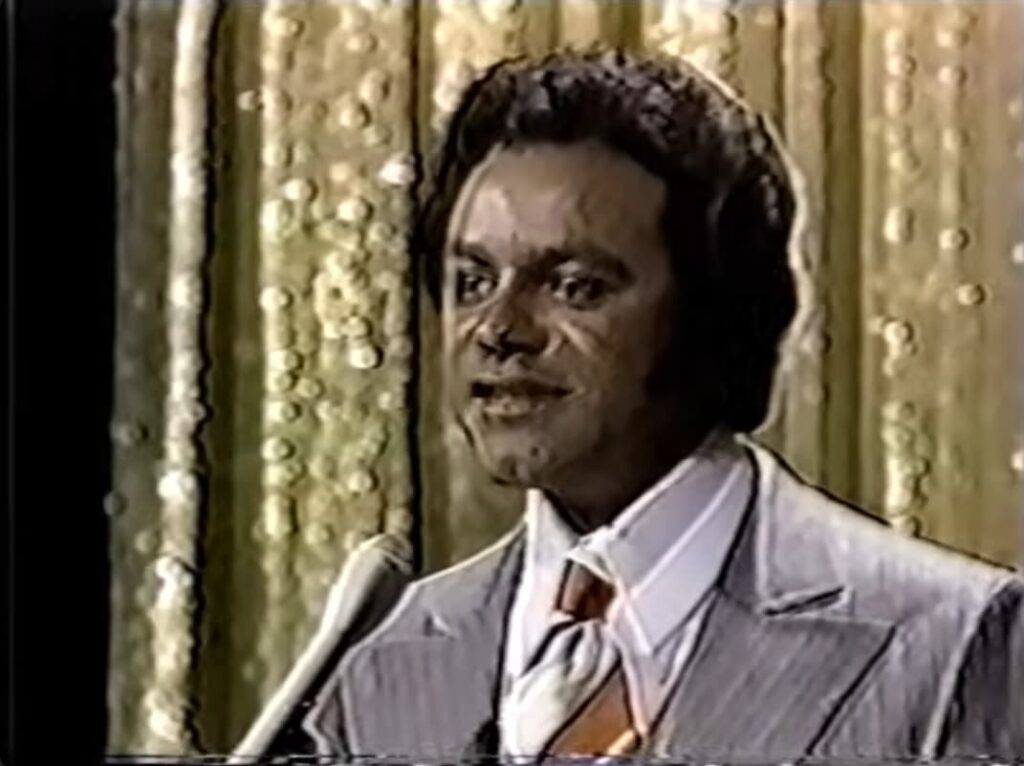
A quiet evening in 1972 where Johnny Mathis turned television into something intimate, reminding us that a voice can carry memory further than any chart ever could
On May 2, 1972, when Johnny Mathis appeared on The Tonight Show Starring Johnny Carson, it was not a debut, nor a comeback, nor even a moment tied to a single charting release. Instead, it stood as part of a continuum, a living extension of a career that had already defined what romantic popular music could sound like across two decades. By that point, Mathis had long since secured his place in the upper reaches of American music history. His 1957 album “Johnny’s Greatest Hits” had spent an astonishing 490 consecutive weeks on the Billboard charts, a record that remained unmatched for years, while singles like “Chances Are” (No. 1 on the Billboard Most Played by Jockeys chart in 1957) and “It’s Not for Me to Say” had established him as one of the most enduring voices of his generation.
So what, then, was the significance of a television appearance in 1972? It lies precisely in what it was not. It was not driven by commercial urgency. It was not framed by competition. It was not about climbing toward a number beside a song title. Instead, it was about presence. About standing in front of an audience, both in the studio and beyond, and offering something that had been refined over years of experience. By 1972, Mathis’s voice had matured into something remarkably controlled, almost weightless, yet carrying within it a quiet emotional gravity that could not be taught or manufactured.
The setting itself played a crucial role. Under the guidance of Johnny Carson, The Tonight Show had become more than just late-night entertainment. It was a cultural meeting place, where music was allowed to breathe in a way that was increasingly rare in an industry moving toward louder, faster expressions. Carson understood timing, not just in comedy, but in conversation and performance. He knew when to step back, when to allow a singer like Mathis the space to create something unspoken yet deeply felt.
Though the exact repertoire from that evening may not be tied to a single definitive recording, Mathis’s performances during this period often drew from the rich body of standards and contemporary ballads he had mastered. Songs that, in another voice, might have felt overly sentimental were transformed into something restrained, almost conversational. He did not impose emotion on the listener. He invited it.
This is where the deeper meaning of that 1972 appearance begins to reveal itself.By the early 1970s, popular music had already shifted dramatically. Rock had become dominant, and the raw, immediate energy of new artists was redefining the sound of the era. In such a landscape, a singer like Johnny Mathis could easily have seemed out of step. Yet, rather than fading, he occupied a different space entirely. His music did not compete with the present. It coexisted alongside it, offering an alternative that felt grounded, reflective, and, perhaps most importantly, enduring.
Watching him on The Tonight Show, one senses a kind of stillness that contrasts sharply with the changing musical climate of the time. There is no urgency in his delivery, no attempt to adapt to trends that do not belong to him. Instead, there is confidence in simplicity, in the belief that a well-phrased line, delivered with sincerity, can resonate more deeply than any elaborate arrangement. And that is precisely what makes moments like May 2, 1972, so significant in retrospect. They are not defined by what was new, but by what remained true. Mathis’s voice, steady and unmistakable, became a kind of anchor, a reminder that music does not lose its value simply because the world around it changes.
In the years since, countless performances have come and gone, each tied to its own moment, its own context. But there is something about that era, about those quiet appearances on late-night television, that lingers. Perhaps it is the sense of closeness, the way the distance between performer and listener seemed to narrow, even through a screen. Or perhaps it is simply the recognition that some voices are not meant to chase time, but to move alongside it, gently, without resistance. In that sense, Johnny Mathis on The Tonight Show in 1972 was not just a guest appearance. It was a quiet affirmation of everything he had already become, and everything his music would continue to mean, long after the applause had faded into memory.