
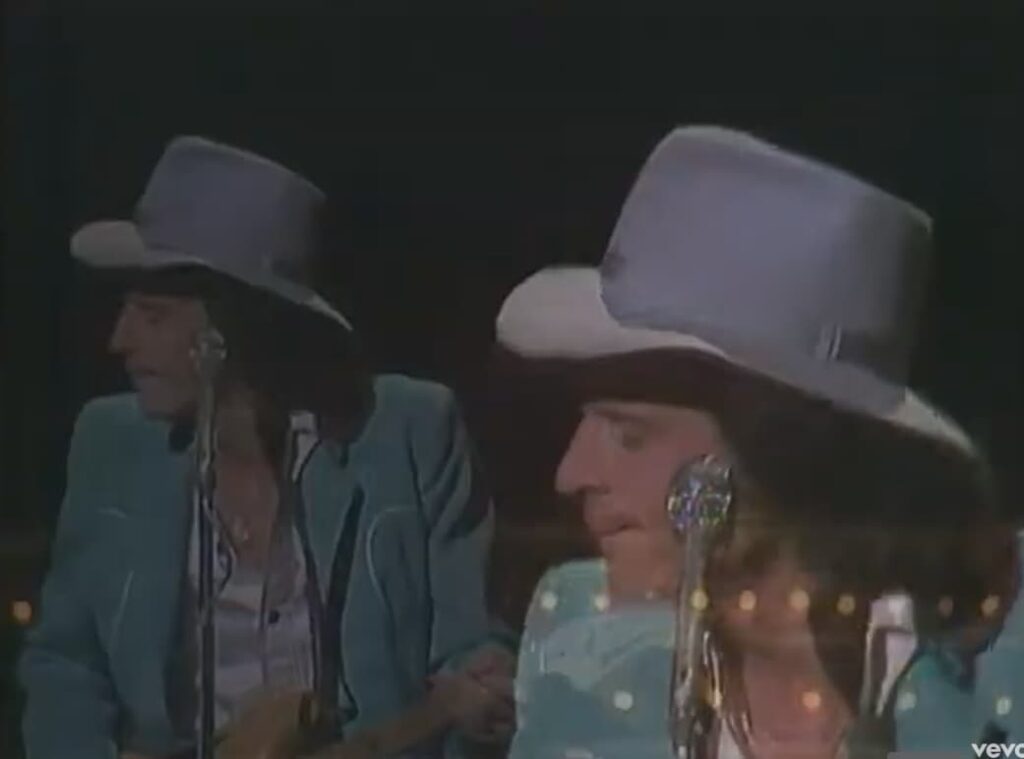
A Restless Spirit in Song—Where Honky-Tonk Tradition Meets the Unquiet Heart of a Troubled Soul
There are voices in country music that feel polished, carefully measured, and reassuringly familiar. And then there are voices like that of Gary Stewart—raw, unpredictable, and deeply human, as though each note carries a story that was never meant to be neatly resolved. In his live performance of “Little Junior”, Stewart does not simply revisit a classic; he inhabits it, reshaping its emotional core with a sincerity that feels both intimate and haunting.
Originally written and recorded by Red Sovine in the early 1950s, “Little Junior” belongs to a tradition of honky-tonk storytelling that predates the smoother, more commercial sounds of later decades. Unlike many chart-driven hits of its time, the song did not achieve significant national chart success upon its initial release. Instead, it lived quietly within the circuits of jukeboxes, radio stations, and live performances—its reputation growing not through numbers, but through the emotional weight it carried.
By the time Gary Stewart brought “Little Junior” into his repertoire, the landscape of country music had changed dramatically. The 1970s saw a shift toward the so-called “outlaw” movement, where artists like Waylon Jennings and Willie Nelson pushed against the polished constraints of Nashville production. Stewart, though often less celebrated in mainstream narratives, stood firmly within this lineage. His music carried the same defiance, the same refusal to smooth over life’s rough edges.
In the live setting, “Little Junior” takes on a new dimension. There is no studio gloss here, no attempt to refine or contain the emotion. Stewart’s voice—strained, expressive, and unmistakably authentic—moves through the song with a kind of restless energy. It is as if he is not merely performing the lyrics, but reliving them, line by line. The band behind him follows closely, their instrumentation grounded in the classic honky-tonk sound: steady rhythm, steel guitar accents, and a sense of movement that feels both urgent and unhurried.
The narrative of “Little Junior” itself is deceptively simple. It tells the story of a man navigating the uncertainties of life and love, caught between longing and resignation. Yet within that simplicity lies a deeper truth—a recognition of how easily dreams can slip away, how quickly certainty can dissolve into doubt. Stewart’s interpretation leans into this ambiguity, allowing the song’s emotional undercurrents to surface without forcing resolution.What makes this performance particularly compelling is its sense of immediacy. There is a vulnerability in Stewart’s delivery that cannot be rehearsed or replicated. Each phrase feels spontaneous, shaped by the moment rather than by expectation. It is this quality that draws the listener in, creating a connection that feels personal, almost confessional.
In many ways, Gary Stewart was an artist out of step with his time—too traditional for the emerging pop-country trends, yet too individualistic to fit neatly within any single movement. Songs like “Little Junior” reveal the depth of his artistry, his ability to bridge past and present without losing the integrity of either. He did not reinvent the genre; he reminded it of its roots.Listening now, there is a quiet poignancy to this performance. It carries with it the weight of a career marked by both brilliance and struggle, of a voice that gave everything it had, often at great personal cost. Yet there is no bitterness here, only a kind of weary honesty—a willingness to confront life as it is, rather than as it might be wished.
For those who encounter “Little Junior” in this form, the experience is less about the song’s history and more about its feeling. It is about the way music can capture something fleeting yet essential—a moment of clarity, a glimpse of truth, a reminder that even in uncertainty, there is meaning to be found.And perhaps that is the enduring legacy of Gary Stewart. Not the charts, nor the accolades, but the ability to make a song feel real—to strip away artifice and leave behind only what matters. In “Little Junior,” that truth resonates clearly, echoing long after the final note has faded.