
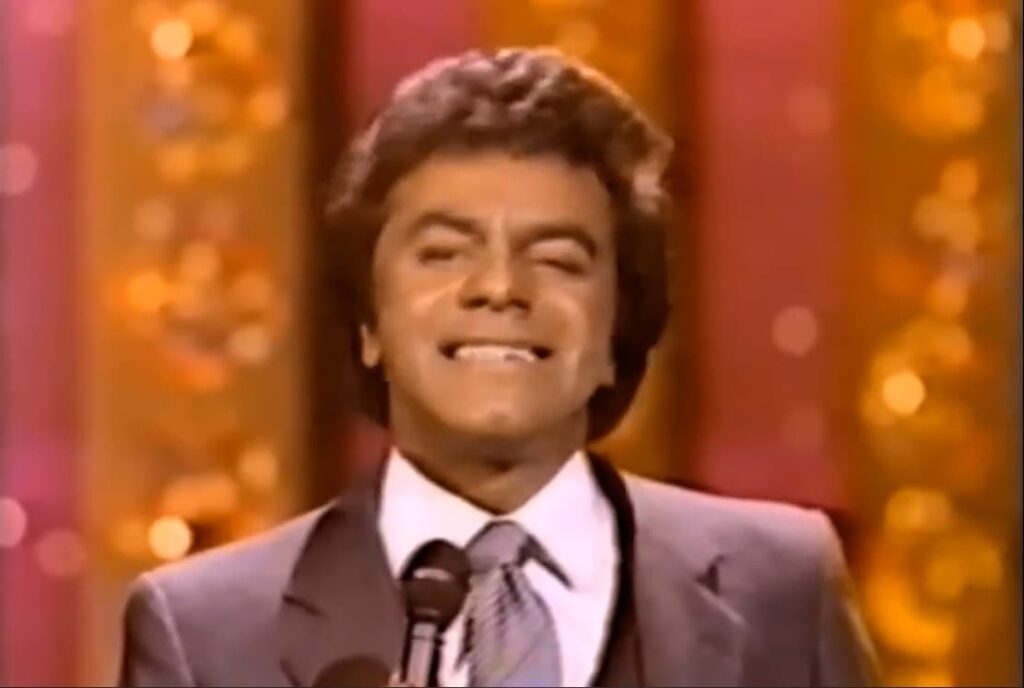
A confession repeated through time, where Johnny Mathis turns a simple declaration of love into something eternal, unhurried, and quietly devastating
When Johnny Mathis stepped onto the stage of The Tonight Show Starring Johnny Carson in 1981 to perform “There! I’ve Said It Again”, it was not the unveiling of a new hit, nor an attempt to reclaim chart dominance. That moment had already passed, decades earlier, when the song itself had lived its first life in the glow of radio waves and vinyl records. Yet, what unfolded that evening carried a different kind of significance, one that only reveals itself with time and distance.
Originally written by Redd Stewart and originally recorded by Vaughn Monroe in 1945, “There! I’ve Said It Again” found renewed success in 1963 when Bobby Vinton took it to No. 1 on the Billboard Hot 100, where it notably became the final No. 1 hit before the arrival of The Beatles with “I Want to Hold Your Hand.” By the time Johnny Mathis embraced the song, it had already become a standard, a piece of musical language understood across generations. Mathis included it in his repertoire with the kind of sensitivity that defined his career, though his version was never about chart placement. It was about interpretation, about inhabiting a lyric so completely that it no longer felt written, but lived.
And that is precisely what made the 1981 performance so quietly remarkable.
Mathis had, by then, long secured his place in popular music history. With dozens of albums, countless chart entries, and a voice that seemed untouched by the passing years, he no longer needed to prove anything. Yet, in performing “There! I’ve Said It Again”, he returned to a kind of emotional ground zero, a place where love is still uncertain, where words carry weight because they are spoken hesitantly, almost reluctantly. The song itself is deceptively simple. Its structure is straightforward, its melody gentle, its message clear. But in the hands of Mathis, it becomes something else entirely, something layered with experience.
There is a subtle shift that happens when a song like this is sung not by a young man discovering love, but by someone who has lived long enough to understand its complexities. The repeated confession in the title no longer feels like nervous excitement. It feels like inevitability, as though the words have been held back for too long and can no longer remain unspoken. Mathis does not rush the phrasing. He allows each line to settle, to breathe, to find its place in the silence between notes. It is in those silences that the true meaning of the performance resides.
The setting of The Tonight Show only deepens this effect. Under the soft studio lights, with the quiet attentiveness of the audience, the performance becomes almost intimate, as if the vast machinery of television has momentarily stepped aside to allow something more personal to emerge. Johnny Carson, known for his effortless charm and timing, provides the perfect frame for such a moment, understanding instinctively when to let the music speak for itself.
What makes this rendition endure is not technical perfection, though Mathis possesses that in abundance. It is the sense of continuity it carries. The song had existed long before him, had reached its commercial peak with Bobby Vinton, and yet here it was again, alive in a different voice, shaped by different years. It is a reminder that great songs do not belong to a single moment or a single artist. They move through time, gathering meaning with each new interpretation.
For Mathis, whose career has always been defined by elegance and restraint, “There! I’ve Said It Again” becomes almost autobiographical in this context. Not in a literal sense, but in the way it reflects a lifetime of expressing emotion through music. There is no need for dramatic reinvention, no attempt to modernize or embellish. The power lies in fidelity to the song’s essence, in trusting that simplicity, when handled with care, can still resonate.
Looking back, that 1981 performance feels less like a television appearance and more like a quiet affirmation. Not of fame, not of success, but of something far more enduring. The belief that a song, even one written decades earlier, can still find new meaning when placed in the right voice at the right moment. And in that gentle, unassuming way, Johnny Mathis reminds us that some truths do not fade. They simply wait to be spoken again.