
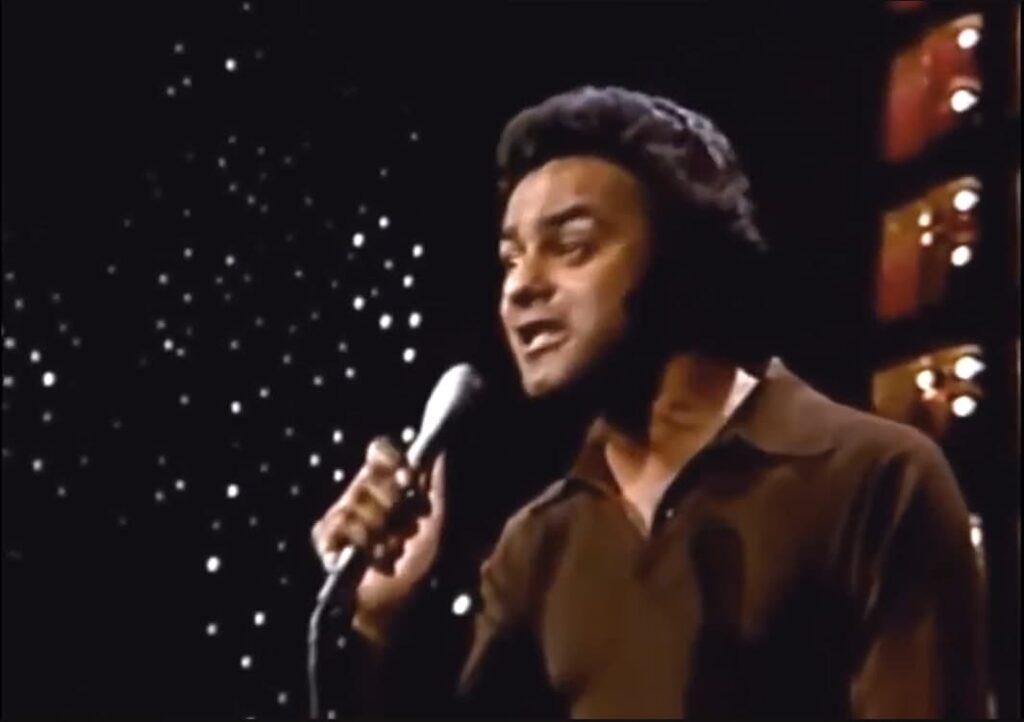
A melody that refuses to fade, where Johnny Mathis breathes life into “Stardust” as a meditation on memory, longing, and the quiet permanence of love once felt
When Johnny Mathis performed “Stardust” on The Tonight Show Starring Johnny Carson in 1976, he was not reviving a forgotten song, nor chasing a place on the charts. He was stepping into a musical lineage that stretched back nearly half a century, carrying with it the weight of countless interpretations and the fragile beauty of a composition that had long transcended its origins. Written in 1927 by Hoagy Carmichael with lyrics added in 1929 by Mitchell Parish, “Stardust” had already become one of the most recorded songs in American popular music history. Early versions by artists such as Isham Jones helped establish its presence, and over the decades, it would find its way through jazz, pop, and orchestral arrangements, each version adding another layer to its quiet mythology.
Unlike many songs tied to a single defining chart moment, “Stardust” belongs to a different category. It achieved early commercial success in the 1930s, with recordings charting in the United States during the pre-Billboard era, and later interpretations, particularly by Nat King Cole in 1957, brought it back into prominence, reaching the Billboard charts once again. But its true “position” has never been numerical. Its place has always been somewhere deeper, embedded in the cultural memory of listeners who recognize its opening phrase almost instinctively, as though it had always been there.
By 1976, Johnny Mathis had already built a career defined by elegance, control, and an almost timeless vocal quality. His decision to perform “Stardust” on national television was not incidental. It was, in many ways, inevitable. Few voices were as suited to the song’s delicate architecture. Where others approached it with jazz phrasing or orchestral grandeur, Mathis brought something more restrained, more introspective. His interpretation does not attempt to reinvent the song. Instead, it leans into its essence, allowing the melody to unfold with patience, as though each note were being rediscovered rather than performed.
There is a particular stillness in that 1976 performance. Under the soft glow of the studio lights, with Johnny Carson presiding over the evening with his characteristic ease, the song seems to suspend time. Mathis does not rush. He lingers on phrases, letting them settle into the silence before moving forward. It is in those pauses that the meaning of “Stardust” reveals itself most clearly.
At its core, the song is about memory, about the way love persists not in grand gestures, but in fragments, in echoes that return uninvited. The lyrics speak of a melody that haunts the heart, a reminder of something that once was and can never fully be again. In Mathis’s voice, this idea takes on an added dimension. There is no sense of youthful urgency here, no attempt to recapture what has been lost. Instead, there is acceptance, a quiet acknowledgment that some emotions do not fade, they simply change their shape over time.
This is what makes his rendition so enduring. It is not bound to the year 1976, nor to the setting of The Tonight Show. It feels untethered, existing somewhere between past and present, much like the song itself. Mathis becomes less an interpreter and more a conduit, allowing the listener to step into that reflective space where memory and music intertwine.
For an artist whose career has spanned decades, moments like this carry a particular significance. They are not about reinvention or resurgence. They are about continuity. About returning to a song that has already lived many lives and finding within it something personal, something quietly true.
In the end, “Stardust” is not simply a standard. It is a kind of emotional language, one that speaks in tones of longing, remembrance, and the passage of time. And in that 1976 performance, Johnny Mathis does not just sing the song. He inhabits it, gently, almost reverently, reminding us that some melodies are never truly left behind. They remain, drifting softly through the years, waiting for a voice capable of carrying them once more into the light.