
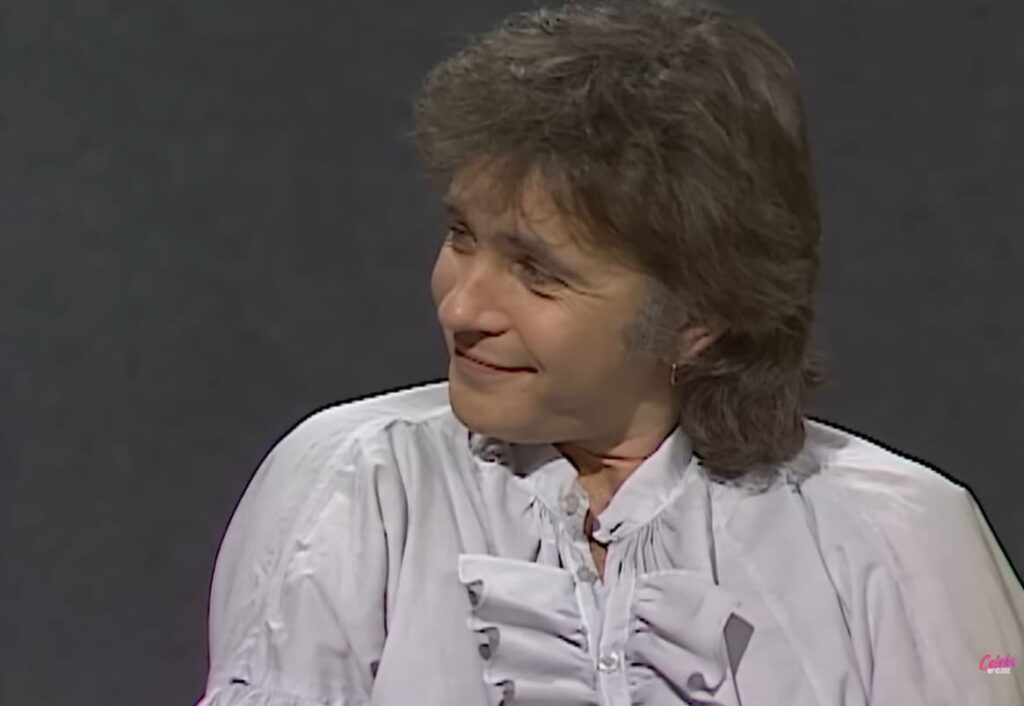
A sparkling portrait of wit and theatrical brilliance, Dame Edna in her 1985 television appearance reveals how humor, satire, and personality can become a lasting art form beyond music.
While not a song in the traditional sense, the 1985 interview featuring Dame Edna Everage—the flamboyant creation of Australian comedian Barry Humphries—on the British television program “Aspel & Co.”, hosted by Michael Aspel, stands as a fascinating cultural moment within the broader landscape of entertainment history. Appearing alongside singer and actor David Essex, the segment offers something akin to a live performance, where personality itself becomes the melody, and wit replaces lyricism. Though it did not chart on the Billboard rankings, its impact belongs to a different kind of chart—one measured in audience memory, cultural influence, and enduring affection.
By 1985, Dame Edna had already established herself as a towering figure in comedy, known for her lilac hair, extravagant glasses, and an unmistakable voice that could glide effortlessly between mockery and charm. Yet what makes this particular interview so compelling is not simply the humor—it is the sense of complete control she exerts over the room. From the moment she speaks, the boundaries between interviewer and guest dissolve. Michael Aspel, seasoned and composed, finds himself gently steered into Edna’s world, where every question becomes an opportunity for playful subversion.
The presence of David Essex, himself a prominent figure in music with hits like “Rock On” and “Gonna Make You a Star,” adds another layer to the exchange. Yet even he, with all his charisma, seems momentarily eclipsed by the sheer force of Dame Edna’s personality. It is not dominance in an aggressive sense, but rather a kind of theatrical gravity—an ability to draw attention effortlessly, to make every aside feel like a carefully crafted line in an ongoing performance.
What unfolds in this interview is, in many ways, a masterclass in character-driven entertainment. Barry Humphries, through Dame Edna, blurs the line between fiction and reality so completely that the audience is invited to suspend disbelief entirely. Edna speaks of her “family,” her “career ambitions,” and her “adoring public” with such conviction that one almost forgets the artifice behind it. This illusion is not meant to deceive, but to delight—to remind us that performance can be as truthful as any confession when delivered with sincerity and intelligence.
The humor itself is layered, often deceptively so. On the surface, there are the quick quips, the playful jabs, the exaggerated self-praise. But beneath that lies a sharper commentary on celebrity culture, social expectations, and the nature of fame. Dame Edna presents herself as a figure adored by millions, yet in doing so, she gently satirizes the very idea of adoration. It is a delicate balance—one that requires not only comedic timing, but a deep understanding of the audience’s perceptions.
There is also a certain warmth that emerges through the laughter. Despite her sharp tongue and grandiose claims, Dame Edna never feels cruel. Her humor, while incisive, carries an undercurrent of affection—a recognition of human quirks rather than a condemnation of them. This quality allows her to connect across generations, to resonate not just as a comic figure, but as a familiar presence, someone who speaks with both mischief and insight.
Looking back, the 1985 appearance on “Aspel & Co.” captures a moment when television itself felt more intimate, more conversational. There were no elaborate sets or rapid edits—just people, speaking, reacting, engaging. In that space, Dame Edna thrives, turning what could have been a routine interview into something memorable, something that lingers long after the broadcast ends.
Though it may sit outside the realm of recorded music, this interview shares much with the great performances of classic songs. It has rhythm, pacing, emotional nuance, and above all, a voice that is unmistakable. Like a timeless melody, Dame Edna’s presence continues to echo, reminding us that entertainment, at its finest, is not confined to any single form.
In the end, what remains is not just the laughter, but the sense of having witnessed something singular—a moment where personality became performance, and performance became memory. And much like a beloved song revisited after many years, the charm of Dame Edna in that 1985 interview endures, inviting us to listen once more, and to smile at the brilliance of it all.