
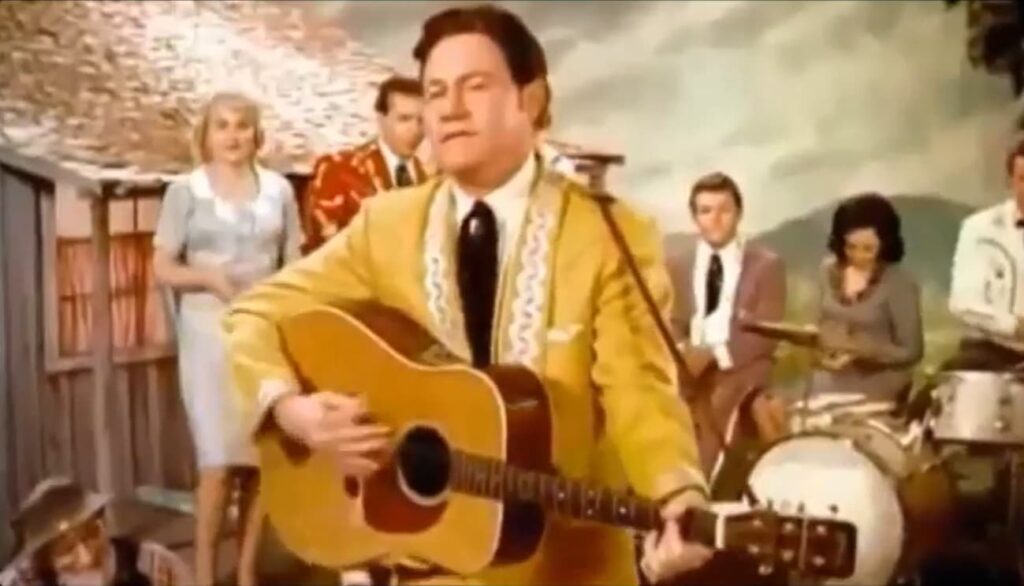
A playful yet poignant celebration of love without pretense, “If You’ve Got the Money (I’ve Got the Time)” reminds us that joy often lives in the simplest bargains of the heart.
When Lefty Frizzell released “If You’ve Got the Money (I’ve Got the Time)” in 1950, it did more than introduce a catchy honky-tonk tune—it marked the arrival of a distinctive new voice in country music. The song soared to No. 1 on the Billboard Country & Western Best Sellers chart, becoming Frizzell’s debut single and an immediate success. Included later on collections such as “Songs of Jimmie Rodgers” (1951) and various compilations, the track helped establish Frizzell as one of the most influential stylists of his generation.
From the very first notes, there is a lightness to the song—a swing in its rhythm, a warmth in its delivery—that feels almost disarming. Yet beneath that easy charm lies something deeper: a subtle reflection on companionship, resilience, and the quiet dignity of making do with what life offers. In the post-war years, when the world was learning to breathe again after hardship, songs like this carried a special kind of comfort. They did not promise riches or grandeur; instead, they celebrated the small, shared pleasures that made life worthwhile.
Lefty Frizzell’s vocal style was, in many ways, revolutionary. His smooth, relaxed phrasing—stretching syllables, bending notes with an almost conversational ease—would go on to influence countless artists, from Merle Haggard to Willie Nelson. In “If You’ve Got the Money (I’ve Got the Time)”, that style is already fully formed. He sings as though he is leaning across a table, speaking directly, without affectation. There is no rush in his delivery, no need to impress—only a quiet confidence that the story will find its way.
The song’s narrative is simple, almost charmingly so. It tells of a man with little to his name but plenty of willingness to enjoy life, especially in the company of someone who shares that spirit. “If you’ve got the money, honey, I’ve got the time,” he sings—a line that has since become part of the country music lexicon. It is playful, yes, but also revealing. There is an honesty in admitting one’s limitations, and a kind of freedom in embracing them.
Behind the song lies the partnership between Frizzell and songwriter Jim Beck, who helped bring the tune to life during those early recording sessions in Texas. The production is spare, unadorned, allowing the rhythm section and steel guitar to provide just enough support without overshadowing the vocal. This simplicity is key to the song’s enduring appeal. It feels unpolished in the best possible way—like something heard in a small dance hall, where the music is close, and the connection immediate.
Listening today, there is a sense of stepping into another time—not in a nostalgic, romanticized way, but in a more grounded, human sense. The concerns of the song are modest: a night out, a shared laugh, the comfort of not being alone. And yet, those modest concerns carry a weight that feels timeless. They remind us that happiness is not always found in abundance, but often in the willingness to share whatever we have.
There is also a quiet resilience embedded in the song’s cheerful exterior. To say “I’ve got the time” is, in a way, to assert presence—to offer oneself fully, even when material means are scarce. It is a declaration that time, attention, and companionship hold their own value, perhaps greater than money itself. In this light, the song becomes more than a simple honky-tonk number; it becomes a gentle philosophy of living.
Over the decades, “If You’ve Got the Money (I’ve Got the Time)” has been covered by numerous artists, each bringing their own shade of interpretation. Yet none quite capture the effortless sincerity of Lefty Frizzell’s original. There is something in his voice—unforced, unguarded—that resists imitation. It carries the unmistakable sound of someone who understands both the hardships and the small joys of everyday life.
As the final notes fade, what lingers is not just the melody, but the feeling it leaves behind—a quiet reassurance that even in lean times, there is room for laughter, for connection, for a moment of shared ease. And perhaps that is why the song endures, long after its chart-topping days: because it speaks to a truth that never grows old. In the end, “If You’ve Got the Money (I’ve Got the Time)” is not merely a reflection of its era. It is a gentle reminder, carried across generations, that sometimes the richest moments are those we spend together, asking for little, and receiving more than we expected.