
A Plea for Presence — When Love Asks Not for Perfection, But Simply to Be Seen and Remembered
There are songs that arrive quietly, without spectacle, and yet leave behind an echo that lingers far longer than louder triumphs. “Don’t Close Your Eyes” by Keith Whitley is one such song—a fragile confession wrapped in the gentle cadence of traditional country music. First introduced to a wider audience during its early performances, including that unforgettable moment on the Grand Ole Opry in 1988, the song would soon rise to No. 1 on the Billboard Hot Country Singles chart, becoming Whitley’s first chart-topping hit and a defining milestone in his career.
Released as the lead single from the album Don’t Close Your Eyes in 1988, the song marked a turning point—not only commercially, but emotionally. It signaled the arrival of an artist who could convey vulnerability with rare authenticity. Written by Bob McDill, the song might have found many voices, but in Keith Whitley, it found its truth.
The story behind the song is deceptively simple. A man, lying beside the woman he loves, senses that her thoughts are elsewhere—perhaps with someone from the past. Rather than anger, he offers a quiet plea: don’t close your eyes, don’t pretend, don’t turn this moment into something it is not. It is a request rooted not in pride, but in longing—the longing to be fully present in the heart of another.
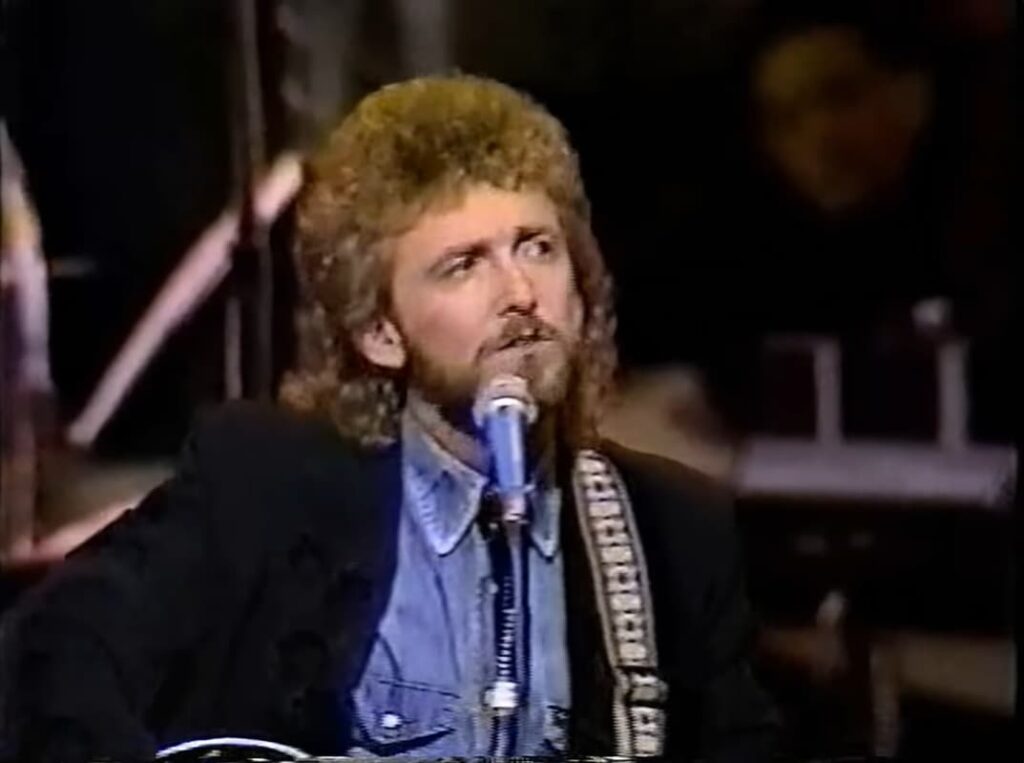
When Keith Whitley performed this song on the Opry stage for the first time, there was no need for dramatic embellishment. The power of the moment came from its sincerity. His voice, soft yet unmistakably expressive, carried a tremor of lived experience. There was something almost confessional in his delivery, as if each word had been carefully weighed before being allowed to fall into silence. Musically, “Don’t Close Your Eyes” embraces the hallmarks of the neotraditional country movement of the late 1980s—a return to clarity after years of crossover gloss. Steel guitar lines drift gently through the arrangement, while the rhythm remains steady and unobtrusive. Nothing competes with the vocal; everything serves it. And in that restraint, the song finds its strength.
What sets this piece apart is not just its melody, but its emotional precision. It does not exaggerate heartbreak, nor does it resolve it. Instead, it lingers in that delicate space between hope and resignation. The narrator does not demand love—he simply asks for honesty. That distinction gives the song a quiet dignity, one that resonates deeply with anyone who has ever felt the distance between two people sharing the same room.
The timing of its release is also significant. In 1988, country music was undergoing a subtle transformation. Artists like Randy Travis and George Strait were steering the genre back toward its roots, and Keith Whitley stood among them, though with a voice perhaps more fragile, more introspective. His rise was swift, but it carried with it an undercurrent of poignancy that would later define his legacy. There is, inevitably, a deeper layer to the song when viewed through the lens of Whitley’s life. His struggles, his sensitivity, his undeniable talent—all seem to converge within this performance. It is as though the song became a vessel for emotions that could not be easily spoken elsewhere. And that is perhaps why it feels so enduring: it is not merely sung, it is felt.
Listening today, one is struck not by nostalgia alone, but by recognition. The emotions remain unchanged, even as time moves forward. The need to be seen, to be chosen, to be present in someone else’s world—these are not bound to any era. As the final notes of “Don’t Close Your Eyes” fade, what remains is not resolution, but a question—quiet, persistent, and deeply human. And in that question lies the song’s lasting power, carried gently through the voice of Keith Whitley, echoing across years that have done little to soften its truth.