
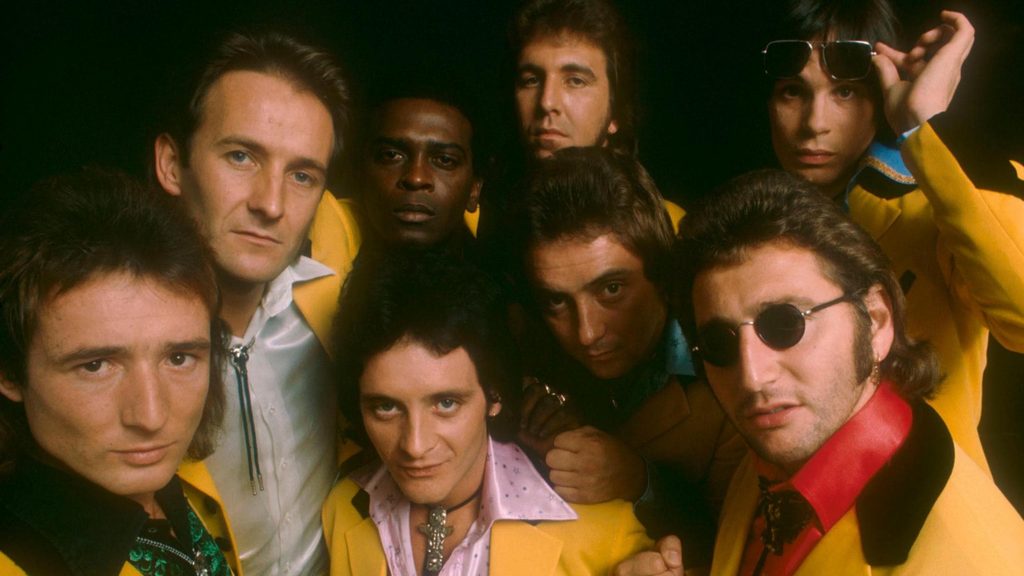
Sweet Music captures Showaddywaddy at their most joyful: a celebration of dancing, youthful energy, and the simple magic of rock and roll that could make an ordinary evening feel unforgettable.
Released on 7 February 1975 on the Bell label, “Sweet Music” arrived at a particularly important moment in Showaddywaddy’s early career. The British group had already announced themselves with “Hey Rock And Roll,” which reached No. 2 in the UK in 1974, followed by “Rock ’n’ Roll Lady” at No. 15 and “Hey Mister Christmas” at No. 13. Their new single therefore carried genuine expectations. When it first entered the UK Singles Chart, “Sweet Music” appeared at No. 44 on 22 February 1975, climbed steadily through the following weeks, and eventually reached No. 14, spending nine weeks on the chart. It also reached No. 12 in Ireland.
There is something especially charming about “Sweet Music” because it says almost exactly what its title promises. This is not a complicated song about heartbreak, regret, or the passing of time. It is about the moment when music takes over. The words invite people to dance, to move, to shout, and simply enjoy being alive. There is an innocence in that message that has become increasingly precious with the passing decades. The song does not ask the listener to analyze life. It asks the listener to put on their dancing shoes and let the music carry them away.
That spirit was perfectly suited to Showaddywaddy, a band whose identity was deeply connected with the rock and roll, rockabilly and doo wop sounds of the 1950s and early 1960s. Yet an important detail is sometimes overlooked. Although the group became famous for bringing older songs back to the charts, “Sweet Music” was an original Showaddywaddy composition. The songwriting was credited to the eight members of the group: Malcolm Allured, Dave Bartram, Romeo Challenger, Rod Deas, Russ Field, Buddy Gask, Al James and Trevor Oakes. Dave Bartram in particular was an important creative force within the band and later identified “Sweet Music” among the songs he had written.
The story behind the recording is perhaps even more interesting than the song itself. Dave Bartram later recalled that the band had been exceptionally excited after recording “Sweet Music.” They believed they had made something special and genuinely thought it might have a chance of reaching the top of the chart. But once producer Mike Hurst completed the final mix, Bartram felt that the finished recording had lost much of the excitement and magic the musicians had experienced in the studio. He described the disappointment as one of the reasons the group eventually began taking greater control of its own production.
That memory gives the record another dimension. On the surface, “Sweet Music” sounds carefree, almost effortlessly happy. Beneath that brightness was a band discovering that making a record was not always the same thing as capturing the feeling that existed in the studio. They were young, ambitious musicians who wanted their records to sound like the excitement they felt when they played together. The experience became part of their artistic education.
There was also a small but revealing story behind the decision to release it. In a later interview, Bartram explained that the record company had considered “Don’t Turn Your Back On Me Baby” as a possible single, but some members of the band were not satisfied with that choice. They instead recorded “Sweet Music,” believing it was one of their strongest songs.
In retrospect, their instinct was understandable. “Sweet Music” had the ingredients that made Showaddywaddy so appealing during the middle of the 1970s. The rhythm is direct, the chorus is immediately memorable, and the whole performance feels designed for a crowded dance floor. It carries the atmosphere of a Saturday night when nobody wanted the evening to end. The song is less about telling a story than creating a moment, and that distinction matters. Some songs remain memorable because of their lyrics. Others survive because of the feeling they create within seconds. “Sweet Music” belongs firmly to the second category.
The single later became part of the band’s second studio album, Step Two, released on 13 June 1975. That album reached No. 7 on the UK Albums Chart, an impressive result that confirmed Showaddywaddy were not simply a one hit curiosity. The album contained a mixture of original material and carefully chosen covers, with “Sweet Music” appearing alongside songs such as “Three Steps To Heaven,” “Chain Gang,” “Rave On,” and “Three Stars.”
Interestingly, the disappointment surrounding the production of “Sweet Music” did not last long. The band’s next single, their version of Eddie Cochran’s “Three Steps To Heaven,” rose all the way to No. 2 in Britain, matching the peak of their debut hit “Hey Rock And Roll.”
But perhaps the most enduring quality of “Sweet Music” is its sense of uncomplicated happiness. Listening to it now, one can almost picture the dance halls, television studios, crowded clubs and Saturday night gatherings where Showaddywaddy built their reputation. The song belongs to a time when a catchy melody, a strong rhythm and a room full of people willing to dance could be enough.
And that is why “Sweet Music” still feels warmer than its modest No. 14 chart peak might suggest. It was never merely another entry in the band’s long list of singles. It was a small declaration of what music meant to Showaddywaddy themselves: movement, friendship, excitement and escape. For a few minutes, the worries of everyday life could be left outside the door. The record simply said to turn up the music, step onto the floor and enjoy the moment.
Some songs remind us of a particular person. Some take us back to a particular year. “Sweet Music” does something slightly different. It reminds us of a feeling, the feeling of being young enough to believe that the night could go on forever, and that somewhere, beneath the noise and laughter, there would always be another song waiting to play.