
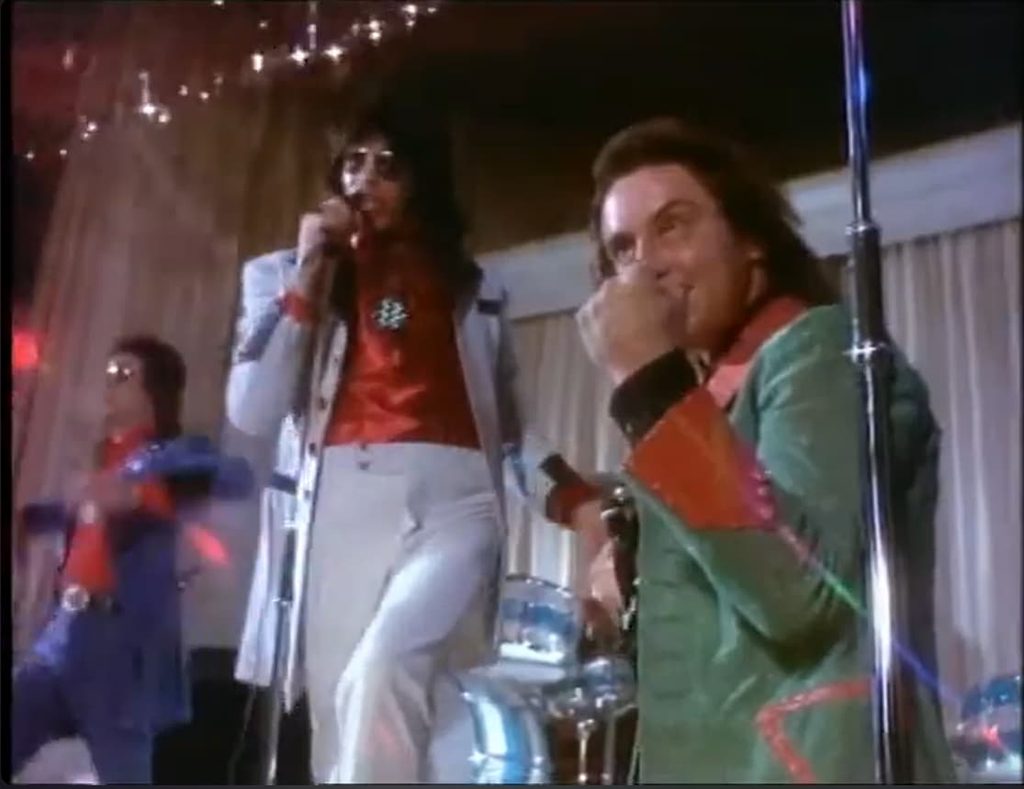
“The Party” captures Showaddywaddy in their purest form: a simple invitation to dance, forget the clock and let rock and roll turn an ordinary night into something worth remembering.
Unlike many of Showaddywaddy’s better known singles, “The Party” was never released as an A side, so it has no individual UK Singles Chart peak of its own. The song first appeared on the band’s self titled debut album, Showaddywaddy, released on 8 November 1974, an album that reached an impressive No. 9 on the UK Albums Chart. The following year, “The Party” was given a much larger spotlight when it became the B side of “Three Steps to Heaven,” released on 19 April 1975. That single reached No. 2 on the UK Singles Chart, giving “The Party” an unusual place in the band’s history: it was not itself a charting single, but it was attached to one of Showaddywaddy’s biggest records and became a regular part of their live performances. The official Showaddywaddy history also records that the song was performed on ITV’s The Geordie Scene on 30 September 1974, several weeks before the debut album appeared, making it an unusually visible album track for a new band.
There is a wonderfully straightforward quality to “The Party”, and perhaps that is exactly why it suits Showaddywaddy so well. From the opening count in, the song feels as though the musicians have simply thrown open the doors and invited everybody inside. There is no elaborate story and no complicated emotional argument. Instead, the lyrics celebrate the physical pleasure of rock and roll: dancing, moving, staying awake late into the night and allowing the rhythm to take over. The scene described in the song is almost wonderfully ordinary, with people dancing in the garden and filling the room until there is barely space left. Yet that simplicity is part of its charm. “The Party” is about those evenings when nobody particularly cares what time it is, when the music is good enough to keep everyone together and when a few hours of dancing can make the outside world seem pleasantly distant. It is the kind of subject Showaddywaddy understood instinctively because their entire musical identity was built around the communal pleasure of rock and roll.
The story behind the recording is also more interesting than the casual nature of the song might suggest. Although the composition was officially credited to all eight members of Showaddywaddy, the band’s own historical records explain that “The Party” was actually written by Trevor Oakes during his time with Choise, one of the two Leicester groups that eventually merged with The Golden Hammers to form Showaddywaddy. In other words, the song existed before the famous eight piece lineup had fully established itself. It was then remodelled for Showaddywaddy and brought into the group’s developing repertoire. That detail reveals something important about the band’s early years. Their sound was not created overnight for the record industry. It grew out of years of playing together, performing in clubs and refining songs that had already worked in front of a live audience. “The Party” therefore feels like a genuine product of the band’s club roots rather than a composition manufactured to fit a commercial formula.
The vocal on the original recording was handled by Bill Gask, with Romeo Challenger providing the memorable count in at the beginning, while Russ Field played lead guitar, Trevor Oakes rhythm guitar, Al James bass and Romeo Challenger drums. That lineup helps explain the directness of the recording. There is no need for an elaborate arrangement because the energy comes from the musicians themselves. The lead guitar gives the song its rock and roll edge, while the rhythm section keeps everything moving forward. Bill Gask’s vocal is particularly important because he gives the song a slightly rougher, more communal character than a polished pop vocal might have provided. It sounds less like someone delivering a carefully rehearsed studio performance and more like the singer is standing in the middle of the party, encouraging everyone else to join in.
What makes the history of “The Party” especially fascinating is how much attention the song received despite being only an album track. Before the debut album was even released, Showaddywaddy performed it on The Geordie Scene, alongside “Hey Rock And Roll” and “Rock ’n’ Roll Lady.” Then, in 1975, the band appeared in the Dejamus Productions television film Three For All, where they performed the song. On the accompanying soundtrack album, the track was titled “Rock ’n’ Roll Party.” By the time “Three Steps to Heaven” arrived as a single in April 1975, “The Party” had already become a familiar part of the group’s repertoire, making its appearance as the B side feel rather natural. The band continued performing it live during this period, and the song eventually disappeared from their regular set for nearly five decades before being brought back in January 2023.
That long absence makes the song’s return especially touching. A piece of music that had belonged to Showaddywaddy’s earliest years was suddenly brought back almost fifty years later. There is something fitting about that because “The Party” itself is essentially a song about preserving a moment of happiness. It does not concern itself with what happens tomorrow. Its entire purpose is to keep the night going for a little longer. In that sense, the song contains the philosophy of rock and roll in miniature. The music is temporary, the party eventually ends, and everyone eventually goes home, but while the song is playing, nobody needs to think about that ending. You simply dance.
This was also the atmosphere that helped make Showaddywaddy so distinctive during their extraordinary rise in the mid 1970s. Their breakthrough single “Hey Rock And Roll” had reached No. 2 in Britain in 1974, and the debut album followed with its own Top 10 success. Then came “Three Steps to Heaven,” another No. 2 hit, before the group eventually reached the summit with “Under the Moon of Love” in 1976. But songs such as “The Party” help us understand what existed underneath those chart successes. Before the television appearances, before the glamorous costumes and before the records were climbing the charts, there was a band that knew how to entertain a room. They understood that rock and roll was not merely a style of music. It was something physical and communal. It belonged to dancers as much as it belonged to singers and guitarists.
That is perhaps why “The Party” feels so nostalgic today. It does not describe a spectacular event. It describes something much more familiar: a crowded room, music playing loudly, people laughing, dancing and refusing to let the evening finish. There is no grand statement about youth or nostalgia in the lyrics. The song simply lives inside the moment. Yet when heard decades later, that very simplicity becomes emotional. The party may have ended, the people who once danced to it may have changed, and the room itself may no longer exist, but the recording preserves the feeling.
And that is one of the quiet powers of Showaddywaddy. Their best songs could make happiness sound uncomplicated. “The Party” does exactly that. It takes the most basic promise of rock and roll, that music can make people move and bring them together, and turns it into a small musical photograph of a night that refuses to end. It was never a No. 1 single, and it never needed to be. Its place in the band’s history comes from something more intimate. It was there at the beginning, on their first album, on television, on the B side of a No. 2 hit and eventually back on stage nearly half a century later. For a song about keeping the music going, there could hardly be a more fitting story.