
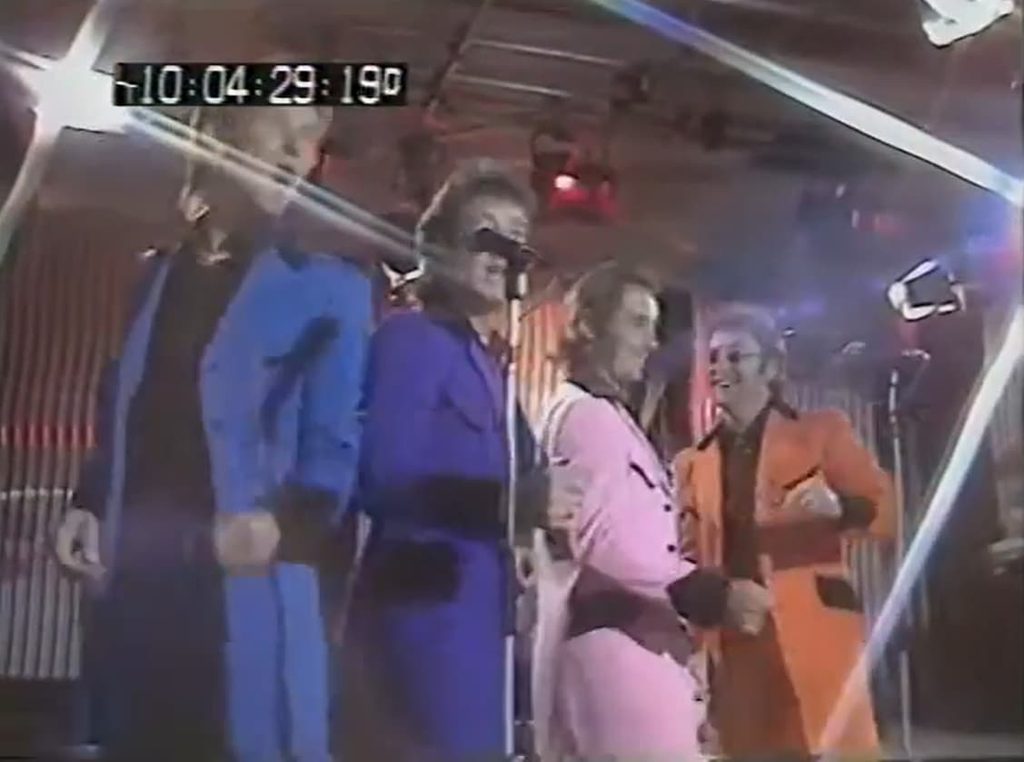
“Always and Ever” captured Showaddywaddy at a fascinating turning point, when the sound of rock and roll nostalgia was beginning to meet the changing musical world of 1980.
On May 23, 1980, Showaddywaddy appeared on BBC1’s daytime programme Pebble Mill at One and performed “Always and Ever.” The group also performed “Three Steps to Heaven” during the same broadcast, giving viewers a reminder of the musical identity that had made Showaddywaddy one of Britain’s most successful chart acts of the 1970s. Contemporary television listings confirm both performances, while surviving footage has preserved the appearance as a vivid snapshot of the band during a period of transition.
There is something particularly interesting about this performance because “Always and Ever” was not one of Showaddywaddy’s great chart successes. In fact, the single, released on April 18, 1980, became the band’s first single since 1976 to miss the UK Singles Chart. The official Showaddywaddy website confirms that the record was backed with “Cool Cool Cat” and notes that, despite the band performing the song on several television programmes and recording a promotional video, it failed to gain the chart momentum that had once seemed almost automatic for them.
That fact gives the Pebble Mill at One performance an emotional dimension that is easy to miss at first glance. Here was a band that had spent much of the previous decade enjoying extraordinary success. Showaddywaddy had become one of Britain’s defining revival groups, bringing the sound, style, harmonies, and theatrical energy of 1950s rock and roll back into the British charts. They were not simply another nostalgia act. During their most successful years, they had managed to turn the music of an earlier generation into something that felt exciting again for a new audience.
Their rise had been spectacular. Songs such as “Under the Moon of Love,” “Three Steps to Heaven,” “Hey Rock and Roll,” “I Wonder Why,” “A Little Bit of Soap,” and “Pretty Little Angel Eyes” made Showaddywaddy one of the most familiar names on British radio and television. Their 1978 compilation album Greatest Hits 1976 to 1978 even reached No. 1 on the UK Albums Chart, a remarkable achievement for a group whose sound was rooted so deeply in the golden age of American rock and roll.
But by 1980, the musical landscape was changing rapidly. Punk had already challenged the polished traditions of mainstream pop. New Wave was moving forward with sharper sounds and a different visual identity. Electronic music was beginning to reshape the possibilities of pop production. Disco was still present, although its dominance was beginning to fade. Against this constantly shifting background, a group dressed in the style of an earlier rock and roll era faced an increasingly difficult challenge. The question was no longer whether Showaddywaddy could perform the old sound brilliantly. They had already proved that many times. The question was whether audiences still wanted to buy it.
“Always and Ever” arrived at precisely that uncertain moment. Released as a single in April 1980, the song was written by Ralph Ruvin and was produced by Showaddywaddy themselves. It later appeared on the group’s album Bright Lights, released on December 1, 1980, which reached No. 33 on the UK Albums Chart. The single itself did not enter the British chart, although it achieved a modest success in West Germany, reaching No. 47 there.
For a band accustomed to regular chart appearances, the disappointment must have been significant. Their previous singles had still been charting in Britain. “Sweet Little Rock ’n’ Roller” reached No. 15 in 1979, while “A Night at Daddy Gee’s” reached No. 39 later that year. But “Always and Ever” suddenly broke a remarkable run. The official band history describes it as their first single not to chart since 1976, even though the group continued to promote it on television.
And perhaps that is exactly why the footage from Pebble Mill at One has become so fascinating with the passing of time. Watching Showaddywaddy perform “Always and Ever” on May 23, 1980, there is no visible sense of defeat. The group still performs with the confidence that had made them famous. The familiar stage presentation remains. The vocal harmonies are carefully arranged. The energy is there. Their appearance still carries the unmistakable visual character that separated Showaddywaddy from almost every other British group of their era. They had always understood that rock and roll was not merely something to hear. It was something to see.
That was one of the secrets of their success. Showaddywaddy were a large group, and their stage identity was built around the contrast and cooperation of multiple personalities. Their performances had a sense of movement and theatre, yet they never lost sight of the songs themselves. Whether performing a classic from the 1950s or a newer composition, they understood the importance of melody, harmony, rhythm, and the simple excitement of a great chorus.
“Always and Ever” fits into that tradition, although it carries a slightly different feeling from some of the band’s biggest hits. The title itself suggests permanence and devotion. There is a romantic innocence to the song that connects naturally with the music Showaddywaddy had spent years celebrating. Their greatest recordings often looked back toward an era when pop songs could tell a love story in three minutes without embarrassment or irony. There was no need for emotional complexity to make a song meaningful. Sometimes a promise of love was enough. Yet by 1980, that kind of straightforward romantic optimism was beginning to sound increasingly connected to another time.
That does not mean “Always and Ever” had become irrelevant. In some ways, its failure to chart makes it more interesting today. Hit records are remembered because millions of people bought them. Songs that disappeared from the charts often survive for another reason: they reveal something about the artist at a particular moment. “Always and Ever” captures Showaddywaddy between two worlds. Behind them stood the extraordinary success of the late 1970s. Ahead of them was an uncertain new decade in which musical fashions would change faster than almost anyone could predict.
The performance on Pebble Mill at One therefore feels like more than a simple television appearance. It preserves the group during a moment when they were still actively fighting for their place in the changing British pop scene. The programme itself was an unusual setting for a band like Showaddywaddy. Pebble Mill at One was a live BBC1 lunchtime programme broadcast from the Pebble Mill Studios in Birmingham, mixing interviews, music, entertainment, and features for a daytime audience. For a popular group, an appearance on the programme offered valuable national exposure outside the familiar world of Top of the Pops. On May 23, 1980, Showaddywaddy used that opportunity to perform both the new single “Always and Ever” and the much more familiar “Three Steps to Heaven.”
The pairing of those two songs says a great deal about where the band stood at the time. “Three Steps to Heaven” represented the Showaddywaddy audiences already knew and loved. Their 1975 recording of the Eddie Cochran classic had reached No. 2 on the UK Singles Chart, becoming one of their biggest hits. It belonged to the glorious period when the group seemed able to take the sound of the 1950s and send it racing back into the charts.
“Always and Ever,” meanwhile, represented the band trying to move forward. It was a newer song, released in 1980 and intended to become part of the next chapter of the Showaddywaddy story. The problem was not that the band had forgotten how to perform. The problem was that the world around them had changed. Music history is full of artists who discover that talent and hard work cannot always defeat changing public taste. A song can be well recorded, carefully promoted, performed on television, and still fail to find an audience at the moment it is released.
Showaddywaddy experienced that reality with “Always and Ever.” Yet their story did not end there. Later in 1980, they returned to the UK Singles Chart with “Why Do Lovers Break Each Other’s Hearts?”, which reached No. 22, followed by “Blue Moon,” which reached No. 32. Their career would continue through the decade, although the extraordinary run of major hits from the 1970s would never return in quite the same form.
Looking back now, however, the value of “Always and Ever” has little to do with whether it reached the Top 40. The surviving performance from May 23, 1980 has become a small window into a vanished world of British television and popular music. There is something wonderfully immediate about seeing a band perform a current single on daytime BBC television, without the endless editing, digital effects, and polished machinery that would later dominate music broadcasting. The performance belongs to a time when a television appearance could become part of a song’s life, when artists travelled from studio to studio promoting a new record, hoping that somewhere in the audience a listener might hear the chorus and decide to buy the single.
For Showaddywaddy, that day at Pebble Mill was another chapter in a career already filled with remarkable memories. They had known No. 1 records, sold out concerts, gold and silver records, and the extraordinary experience of hearing their songs played across Britain. But “Always and Ever” reminds us that even successful careers have quieter moments, songs that did not become hits, and performances that only grow more valuable with time. Perhaps that is why this particular footage feels so nostalgic today.We are not watching a band at the peak of a chart triumph. We are watching artists continuing to do what they had always done: standing together, singing, performing, and believing in the next song. The record may have missed the UK chart, but the performance survived.
And sometimes, decades later, survival becomes its own kind of success. Showaddywaddy’s “Always and Ever” on Pebble Mill at One remains a beautiful reminder of a band that carried the spirit of rock and roll through changing times, still dressed for the dance, still singing with energy, and still believing that somewhere, someone might be listening.