
“From Here to the Moon and Back” is Dolly Parton’s promise of a love so enduring that ordinary words are simply not enough to measure it.
Some love songs speak about passion, heartbreak, or the uncertainty of romance. “From Here to the Moon and Back” speaks about something quieter and perhaps more difficult to explain: love that remains. Written by Dolly Parton, the song first appeared in 2012 on the soundtrack to the film Joyful Noise, where Dolly performed it with Kris Kristofferson and Jeremy Jordan. Released as a single on July 6, 2012, the recording reached No. 2 on Billboard’s Christian Digital Song Sales chart and No. 2 on the Gospel Digital Song Sales chart, giving this gentle ballad a strong chart presence despite never being designed as a conventional pop or country radio hit.
The song later found an even more intimate life. In 2013, Dolly re recorded “From Here to the Moon and Back” as a duet with Willie Nelson for his album To All the Girls…. Their version was released as part of the album’s first single campaign and later appeared on Dolly’s 2014 album Blue Smoke. The meeting of their voices gave the song a completely different emotional colour. Willie’s weathered, unhurried phrasing and Dolly’s clear, expressive voice did not compete with one another. Instead, they sounded like two people who had travelled long enough to understand what it means to promise someone that love will endure.
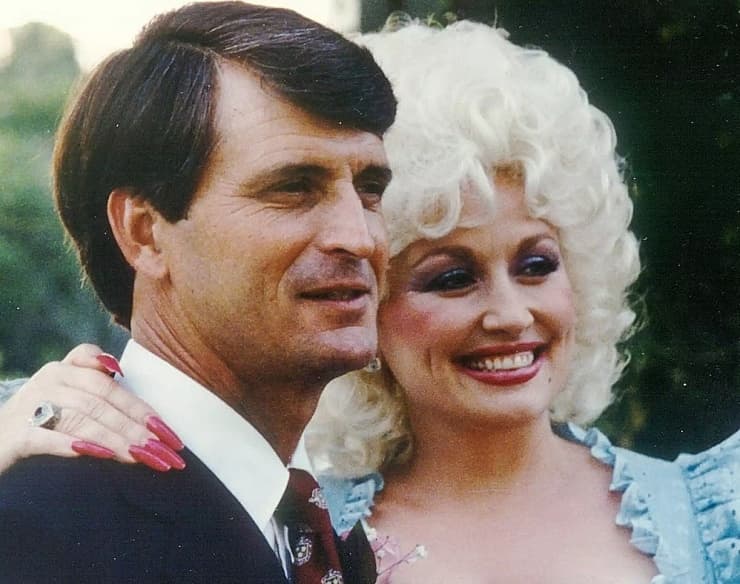
The story behind the song is particularly touching because Dolly later revealed that “From Here to the Moon and Back” was very much based on her husband, Carl Dean. In her 2020 book Songteller: My Life in Lyrics, she explained the personal inspiration behind it, giving listeners a deeper understanding of a song that had always sounded unusually sincere.
For decades, Dolly Parton and Carl Dean represented one of the most private relationships in the world of entertainment. While Dolly became internationally famous, Carl remained largely outside the spotlight. Their marriage was rarely turned into a public spectacle, and perhaps that privacy helped preserve something that the song captures beautifully: love does not need an audience to be real. It does not have to announce itself every day. Sometimes it exists quietly through the years, growing stronger because it has survived ordinary life, difficult moments, distance, laughter, arguments, and the countless small days that eventually become a lifetime.
That is the emotional heart of “From Here to the Moon and Back.” The title itself uses an image that sounds almost childlike in its simplicity. We often speak about loving someone “to the moon and back” because there is no practical way to measure the depth of such feeling. Dolly takes that familiar expression and turns it into a promise. The central question is not whether love is perfect. It is whether there is anyone else in the world who could possibly love this person with the same devotion.
Musically, the song is built around that restraint. Dolly did not write it as a dramatic showpiece filled with enormous vocal climaxes. Instead, the melody allows the words to carry the emotional weight. The arrangement leaves space around the voices, making the song feel almost like a conversation between two people who no longer need to impress each other. When Willie Nelson joins Dolly in the 2013 recording, the song gains another layer of meaning. Both artists had spent their lives singing about love, loss, loneliness, and the passing of time. Their voices carried history. Neither singer needed to force the emotion because experience had already placed it there.
The original 2012 version from Joyful Noise is also significant because of the unusual combination of voices. Dolly Parton, Kris Kristofferson, and Jeremy Jordan represented different generations and different musical backgrounds, yet the song remained rooted in Dolly’s unmistakable style as a songwriter. She has always possessed a remarkable ability to write in plain language without making her emotions feel simple. The words of “From Here to the Moon and Back” are easy to understand, but their meaning grows deeper with each passing year. There is no complicated philosophy hidden inside the song. Dolly Parton is simply writing about the kind of love that asks for nothing except the chance to remain.
That may be why the song feels especially moving when considered alongside Dolly’s long career. She wrote some of country music’s greatest songs about jealousy, separation, regret, poverty, family, and independence. “Jolene” gave us insecurity. “I Will Always Love You” gave us farewell. “Coat of Many Colors” gave us memory and family. But “From Here to the Moon and Back” belongs to another emotional place. It is about staying. The song became particularly meaningful because Dolly’s marriage to Carl Dean lasted through a lifetime that changed almost everything around them. Fame arrived. Success became enormous. The music industry changed again and again. Yet their relationship remained one of the few things Dolly kept deliberately away from the machinery of celebrity.
In that sense, “From Here to the Moon and Back” sounds less like a typical love song and more like a private letter that somehow found its way into the public world. The Willie Nelson version adds a beautiful final dimension to that idea. Willie and Dolly were not portraying the excitement of new love. Their voices suggest something more mature and enduring. They sound like people who understand that time is the true test of devotion. Grand promises are easy when life is beginning. They become more meaningful after years have passed.
That is why the song’s simple promise remains its most powerful idea. To love someone from here to the moon and back is not really about distance. It is about saying that even the largest distance we can imagine is still not enough to describe how far love is willing to travel. “From Here to the Moon and Back” may not be one of Dolly Parton’s most famous songs, but it is one of her most revealing. Beneath the glitter, the humour, the enormous career, and the public legend was a songwriter who understood that the deepest love stories are often lived quietly. And sometimes the most powerful love song is simply the one that says: I am still here, and my love is still travelling with you.