
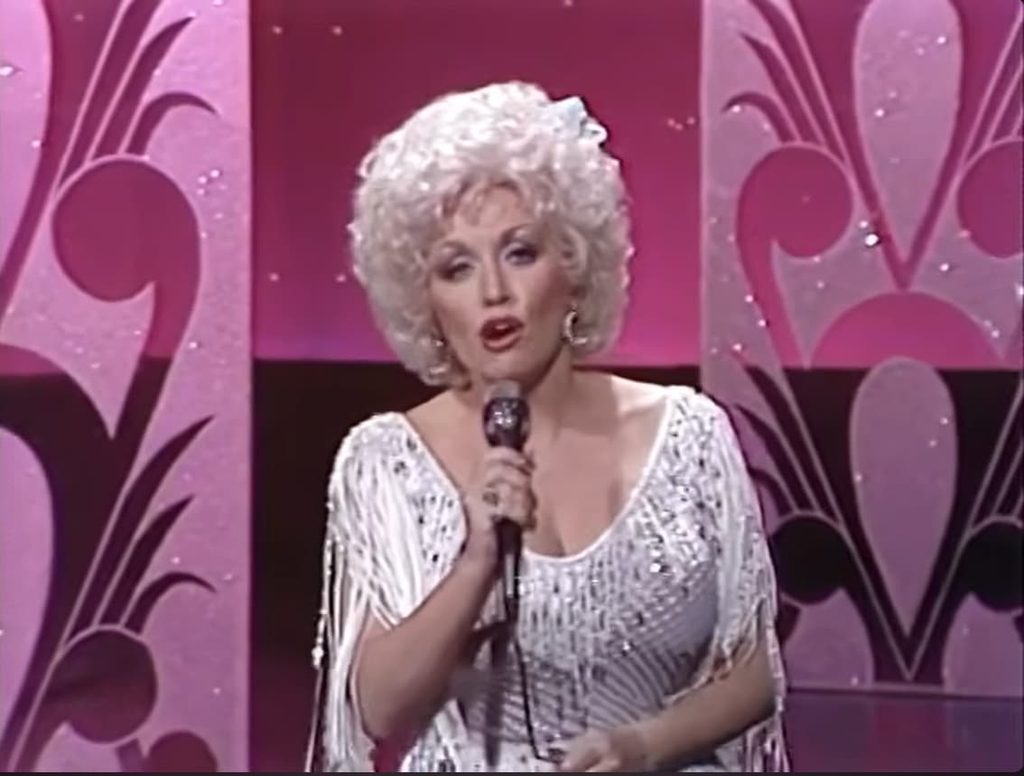
Dolly Parton brought a centuries old song of regret and ruin to late night television, transforming “The House of the Rising Sun” into a dramatic country performance filled with darkness, power, and unmistakable individuality.
On November 18, 1980, Dolly Parton appeared on The Tonight Show Starring Johnny Carson, one of the most important stages in American television. The date placed her at a remarkable moment in her career. Her new album, 9 to 5 and Odd Jobs, had been released only one day earlier, on November 17, and Dolly was entering a period that would soon take her beyond country music and into the very centre of American popular culture. The album would reach No. 1 on Billboard’s Top Country Albums chart and No. 11 on the Billboard 200, while its title song, “9 to 5,” would become one of the biggest records of her entire career, eventually reaching No. 1 on the Billboard Hot 100, Hot Country Songs, and Adult Contemporary charts. Yet on that November evening, Dolly chose to reveal another side of the album by performing “The House of the Rising Sun,” a song with a history stretching back long before rock and roll, country music, or even the recording industry itself.
“The House of the Rising Sun” is a traditional American folk song whose origins are difficult to trace with certainty. Over the years, it has been sung by countless artists and reshaped to suit different generations. For many listeners, the song became permanently associated with The Animals, whose electrifying 1964 version reached No. 1 in both the United States and the United Kingdom. But Dolly Parton approached the song from a completely different direction. Her version was not an attempt to recreate the dark rock drama of Eric Burdon and The Animals. Instead, she brought the story back toward its folk and country roots, turning it into something more personal and theatrical.
The song tells of a life destroyed by the mysterious “House of the Rising Sun” in New Orleans. Depending on the version, the narrator may be a woman whose life has been ruined or a man looking back on the mistakes that led him toward suffering. That uncertainty has always been part of the song’s power. The Rising Sun is never fully explained, and perhaps it does not need to be. It becomes a symbol of temptation, bad decisions, poverty, sin, and the terrible knowledge that sometimes a person understands the consequences of a choice only after it is too late. The song has survived for generations because its central emotion remains painfully familiar: regret.
Dolly’s recording appeared as the third track on 9 to 5 and Odd Jobs, an album that was far more musically varied than its famous title song might suggest. While “9 to 5” was bright, energetic, and filled with the determination of working people, “The House of the Rising Sun” travelled in the opposite direction. It was shadowy and dramatic. The arrangement was credited to Dolly Parton and Mike Post, and the recording featured an impressive group of musicians, including Larry Carlton on guitar, John Goux on slide guitar, Eddie Bayers on drums, Leland Sklar on bass, Joe McGuffee on steel guitar, Ron Oates on keyboards, and Anita Ball, Joey Scarbury, and Richard Dennison on background vocals. The result was a country interpretation with a broad, almost cinematic atmosphere.
Her appearance on The Tonight Show is especially fascinating because Dolly was standing at the beginning of one of the most transformative chapters of her career. “9 to 5” had been released as a single on November 3, 1980, only two weeks before the television appearance. At that point, its enormous success was still ahead of her. The single would enter Billboard’s country chart at No. 47 on November 29, eventually reaching No. 1 in January 1981 before also conquering the pop and Adult Contemporary charts. Dolly was about to become a major movie star through the film 9 to 5, alongside Jane Fonda and Lily Tomlin, and her music was reaching audiences who had never previously considered themselves country fans.
Yet instead of using the moment simply to perform the cheerful new hit that would soon be heard everywhere, she brought a traditional song of darkness and sorrow to Johnny Carson’s stage. That choice said something important about Dolly Parton as an artist. Beneath the rhinestones, humour, and dazzling public personality was a musician deeply connected to old songs and traditional storytelling. She had grown up surrounded by Appalachian music, where songs were often passed from one voice to another and where stories of loss, hardship, love, and death could survive for generations. “The House of the Rising Sun” belonged naturally to that world.
Dolly’s version would later become a single in its own right in 1981, and although it did not reach the heights of “9 to 5,” it became another successful country record. It peaked at No. 14 on Billboard’s Hot Country Songs chart, while also reaching No. 77 on the Billboard Hot 100 and No. 30 on the Adult Contemporary chart. Those positions are particularly interesting because they show that even in the middle of her greatest crossover period, Dolly could still take a dark traditional song and bring it onto the country charts.
Looking back at the November 18, 1980 performance, what makes it memorable is the contrast between the song and the moment in Dolly’s life. She was standing on the edge of enormous mainstream success. Within months, “9 to 5” would become an anthem, the film would make her a major Hollywood star, and Dolly Parton would become one of the most recognisable entertainers in America. But here she was, singing about regret, lost lives, and a house in New Orleans that had brought sorrow to generations.
Perhaps that is why “The House of the Rising Sun” suited Dolly Parton so unexpectedly well. She understood that beneath the brightness of popular music, there is always another world where songs carry darker memories. Her voice had the ability to sound warm and comforting, but it could also carry the weight of a story that had travelled through time. On The Tonight Show, she did not merely perform an old folk song. She reminded audiences that the oldest songs often survive because they understand something about human life that newer songs are still trying to explain.