
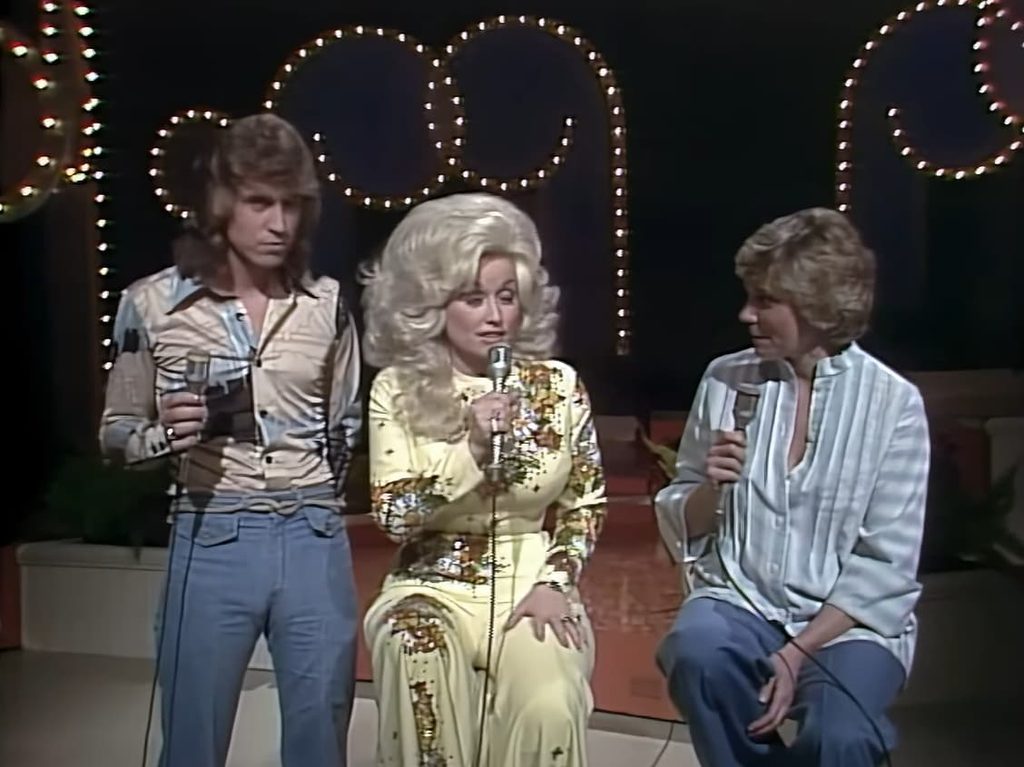
DOLLY, RANDY & ANNE MURRAY: A BEAUTIFUL 1976 MOMENT WHEN FAMILY AND FRIENDSHIP MET ON DOLLY’S FIRST TELEVISION SHOW
There is something wonderfully unpolished and intimate about watching Dolly Parton, her younger brother Randy Parton, and Anne Murray singing together in 1976. Dolly was already a major country star by then, but her television series Dolly gave her an opportunity to show audiences something beyond the polished image of a successful recording artist. In the episode featuring Anne Murray and Randy, the three came together for “Drift Away,” while they also performed Dolly’s “All I Can Do.” Randy was given his own moment with “Tennessee Born,” making the program an especially interesting snapshot of the Parton family at a time when Dolly’s career was rapidly expanding. The episode is listed as having originally aired in Nashville on September 20, 1976, although the syndicated series circulated through different stations and schedules.
The choice of “Drift Away” was particularly fitting. Written by Mentor Williams, the song had already become a major hit for Dobie Gray in 1973, reaching No. 5 on the Billboard Hot 100. By 1976, it had become familiar enough to invite different interpretations, and Dolly, Randy and Anne approached it from a distinctly country perspective. Their voices do not sound as though they are competing for the spotlight. Instead, the performance has the relaxed quality of musicians enjoying one another’s company. There is a little roughness around the edges, but that is part of its charm. This is television from an era when a song could breathe without being polished into oblivion.
For Randy Parton, the appearance is especially valuable because it allows viewers to see him not simply as Dolly’s younger brother, but as a musician with a voice and identity of his own. He performs “Tennessee Born” by himself during the episode, while Dolly and Anne join him for the group numbers. The program therefore moves naturally between Randy as a solo performer and Randy as part of the family ensemble. That balance matters when looking back at the Parton family story. Dolly became the international star, but music was never hers alone. Her brothers and sisters were part of the musical environment in which she grew up, and Randy would continue working as a musician and songwriter throughout his life.
Then there is Anne Murray, whose presence gives the performance another layer. By 1976, the Canadian singer had already established herself as one of North America’s most successful country-pop artists, with hits that crossed comfortably between country and adult contemporary audiences. On Dolly’s program, however, she was not treated as a distant superstar. She was simply another singer joining Dolly and Randy around the microphone. The episode also included Murray performing “Blue Finger Lou” and “Golden Oldie,” while Dolly opened with “Let Me Be There” and “The Battle of New Orleans.” It was precisely the kind of variety that made the series distinctive.
The series itself was an ambitious project for Dolly. Dolly began in first-run syndication in September 1976 and brought together an unusually wide range of guests, from Kenny Rogers and Ronnie Milsap to Emmylou Harris, Linda Ronstadt, Rod McKuen and the Hues Corporation. Dolly was already successful enough to headline her own television program, yet the format allowed her to move easily between country, pop, gospel, comedy and family material. The Anne Murray and Randy Parton episode is one of the clearest examples of that mixture. It feels like a television variety show, but there is also a family-room quality underneath it.
And that is what makes this little performance so precious today. Dolly is the star, Anne is the celebrated guest, and Randy is Dolly’s brother, but for the length of “Drift Away,” those distinctions become less important. Three singers simply share a song. There is no attempt to turn the moment into a grand historical event. It is a small piece of 1976 television, preserved from a period when Dolly was still close enough to the beginning of her own television era to bring family into the spotlight naturally. Watching Randy stand beside his sister and Anne Murray, it feels less like a carefully constructed piece of country history and more like finding an old photograph in a family album, except this photograph happens to sing.