
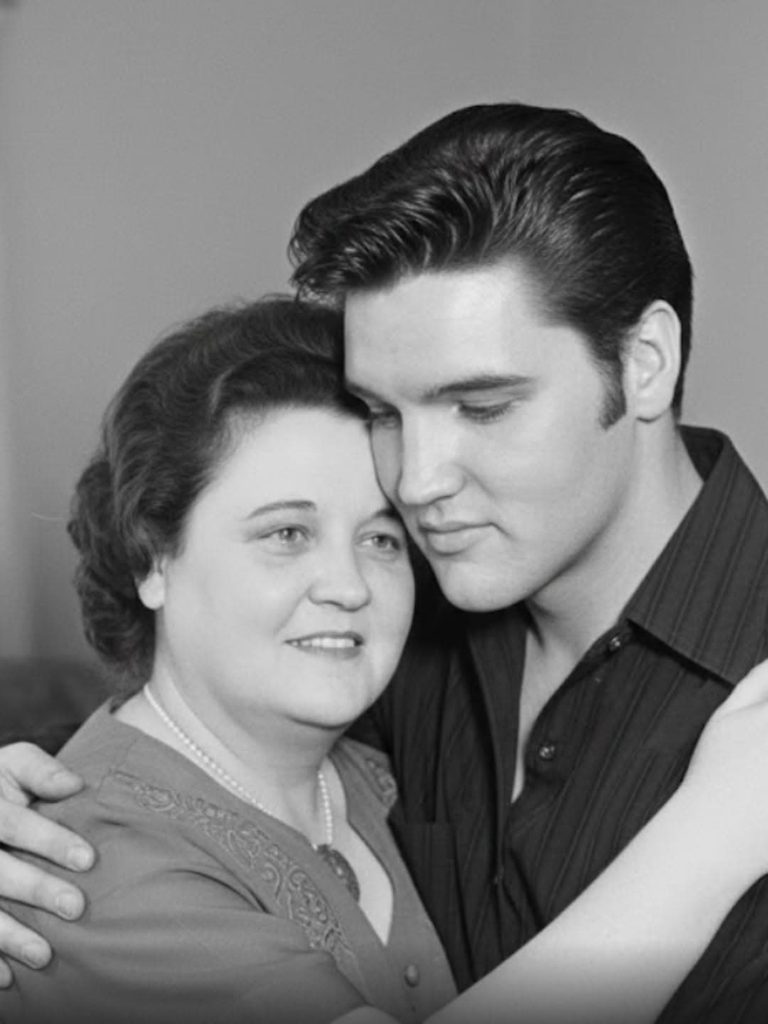
BEFORE THERE WAS “ELVIS THE KING,” THERE WAS JUST A YOUNG MAN SINGING “MY HAPPINESS” FOR HIS MOTHER
On a summer day in July 1953, an 18-year-old Elvis Presley walked into the Memphis Recording Service at Sun Records and spent his own money to make a private recording. The song he chose was “My Happiness,” a sentimental 1948 popular standard written by Betty Peterson and Borney Bergantine. Elvis accompanied himself on guitar, singing without the band, without a producer shaping his sound and without any idea that the little acetate he was making would eventually become one of the most famous first recordings in popular music history. This was not his professional debut. It was something much more personal: the first surviving recording that allows us to hear Elvis before the world knew his name.
The story becomes even more poignant because Elvis recorded “My Happiness” together with “That’s When Your Heartaches Begin” on the same acetate. According to the official Elvis Presley archive, these were among the four songs he paid to record himself before signing with Sun. The second pair, “I’ll Never Stand in Your Way” and “It Wouldn’t Be the Same (Without You),” followed on January 4, 1954. The July 1953 session therefore occupies a remarkable place in his story. Elvis was essentially testing himself, hearing his own voice preserved on a record and perhaps wondering what that voice might become. There was no Scotty Moore, no Bill Black, no Sam Phillips and no rock ’n’ roll revolution yet. There was simply Elvis and a guitar.
The recording has often been associated with the idea that Elvis made it specifically as a birthday gift for his mother, Gladys Presley. The official Elvis site describes it as the first demo acetate he made as a gift for his mother, while its historical account confirms that he paid for the private recording himself. The famous original acetate eventually became a remarkable piece of Elvis history. Decades later, it was purchased at auction by Jack White, and in 2015 the one-of-a-kind disc was digitally transferred at the Country Music Hall of Fame. That process allowed modern listeners to hear this fragile document from 1953 without turning it into something it never was.
What is striking when listening to “My Happiness” is how far the voice still is from the explosive sound that would emerge one year later. There is no swagger here, no aggressive rhythm, no rockabilly pulse. Elvis sings the melody with the tenderness of a young man drawn to the kind of pop and country ballads he had grown up hearing. His voice already carries a distinctive softness and emotional directness, but the revolutionary performer is still hidden inside it. That makes the recording fascinating. We know what Elvis will become, but the teenager behind the microphone does not. He has not yet discovered the combination of blues, country and rhythm and blues that will change popular music.
Less than a year later, everything would change. On July 5, 1954, Elvis returned to Sun for the session that produced “That’s All Right,” with Scotty Moore and Bill Black. The Library of Congress recognizes the Sun recordings of 1954 and 1955 as recordings that helped launch Elvis’s career and the rock ’n’ roll era. The official Elvis archive likewise describes that July 1954 session as the beginning of his professional recording career. The distance between the quiet “My Happiness” acetate of 1953 and the startling energy of “That’s All Right” is almost impossible to overstate.
And that is why “My Happiness” remains so precious. It is not famous because it was a hit. It was never released as a commercial single during Elvis’s lifetime, and it contains none of the spectacle that would eventually surround him. Its importance is much more intimate. It preserves Elvis before the leather jackets, television appearances, screaming crowds, Hollywood, Las Vegas and the mythology. Before all of that, there was an 18-year-old boy in Memphis, holding a guitar, singing an old love song into a microphone and paying for two songs to be captured on a piece of acetate. For a few minutes, the future King was simply Elvis Presley, a young man with a voice and a dream that nobody else could yet hear coming.