
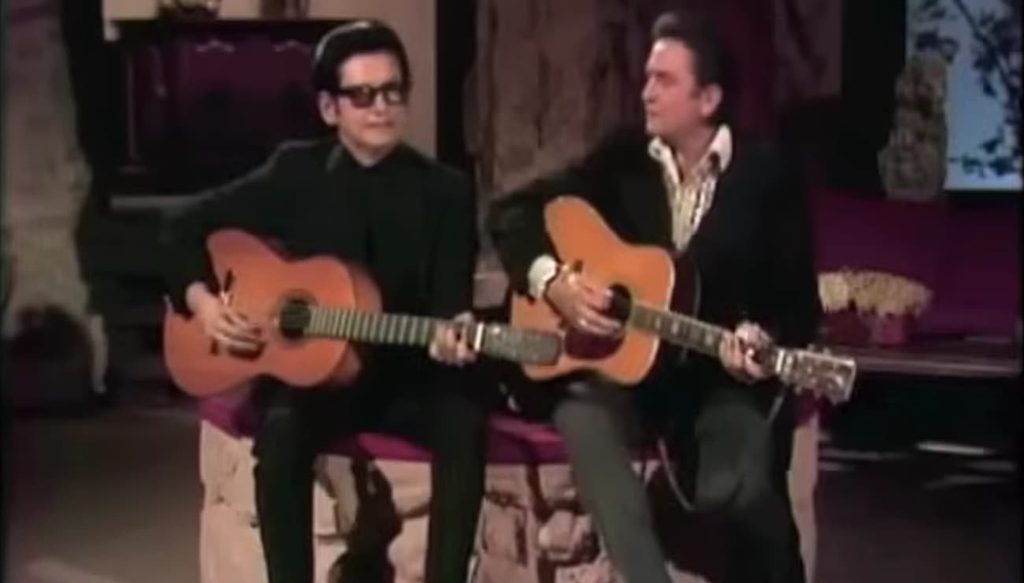
When Two Old Friends From The Memphis Music Scene Shared The Stage For A Remarkable Television Performance
On 27 September 1969, American television captured a meeting between two extraordinary voices when Roy Orbison and Johnny Cash stood together on The Johnny Cash Show to perform “Oh, Pretty Woman.” The episode, the 15th installment of the first season, also featured Creedence Clearwater Revival and Phil Harris, but the meeting between Orbison and Cash carried a special significance. Orbison first appeared on the program with “Crying,” before Cash joined him for “Oh, Pretty Woman,” turning one of Orbison’s most recognizable songs into a warm encounter between two artists whose careers had crossed paths long before either became a household name.
The song itself had already become a phenomenon. Orbison and Bill Dees wrote “Oh, Pretty Woman”, and Orbison released it in 1964. The record became his defining international hit, reaching No. 1 on the Billboard Hot 100 and spending three weeks at the top of the UK Singles Chart. Its famous opening guitar figure, sudden rhythmic energy and Orbison’s dramatic vocal made it unlike the sorrowful ballads for which he was also famous. By the time he appeared on Cash’s program in 1969, however, the song had already become part of the fabric of popular music. Performing it again was not about proving that it was a hit. It was about allowing the song to live in a completely different setting.
There was history between the two men that made the duet more meaningful. Roy Orbison and Johnny Cash had known each other since the 1950s, and both were connected to the extraordinary musical world surrounding Sun Records in Memphis. Orbison had recorded for Sun before moving to Monument Records, while Cash had become one of Sun’s foundational stars. Decades later, both would also be associated with the celebrated Class of ’55 sessions alongside Carl Perkins and Jerry Lee Lewis. Roy Orbison’s official website specifically recalls that Cash joined Orbison on “Oh, Pretty Woman” for The Johnny Cash Show, while noting their connection stretching back to the early days of their careers.
What makes the television performance so enjoyable is that Cash does not attempt to turn the song into another Johnny Cash recording. Orbison remains at the center, delivering the melody with that unmistakable voice, while Cash contributes his darker, conversational presence. It creates a fascinating contrast. Orbison’s voice could climb from a quiet, almost intimate delivery into those soaring notes that became his trademark, while Cash brought the grounded authority of a country storyteller. The result feels less like two singers competing for the spotlight and more like two friends enjoying a song they already knew inside out. The surviving performance is also remarkably brief and spontaneous, which gives it a quality that polished modern television performances sometimes lack.
The timing of the appearance is worth remembering too. 1969 was a remarkable year for Roy Orbison. The previous decade had established him as one of the most distinctive figures in popular music through songs such as “Only the Lonely,” “Crying,” “In Dreams,” “Running Scared,” “It’s Over” and “Oh, Pretty Woman.” But the late 1960s had brought enormous personal tragedy. In 1968, Orbison lost his wife Claudette in a motorcycle accident, and later that year a house fire killed two of his three sons. Yet he continued recording and performing. In that context, seeing him walk onto Cash’s stage in 1969 carries an additional layer of poignancy, even though the program itself remains light and musical rather than explicitly somber.
For Johnny Cash, The Johnny Cash Show represented another remarkable chapter. The ABC series premiered in June 1969 and was filmed at the Ryman Auditorium in Nashville, bringing country music together with rock, folk, gospel and mainstream popular artists. Guests ranged from Bob Dylan and Joni Mitchell to Ray Charles, Neil Young, Louis Armstrong and many others. Orbison’s appearance fit perfectly into Cash’s philosophy of inviting artists he respected rather than restricting the program to one narrow definition of country music.
There is something particularly satisfying about watching the performance now. “Oh, Pretty Woman” is usually remembered as Roy Orbison’s song, but on this night it became a small meeting point between two worlds. One man represented the operatic emotional intensity of rock and pop, the other the deep, plainspoken storytelling tradition of country music. They had come through the same Memphis musical landscape, survived the unpredictable changes of the music business and reached a point where neither needed to prove anything. They could simply stand together and sing.
And that is why this 1969 performance on The Johnny Cash Show remains such a lovely piece of television history. It is not remembered because it was the biggest performance either man ever gave. It is remembered because of the people involved and the history sitting quietly behind the song. Roy Orbison had written a classic, Johnny Cash had built a stage where artists could meet, and for a few minutes two old friends from the early days of American rock and country music shared the spotlight. The cameras captured the performance, but what survives is something warmer: the feeling of two legends recognizing the music they had traveled so far to make.