
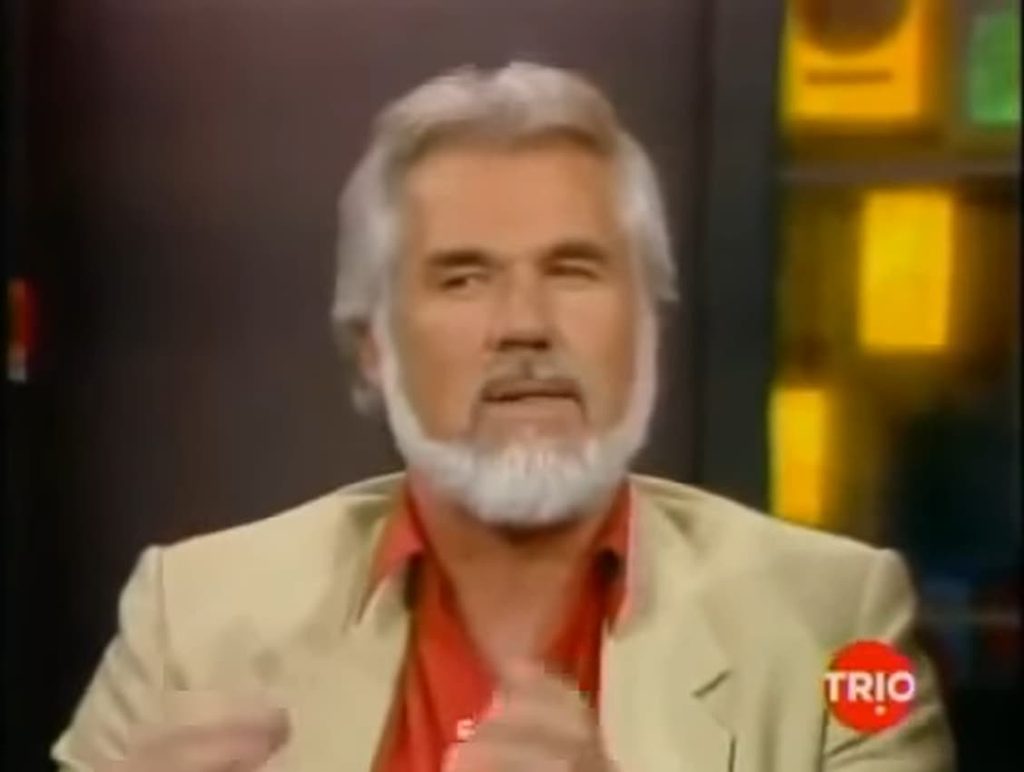
A Country Superstar Walks Into Letterman’s Wild World From Tokyo
In November 1985, Kenny Rogers stepped into the wonderfully unpredictable world of David Letterman, but this was no ordinary Late Night appearance. The episode, titled “From Tokyo,” was broadcast by NBC on 26 November 1985, with Letterman and his team presenting the show from Japan. Rogers was among the guests appearing during this unusual international edition, placing one of country music’s biggest stars inside a television program that was already developing its own wonderfully strange identity.
By this point, Kenny Rogers was far beyond being simply a country singer. The former First Edition member had transformed himself into a major crossover star whose audience stretched across country, pop and adult contemporary music. The early 1980s had brought him enormous success with songs such as “Lady,” “The Gambler,” “Lucille,” “She Believes in Me” and “Islands in the Stream.” His image was equally distinctive: the silver beard, dark hair, relaxed confidence and deep, unmistakable voice had made him one of the most recognizable entertainers in America. By 1985, he was also an established actor, with films such as Six Pack adding another dimension to his public persona.
That made the meeting with David Letterman particularly interesting. Letterman’s Late Night was almost the opposite of the polished variety and country television environments in which Rogers had become so comfortable. The program, which had premiered on NBC in February 1982, was built around Letterman’s deliberately awkward interviews, unpredictable comedy, strange demonstrations and a willingness to make even famous guests look slightly bewildered. Yet Rogers had the kind of relaxed personality that could survive the Letterman treatment. His appearance from Tokyo became part of an episode that also featured Japanese television personalities, baseball player Randy Bass, interpreter Mako Hattori, and Letterman’s eccentric recurring character Larry “Bud” Melman.
The musical side of Rogers’ appearance is also remembered in surviving television listings and archival material. A contemporary performance listing identifies the segment as “Interview / Love Gimme Some Lovin’,” placing Rogers not merely in the role of celebrity guest but also as a performer. The choice is interesting because Rogers had always been capable of moving comfortably between country storytelling and more broadly accessible pop and rock material. It was part of what made his television appearances so effective. He could talk about records, movies, television or life on the road without appearing to separate those worlds too sharply.
There is something particularly charming about seeing Kenny Rogers in 1985, at the height of his international fame, sitting across from a young David Letterman. Rogers was already a veteran entertainer, while Letterman was still building the late night persona that would eventually make him one of American television’s most influential hosts. The contrast is almost cinematic. Rogers arrived carrying decades of musical experience and the authority of a superstar, while Letterman approached him with the irreverence of a host who seemed determined never to treat celebrity too seriously.
The timing makes the appearance even more fascinating. 1985 was one of the most important years of Rogers’ career, coming after his extraordinary run of country and crossover hits and during a period when he was successfully balancing recording, touring, acting and television appearances. The Late Night appearance therefore captures Rogers not at the beginning or end of his story, but right in the middle of his remarkable second act as an international entertainer. His name was already familiar to millions, yet there was still a sense of discovery around him.
Looking back now, the “From Tokyo” episode preserves something that ordinary promotional appearances often lose. It shows a major star stepping outside his usual setting and entering Letterman’s peculiar late night universe, where the rules were deliberately loose and the atmosphere could change from serious conversation to absurd comedy in seconds. Rogers handled that world with the calm assurance that had become part of his appeal. The man who could sing about gamblers, cowboys, broken hearts and complicated relationships suddenly found himself in Letterman’s Tokyo adventure, and somehow it all worked.
For viewers today, the footage is more than an old television appearance. It is a small time capsule from 1985, when Kenny Rogers was one of the biggest names in popular music and David Letterman was still defining what late night television could become. Rogers would return to Late Night again in later years, and his television relationship with Letterman continued into the 1990s. But this 1985 encounter has its own special character. It catches Kenny Rogers at full strength, relaxed, recognizable and completely at home even when the setting was anything but familiar, while Letterman was still young enough in his career to make the meeting feel like a collision between two very different kinds of American entertainment.