
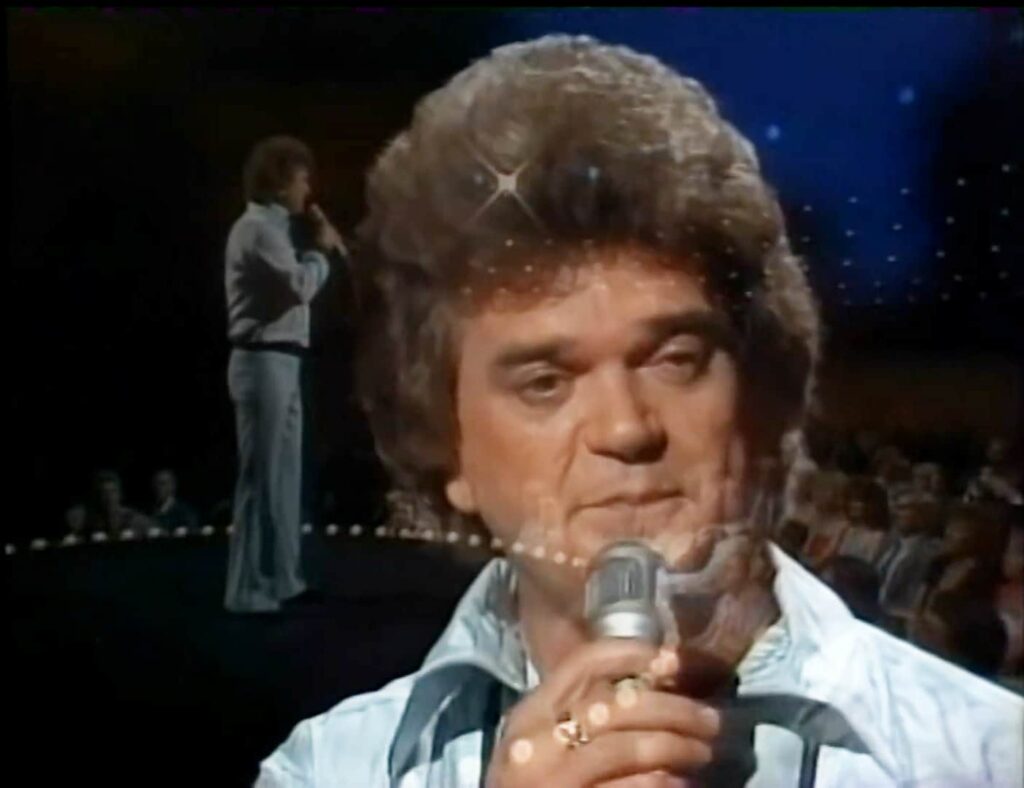
A Quiet Promise in Song: When “Rest Your Love on Me” Turned a Country Stage Into a Moment of Tender Reflection
In June of 1981, during a live performance that still circulates among devoted country music listeners today, Conway Twitty stepped onto the stage and delivered one of the most heartfelt interpretations of “Rest Your Love on Me.” The song had already made history the year before. Released in 1980, it became the 25th No. 1 country single on the Billboard Hot Country chart for Twitty, strengthening his place among the defining voices of American country music. Written by Barry Gibb of the legendary Bee Gees, the song carried an unusual lineage, bridging the emotional storytelling of country with the songwriting brilliance of pop’s most famous brother trio.
But statistics and chart positions never fully explain why a performance lives on.
That evening in 1981, the stage lights were soft, the band understated, and Conway Twitty stood at the microphone with the quiet confidence of an artist who had spent decades understanding the power of a simple love song. By then, his career already stretched back to the rock and roll era of the late 1950s before he became one of country music’s most recognizable voices. His baritone had matured into something deeper and warmer, carrying a sense of experience that no studio recording could entirely capture.
When the opening notes of “Rest Your Love on Me” began, the atmosphere in the room shifted. The song itself tells the story of a man who knows a woman’s heart belongs to someone else, yet gently offers comfort if she ever needs a place to turn. It is not a song of triumph or conquest. Instead, it is built on patience, vulnerability, and the quiet hope that love sometimes arrives in unexpected ways.
In the live setting, Twitty delivered those lyrics with remarkable restraint. He did not push the melody or dramatize the emotion. Instead, he allowed each line to unfold naturally, his voice steady and expressive, as if speaking directly to someone across the room. The audience responded with attentive silence rather than applause between verses, the kind of stillness that signals a song has truly reached its listeners.
What made the performance especially meaningful was the collaboration behind the song itself. Barry Gibb, known for writing some of the most recognizable pop hits of the 1970s with the Bee Gees, had crafted a composition that translated beautifully into the language of country music. In Twitty’s hands, the song gained a different dimension. The polished pop structure softened into something more intimate, guided by the singer’s unmistakable phrasing and emotional sincerity.
By 1981, Conway Twitty had already accumulated a remarkable string of hits and was widely respected for his ability to transform a simple lyric into a deeply personal moment. Songs like “Hello Darlin’,” “Linda on My Mind,” and “Tight Fittin’ Jeans” had made him a familiar presence on radio and on stage. Yet “Rest Your Love on Me” carried a slightly different emotional weight. It was quieter, gentler, almost reflective.
Watching that performance today, decades later, one can sense the patience of an artist who understood the long road of love songs. Twitty did not treat the moment like another entry in a list of hits. Instead, he sang it as though it were a conversation, a promise delivered softly through melody.
The applause at the end was warm and genuine, but the true power of the performance lay in the moments before that applause arrived. For a few minutes in June of 1981, “Rest Your Love on Me” was more than a chart topping single. In the voice of Conway Twitty, it became a quiet reminder that the simplest songs about love often carry the deepest echoes long after the final note fades.
 Music Legend
  Oldies Songs