
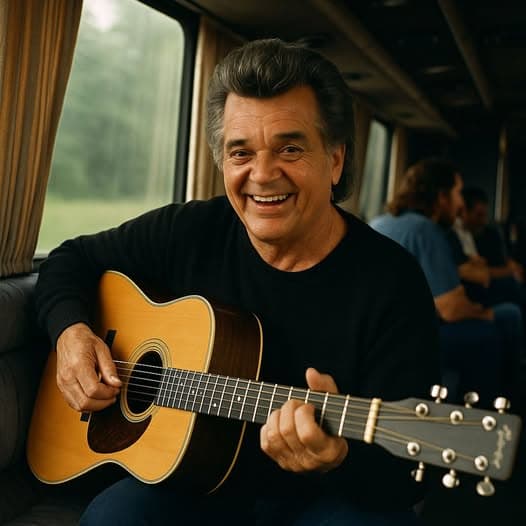
A Voice That Stayed Gentle to the End, Singing of Love, Duty, and the Quiet Weight of Living
Few figures in country music carried both intimacy and endurance quite like Conway Twitty. By the time the news broke on June 5, 1993 that he had passed away suddenly while on tour, the shock was not merely that a legend was gone, but that the voice itself seemed unfinished. Just one day earlier, on June 4, 1993, Twitty had departed Arkansas for another run of dates, laughing with his band, sounding exactly as he always had. Hours later, an abdominal aortic aneurysm took his life in Springfield, Missouri. He was sixty years old. The timing felt cruelly symbolic. Music did not pull him away from life. Music was where life ended.
By then, Conway Twitty had already secured one of the most formidable legacies in American popular music. Born Harold Lloyd Jenkins, he crossed genres with rare success, placing hits on both the rock and roll and country charts. Yet it was country music that became his true home. Between 1970 and 1995, he scored an astonishing fifty-five No. 1 singles on the Billboard country charts, a record that stood for decades. Songs like “Hello Darlin’” from 1970, which reached No. 1 on the Billboard Hot Country Singles chart, redefined the language of romantic confession. It opened with a spoken greeting so plain, so human, that it felt less like a performance and more like a private moment accidentally overheard.
As the years went on, Twitty’s voice deepened, not just in pitch but in perspective. By the early 1980s, he was no longer simply singing about desire. He was singing about responsibility, regret, and emotional consequence. “Tight Fittin’ Jeans”, released in 1981, climbed to No. 1 and became one of his signature recordings. Beneath its casual phrasing and late-night atmosphere lay a meditation on temptation and restraint, delivered with a calm that trusted the listener to read between the lines.
That maturity reached one of its most moving expressions in “That’s My Job”, released in 1987 as part of the album Borderline. The song peaked at No. 6 on the Billboard Hot Country Singles chart, yet its impact has always exceeded its chart position. Written by Gary Burr, the song unfolds as a conversation between father and son, tracing life lessons not through grand speeches but through steady presence. Twitty’s baritone does not dramatize the emotion. It absorbs it. The power of the song lies in its restraint, in the way love is framed as responsibility rather than sentimentality. For many listeners, it became less a song than a reflection of personal memory.
What made Conway Twitty exceptional was not technical showmanship, though he possessed it in abundance. It was his instinct for emotional truth. He sang as if aware that every story carried weight, and that weight deserved respect. Even in moments of commercial success, his delivery remained conversational, almost humble. The stage was never a pedestal. It was a place to speak plainly.
That is why his passing felt so deeply unsettling. He did not fade quietly into retirement. He did not step away from the microphone. He was still moving forward, still singing, still living inside the songs that had defined him. When people say his voice lingers in every country love song, it is not metaphor. It is lineage. Modern country music still borrows his pacing, his phrasing, his willingness to let silence speak.
Each time “Hello Darlin’”, “Tight Fittin’ Jeans”, or “That’s My Job” plays, the sensation is not nostalgia alone. It is continuity. A reminder that some voices do not end. They simply stop appearing in person. The stories remain, steady and unforced, waiting patiently for the next listener to recognize a piece of life within them.
 Music Legend
  Oldies Songs