
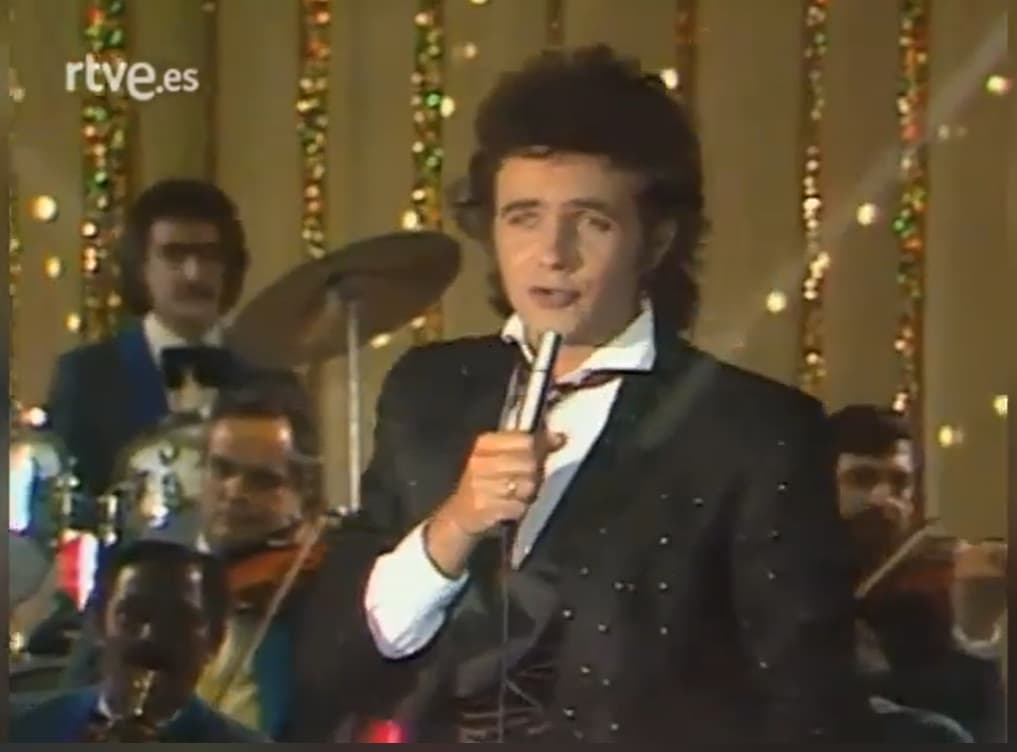
DAVID ESSEX – “OH WHAT A CIRCUS”: THE SONG THAT TURNED “EVITA” INTO A ROCK STAR MOMENT
On May 5, 1979, David Essex appeared on the Spanish television music programme Aplauso, bringing one of the most dramatic songs of his career to the screen: “Oh What a Circus.” By then, the song had already travelled a remarkable distance from the London stage. Essex had originated the role of Che in the original London production of Andrew Lloyd Webber and Tim Rice’s Evita, and his recording of “Oh What a Circus” had become a major British hit in 1978. On the UK Singles Chart, it entered at No. 36 in August before climbing all the way to No. 3, spending 11 weeks on the chart. For a performer who had already experienced enormous success with songs such as “Rock On,” “Gonna Make You a Star,” and “Hold Me Close,” it was another reminder that David Essex could move effortlessly between pop music and theatre.
The song itself was unlike a conventional love song. Written by Tim Rice and Andrew Lloyd Webber, “Oh What a Circus” is sung from Che’s perspective as he reflects on the death and public mythology surrounding Eva Perón. Its title deliberately captures the contradiction at the heart of the song. Eva’s death becomes a national spectacle, filled with adoration, ceremony and political theatre, while Che questions the way her life has been transformed into something almost larger than reality. The music is energetic and theatrical, but beneath that excitement is a skeptical voice asking why a political figure has been turned into a kind of saint. It was an unusual subject for a pop single, yet Essex made it sound immediate and accessible.
That connection to the stage is essential to understanding why David Essex was such a natural performer of the song. In 1978, he took over the role of Che in the original London production of Evita, bringing his established pop star identity into one of the most ambitious British musicals of the period. His performance meant that “Oh What a Circus” was never merely something he recorded in a studio. He had inhabited the character who delivered it. He understood the theatrical timing, the tension between celebration and criticism, and the need to make the character feel like an observer standing slightly outside the spectacle. His official career timeline specifically identifies his role as Che and notes that “Oh What A Circus” reached No. 3 in the charts after Phonogram released it.
There was another clever element hidden inside the song. “Oh What a Circus” shares its melodic foundation with “Don’t Cry for Me Argentina,” the musical’s best known song, but approaches Eva from an entirely different direction. Where “Don’t Cry for Me Argentina” presents Eva speaking directly to the Argentine people, “Oh What a Circus” watches the phenomenon around her from the outside. The contrast gives the song much of its energy. Essex’s delivery is urgent, theatrical and slightly provocative, which suited the character of Che and also suited his own stage persona at the height of his popularity.
By the time of the Aplauso appearance in 1979, Essex was already far beyond the young singer who had first emerged with “Rock On.” His career had developed at extraordinary speed. He had become a film actor through That’ll Be the Day, a major recording artist through hits including “Gonna Make You a Star” and “Hold Me Close,” and then a leading stage performer through Evita. “Oh What a Circus” brought all three sides of him together. It had the rhythm and immediacy of pop, the dramatic structure of musical theatre, and the presence of an actor who knew how to inhabit a character rather than simply stand behind a microphone. That mixture was one of the reasons Essex remained so distinctive in British entertainment.
Watching the Aplauso performance today, the period itself becomes part of the attraction. The late 1970s were changing rapidly, with disco, punk and new wave beginning to reshape popular music, yet David Essex could still walk onto a television stage with a song from a serious theatrical production and command the room through personality alone. His performance of “Oh What a Circus” does not feel like a museum piece from Evita. It feels like a snapshot of Essex at a moment when his career crossed several worlds at once. The pop idol, the actor, the theatre performer and the singer were all standing in the same spotlight.
And that is what makes “Oh What a Circus” such an important David Essex recording. It was not his biggest chart hit, reaching No. 3 rather than No. 1, but it represented something his career had always done unusually well: refusing to stay in one box. The young man who had once sung “Rock On” was now singing about Eva Perón, politics, celebrity and public mythology through a character from one of the most important British musicals of the decade. On Aplauso in May 1979, he brought that world to Spanish television, and for a few minutes the television studio became another stage for David Essex as Che, still carrying the electricity of Evita with him.