
Behind The Wigs, Rhinestones And Famous Smile, Dolly Parton Revealed The Woman Who Chose Her Own Image And Built A Marriage That Never Needed The Spotlight
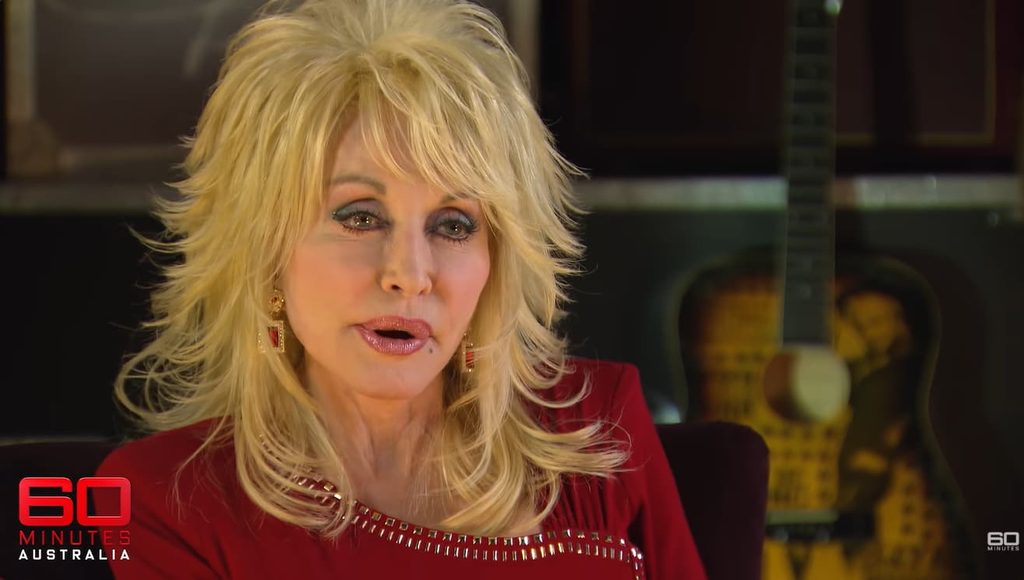
There was a particularly revealing side of Dolly Parton in her extended conversation with Ray Martin for 60 Minutes Australia. The interview, originally conducted in 2013, allowed Dolly to talk with unusual openness about the image that had become inseparable from her name, the cosmetic surgery she had chosen, the childhood experiences that shaped her idea of beauty, and the husband who had spent almost her entire adult life deliberately staying away from the cameras. More than a decade later, 60 Minutes Australia republished the extended conversation, allowing viewers to hear the extraordinary honesty behind the public Dolly.
Dolly was remarkably straightforward about her appearance. She explained that she had not undergone facial plastic surgery until she was 40, after she had already become a major star. She had chosen cosmetic procedures because she wanted to maintain the appearance she had created for herself, rather than because she believed she had to satisfy somebody else’s idea of beauty. Her philosophy was refreshingly practical. If something could be improved and she wanted it improved, she saw no reason to apologize for it. She was equally candid about Botox and collagen, describing them as part of the ongoing maintenance of her appearance. But the most interesting part of the conversation was that Dolly’s fascination with glamour had begun long before she had money for surgery, wigs or expensive clothes. As a poor child growing up in Tennessee, she used poke berries as lipstick, experimented with homemade beauty products and became fascinated by a glamorous woman in her hometown whose exaggerated appearance left an unforgettable impression on her.
That childhood story explains something important about Dolly’s famous image. The enormous hair, high heels, fitted clothes and makeup were never simply a costume imposed on her by the entertainment industry. They were part of an identity she had consciously created. Dolly remembered seeing the glamorous woman in her hometown with her blonde hair, red lipstick, tight skirts and high heels and thinking she was beautiful. Dolly’s family did not always approve. Her father sometimes punished her for dressing in ways he considered too provocative, while her mother understood that there was something deeper behind the young girl’s determination to create her own appearance. Dolly was not merely trying to look beautiful. She was discovering the character she wanted to become.
Yet the interview became even more revealing when Ray Martin turned from Dolly’s appearance to Carl Dean, the man she had married in 1966. By the time of the interview, they had been married for 47 years, an extraordinary length of time for a relationship involving someone as famous as Dolly. What made their marriage unusual was not that Carl shared Dolly’s celebrity, but that he refused almost completely to participate in it. He disliked publicity, avoided cameras and remained largely invisible to the public. Dolly acknowledged that his absence had created endless speculation. People assumed that because they rarely saw Carl, he must not exist in the way a conventional celebrity husband was expected to exist. Dolly’s answer was essentially the opposite. Their marriage worked precisely because Carl had his own life and had no desire to become part of hers professionally.
Dolly also laughed at the endless rumors surrounding her relationships with famous men. She admitted that she was a flirt and enjoyed teasing people, but she made an important distinction between having chemistry with someone and having an affair. Her personality was naturally playful, and working with famous actors and singers inevitably produced stories, but the public version of Dolly’s romantic life was often far more dramatic than the private reality. Her marriage survived partly because Carl understood who she was. Dolly could be glamorous, flirtatious and larger than life on stage while still returning home to the private world she had built with the man who wanted almost nothing to do with fame.
What makes the marriage story particularly touching is Dolly’s admission that she still made an effort to look good for Carl. She explained that even at home she would put on a little makeup, fix her hair and make herself presentable for him. The woman who could spend hours being photographed, filmed and watched by millions still cared about how she looked when she walked through the door at home. It is a small detail, but it says something intimate about their relationship. Behind the enormous public image was a woman who still wanted to look attractive for the one person who had known her since before the world turned her into Dolly Parton.
The interview also opened a much darker window into Dolly’s life. She spoke candidly about a period of depression in the 1980s, explaining that it became deeply personal rather than something caused by the music business. She described feeling unhappy with herself, struggling with her weight and experiencing thoughts that frightened her. She said that prayer, God and the support of friends helped her hold on. What is striking is the way Dolly connected that difficult period to her later ability to understand other people’s pain. She believed that going through suffering had given her greater empathy, allowing her to understand emotions she might otherwise never have experienced so completely.
That honesty gives the conversation a much deeper meaning than its provocative title might suggest. This was not simply Dolly Parton talking about plastic surgery or defending her famous appearance. She was explaining the complicated relationship between the person she was, the person she chose to become and the character the world eventually created around her. She could laugh about her wigs and makeup, talk openly about cosmetic procedures and still acknowledge insecurity, depression, aging and vulnerability. Her confidence was not the absence of insecurity. It was her decision to keep moving forward despite it.
Perhaps the most beautiful thread running through the entire conversation is Dolly’s refusal to separate her public self from her private self. She did not pretend that the wigs were her natural hair. She did not pretend that she had never had cosmetic work. She did not pretend that her marriage looked like anyone else’s. And she certainly did not pretend that fame had made life effortless. Instead, she owned every part of it. The glamour, the jokes, the hard years, the music, the marriage, the mistakes and the determination were all pieces of the same woman.
And after 47 years of marriage, Dolly’s answer about retirement revealed perhaps the clearest expression of what mattered most to her. She said she would continue working as long as she was healthy enough to stand, think clearly and sing, adding that she could not imagine life without her music. The only things that might make her step back would be serious illness or the need to care for Carl. That answer brought the conversation back to where it had quietly been all along: beneath the wigs, the rhinestones and the millions of records was a woman who had never stopped loving her work, her faith, her home and the people closest to her.
The extended 60 Minutes Australia interview is therefore valuable not because it reveals a secret Dolly Parton, but because it reveals how little she has ever hidden. She simply refused to be ashamed of the things other people might judge. Dolly chose the look she wanted, loved the man she wanted, protected the private life she wanted and continued making music on her own terms. For nearly half a century, Carl Dean remained outside the spotlight while Dolly stood directly in its center. Somehow, that distance between their worlds may have been one of the reasons their marriage endured. And listening to Dolly speak about it with that familiar mixture of humor, honesty and vulnerability, you begin to understand that the woman beneath all the glitter was never trying to disappear. She was simply determined to become exactly who she had imagined when she was that little girl in the Tennessee mountains.