
How Two Very Different Stars Came Together To Bring Buddy Holly’s Songs Back To Life On British Television
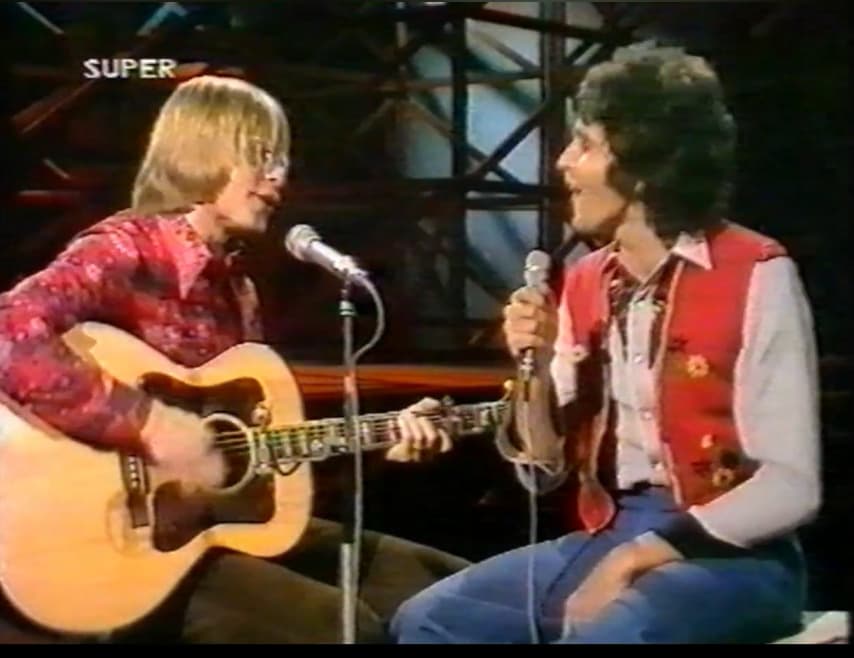
On 29 April 1973, British television captured a wonderfully unexpected meeting between two rising stars from opposite sides of the Atlantic. John Denver and David Essex stood together on the BBC Two series The John Denver Show and performed a lively Buddy Holly medley, bringing several of Holly’s most enduring songs into one performance. The programme was the first episode of Denver’s six part 1973 British television series, and David Essex was its special guest. The surviving programme information lists the pair performing “That’ll Be the Day,” “Everyday,” “Slippin’ and Slidin’” and “Peggy Sue.”
The choice of material was particularly fitting for David Essex, because his career at that moment was already closely connected with the world of 1950s rock and roll. Essex had appeared as Jim MacLaine in the 1973 film That’ll Be the Day, alongside Ringo Starr, Billy Fury and other major British performers. The film drew heavily on the atmosphere of the early rock and roll era, and its title itself came from Buddy Holly’s 1957 hit “That’ll Be the Day.” So when Essex joined Denver on television to sing Holly’s music, it was not simply a collection of oldies chosen at random. It connected directly with the musical world that Essex was inhabiting in 1973, both on screen and in his rapidly developing career as a recording artist. Getty Images also records Essex performing on The John Denver Show on 29 April 1973, preserving a visual record of the occasion.
For John Denver, the performance revealed another side of an artist who was already becoming a major international singer songwriter. By April 1973, Denver had built a strong reputation through songs such as “Take Me Home, Country Roads,” “Leaving on a Jet Plane” and “Rocky Mountain High.” His own musical identity was rooted in folk, country and acoustic songwriting, yet he clearly had an affection for the rock and roll songs that had shaped the generation before him. Bringing David Essex into the programme created a natural bridge between Denver’s American folk country sound and Essex’s British rock and pop background. The result was relaxed rather than grand, with the two singers sharing material that was instantly recognizable to television viewers.
The medley itself is fascinating because the songs represent different sides of Buddy Holly’s extraordinary catalogue. “That’ll Be the Day” had been a major breakthrough for Holly and The Crickets in 1957, while “Peggy Sue” became one of his signature recordings that same year. “Everyday”, released in 1957, showed the gentler, more intimate side of Holly’s songwriting. Bringing those songs together allowed Denver and Essex to move rapidly from energetic rock and roll into lighter melodic territory before returning to the familiar excitement of Holly’s best known work. The performance therefore feels like a compact tribute to an artist whose influence had already spread far beyond the brief years of his recording career.
There is an additional poignancy in seeing these songs performed in 1973, only fourteen years after Buddy Holly’s death. Holly had died in the plane crash near Clear Lake, Iowa, on 3 February 1959, at just 22 years old. By the time Denver and Essex performed the medley, Holly had already become a symbol of the first great generation of rock and roll, but his music was still close enough to the era to feel immediate rather than ancient. For a British audience watching in 1973, songs such as “Peggy Sue” and “That’ll Be the Day” carried the energy of a musical revolution that had happened within living memory.
The performance also captures David Essex at a fascinating point in his own story. He was not yet the established superstar he would become later in the decade. His breakthrough with “Rock On” was still to come, and his 1974 No.1 “Gonna Make You a Star” was still over a year away. Yet 1973 was already an important year. He had appeared in That’ll Be the Day, was establishing himself as a recording artist and was increasingly visible on British television. His appearance with John Denver therefore feels like a snapshot of an artist standing on the threshold of much greater fame.
Perhaps the most appealing thing about the footage is how naturally the two men fit together. John Denver, the American singer songwriter with the warm acoustic voice, and David Essex, the young British performer with the movie star presence, came from different musical worlds, but Buddy Holly gave them common ground. There was no need for elaborate staging. The songs themselves did the work. For a few minutes, the television studio became a meeting place between the first generation of rock and roll and the artists who had grown up listening to it.
Looking back, the 29 April 1973 performance feels like a small but revealing piece of music history. John Denver would go on to become one of America’s most beloved singer songwriters, while David Essex would soon become one of Britain’s most recognizable stars of the 1970s. But here they were, still relatively early in their journeys, singing songs written by a young man whose own journey had ended far too soon. “That’ll Be the Day,” “Everyday” and “Peggy Sue” had already survived Buddy Holly, and in the hands of Denver and Essex, they continued to travel into another generation. That is what makes this forgotten television moment so special: two emerging stars were not simply performing old songs, they were keeping a piece of rock and roll history alive.
 Oldies Songs
  Oldies Songs