
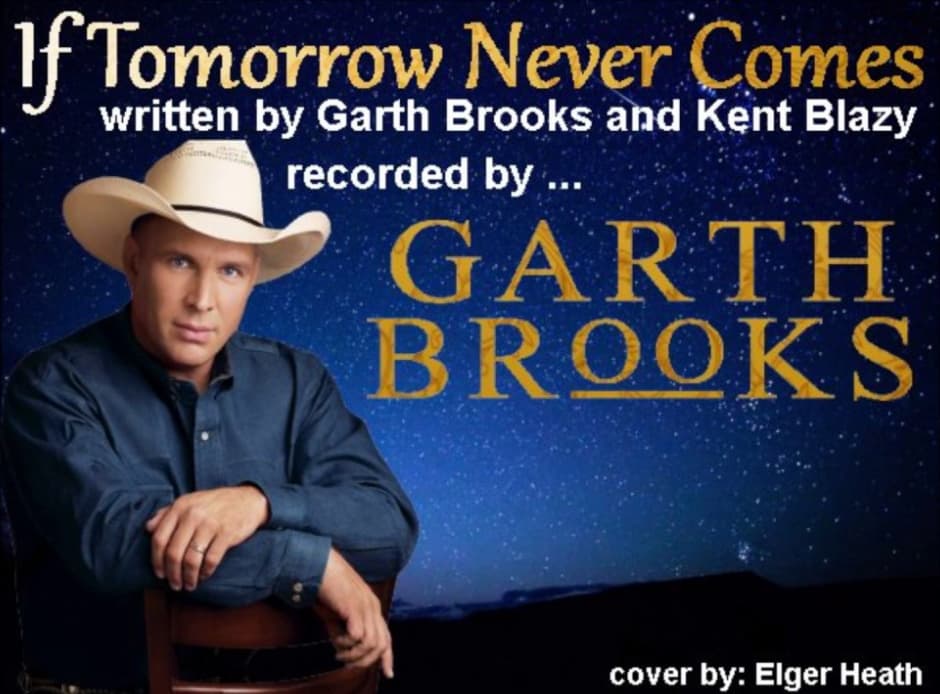
Garth Brooks – If Tomorrow Never Comes: A Profound Question That Redefined A Career and A Genre
There are defining moments in any artist’s journey, and for the man who would become the most consequential country singer of his era, that moment arrived with a quiet, introspective ballad. “If Tomorrow Never Comes,” released in August 1989 as the second single from his self-titled debut album, Garth Brooks, was more than just a song—it was a seismic event that announced the arrival of a superstar whose emotional depth matched his stadium-sized ambition.
This song is profoundly significant because it gave Garth Brooks his very first #1 single on the US Billboard Hot Country Songs chart, peaking at the top position on December 9, 1989. This achievement was the official launchpad for a career that would shatter sales records and redefine the boundaries of country music. Brooks himself has referred to this timeless piece, which earned a Favorite Country Single at the 1991 American Music Awards, as his signature song—a remarkable admission considering his catalog of megahits.
The Genesis of the Emotion: A Promise Made
The story behind this enduring ballad speaks volumes about its deeply personal core. The song was co-written by Garth Brooks and his close collaborator Kent Blazy. Brooks had been wrestling with the idea for years, a concept that was intensely private and universally relatable: the fear of leaving a loved one without them truly knowing the depth of your devotion. He reportedly ran the idea by numerous songwriters who didn’t quite grasp its potential, until he met Blazy, who, within moments, delivered the now-classic opening verse. The collaboration was instant and profound, resulting in a lyric that cuts directly to the fundamental human anxiety about mortality and unconditional love.
The narrative places the listener in a deeply vulnerable, solitary moment: a man lies awake, watching his partner sleep, suddenly struck by the chilling thought of his own abrupt absence. The core of the song is the agonizing, hopeful question of the chorus:
“If tomorrow never comes, will she know how much I loved her? Did I try in every way to show her every day that she’s my only one?”
The Meaning That Transcends Genre
For the older generation, the song’s meaning is amplified by the weight of years and accumulated loss. The lyric addresses the haunting regret that so many carry: “I’ve lost loved ones in my life / Who never knew how much I loved them / Now I live with the regret.” This acknowledgment of previous failures to express love fully is what gives the song its powerful, urgent ethical imperative. It’s not simply a romantic declaration; it’s a philosophical plea to live fully in the present and leave nothing unsaid.
Garth Brooks’ delivery, with its sincere, almost pleading intensity, gives the song the required emotional gravity. He turned a quiet, bedroom meditation into an anthem of preemptive gratitude. It resonated so broadly that it crossed over internationally, most notably when former Boyzone member Ronan Keating covered it in 2002, taking it to #1 in the UK and various other European charts, proving the universal, timeless nature of the message crafted in a Nashville writing room.
This song served as a beautifully tender counterpoint to the more rambunctious side of the New Country movement. It reassured an audience—especially those older listeners accustomed to the heartfelt honesty of classic country—that despite the shift in sound, the genre’s core commitment to powerful, relatable storytelling remained intact. It is a song that compels us all to pause, look at the ones we love, and ensure that our actions and our words are sufficient, “If Tomorrow Never Comes.”
 Music Legend
  Great Songs