
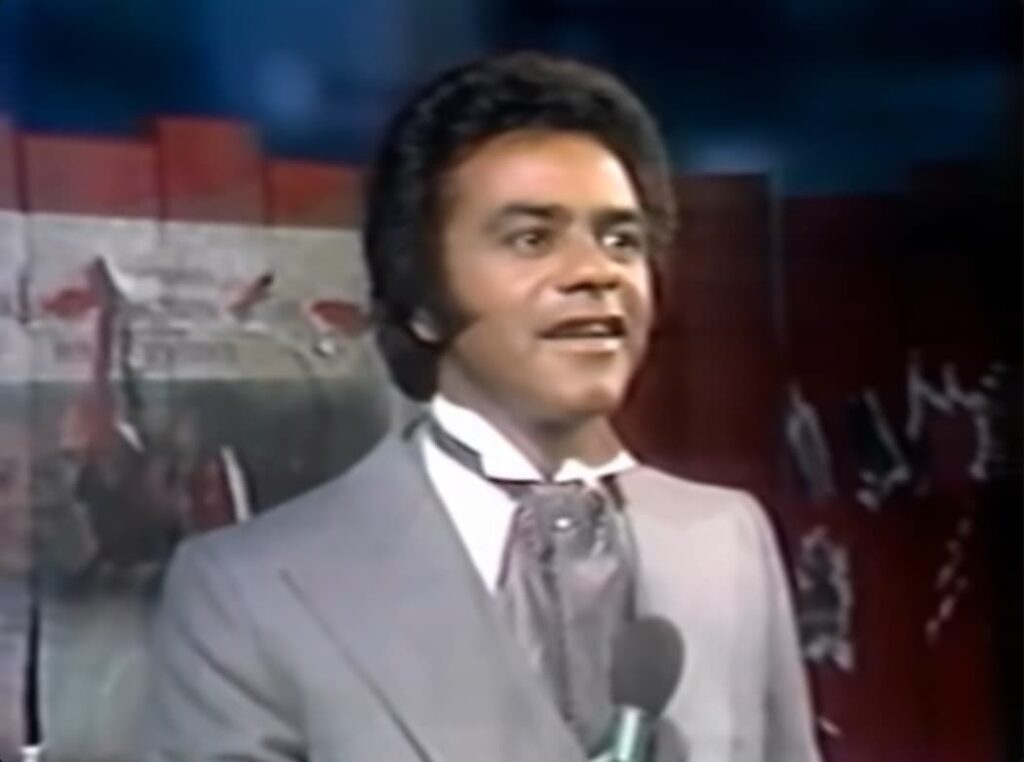
A timeless declaration of love and longing—“Maria” becomes, in the voice of Johnny Mathis, a moment where romance, memory, and musical elegance meet on a quiet stage.
In January 1977, audiences watching a French television special were treated to a moment that felt almost suspended in time. Standing under soft studio lights, Johnny Mathis performed the classic ballad “Maria”, a song already deeply embedded in the history of musical theatre. What made that performance remarkable was not spectacle or grand orchestration, but the quiet authority of Mathis’ voice—still velvety, still luminous, and still capable of turning a familiar standard into something deeply personal.
The song “Maria” was originally written in 1957 by Leonard Bernstein (music) and Stephen Sondheim (lyrics) for the groundbreaking Broadway musical West Side Story. Within the story, the song is sung by Tony after he first meets Maria, capturing the almost mystical realization that he has just encountered the love that will change his life forever. The melody rises with breathtaking emotional urgency, as if the singer himself can barely contain the overwhelming feeling of love. When the West Side Story Original Cast Album was released, it became one of the most successful cast recordings in history, spending 54 weeks at No. 1 on the Billboard 200 chart and helping introduce these songs to a worldwide audience.
By the time Johnny Mathis sang “Maria” on French television in 1977, the song had already passed through many great voices. Yet Mathis brought something distinctive to it—an emotional softness and romantic sincerity that had defined his career since the late 1950s. Known for timeless hits such as “Chances Are,” “Misty,” and “Wonderful! Wonderful!”, Mathis possessed a vocal style that was less about theatrical drama and more about emotional intimacy. His interpretations often felt like quiet confessions rather than performances.
Mathis had explored Broadway material before, notably on his 1964 album Broadway, where he interpreted classic theatre songs with lush orchestral arrangements. His connection to songs like “Maria” felt natural because his voice carried the same lyrical sensitivity that musical theatre demands. But the 1977 television performance stripped away much of the grand Broadway scale and revealed something more reflective.
Watching the performance today, one notices how gently Mathis approaches the opening phrase—“The most beautiful sound I ever heard…”. He does not rush the line. Instead, he lets the melody breathe, as though savoring every syllable. That patience transforms the song into something almost meditative. The famous soaring note on Maria becomes less of a dramatic climax and more like a moment of quiet revelation.
By 1977, Johnny Mathis was already an established international star with two decades of success behind him. His music had traveled far beyond American radio stations, and European audiences had long embraced his romantic style. Appearances on European television specials were common for him during this period, reflecting the global reach of his artistry. In France especially, audiences appreciated his refined phrasing and emotional warmth—qualities that aligned beautifully with their long tradition of romantic chanson.
There is also something quietly symbolic about hearing “Maria” in this setting. The song itself tells a story of love discovered suddenly and intensely, but when performed by a seasoned artist like Mathis, it carries additional layers of reflection. The youthful excitement of the original Broadway character becomes, in Mathis’ interpretation, a deeper meditation on memory and devotion. It feels less like the beginning of a love story and more like someone remembering the moment everything once changed.
That is the subtle magic of Johnny Mathis as an interpreter. He rarely overwhelms a song with dramatic gestures. Instead, he illuminates its emotional core with warmth and grace. In the 1977 French television performance of “Maria”, the result is not simply a cover of a Broadway standard—it is a quiet reminder of why great songs endure.
Because sometimes, when a melody is beautiful enough and a voice sincere enough, even a single name—Maria—can still echo with wonder decades later.