
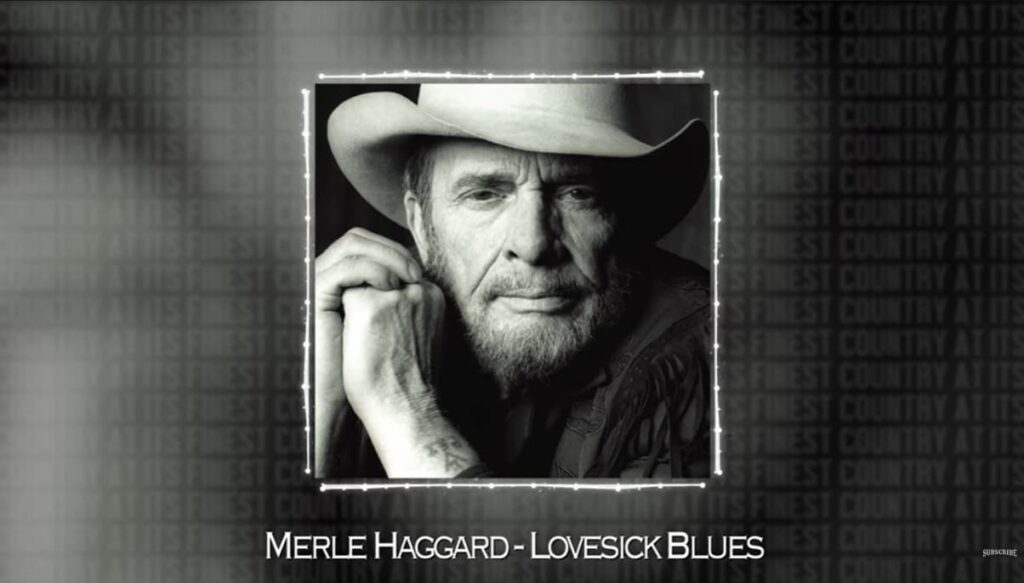
Merle Haggard – “The Poet of the Common Man”: A Raw, Unfiltered Chronicle of the Hard-Earned American Life
If Marty Robbins was the cinematographer of the Old West, then Merle Haggard was the undisputed journalist of the American soul. He was the “Poet of the Working Class,” not because he observed their struggles from a distance, but because he wore those struggles like a second skin. Born in 1937 in a converted boxcar in Oildale, California, Haggard didn’t just sing about “the struggle”—he lived the trajectory from a rebellious youth in San Quentin State Prison to the pinnacle of the Country Music Hall of Fame. His music, particularly during his legendary tenure with Capitol Records in the 1960s and 70s, provided a voice for the forgotten, the weary, and the fiercely independent spirits who built the world with their calloused hands.
The “ranking” of Merle Haggard’s career is staggering: 38 number-one hits on the Billboard Country charts, including timeless anthems like “Mama Tried,” “Okie from Muskogee,” and “Workin’ Man Blues.” Yet, to describe him through statistics is to miss the point entirely. His true position is held in the hearts of those who recognize the honesty in his “Bakersfield Sound”—that sharp, electric twang that offered a gritty alternative to the polished “Nashville Sound.” When Merle sang, he wasn’t performing a character; he was recounting a life of boxcars, barrooms, and the bittersweet taste of freedom.
The Architecture of the Working-Class Soul
For the listener who has navigated the complexities of a long career and a changing world, Merle Haggard’s lyrics feel like a conversation with an old friend who isn’t afraid to tell the truth. He captured the duality of the working man: the pride in a day’s labor and the crushing weight of the routine. In his 1969 masterpiece “Workin’ Man Blues,” he voiced the quiet defiance of the blue-collar spirit:
“I’ll be working as long as my two hands are fit to use… I’ve got a little girl to feed and a lot of bills to pay, and I’ll be at the drive-in in my dreams at the end of the day.”
This wasn’t just a song; it was an acknowledgment of dignity. Haggard understood that for most people, life isn’t a series of grand adventures, but a series of small, heroic acts of endurance. He spoke to the vulnerability of the man who worries about his family, the nostalgia of the “old man” looking back at his “Mama Tried” days, and the fierce patriotism that was often misunderstood as simple politics.
A Legacy of Truth and Tenacity
What makes Haggard’s legacy so enduring for our generation is his refusal to simplify the human experience. He could be a rambler in “Lonesome Fugitive” and a devoted son in “Sing Me Back Home” within the same hour. His voice, a rich, weathered baritone, carried the grain of the San Joaquin Valley and the smoke of a thousand honky-tonks. He taught us that it is possible to make mistakes—even great ones—and still find a way to contribute something beautiful and lasting to the world.
As we look back at the landscape of 20th-century music, Merle Haggard stands as a monolith of authenticity. He reminds us that poetry doesn’t always have to be written with a quill; sometimes, it’s written with a wrench, a guitar, and a stubborn refusal to back down. He was the guardian of the working-class story, ensuring that the sweat, the tears, and the quiet triumphs of the common man would never be forgotten.
 Music Legend